Baltimore looks to boost Black homeowner rates
Published in News & Features
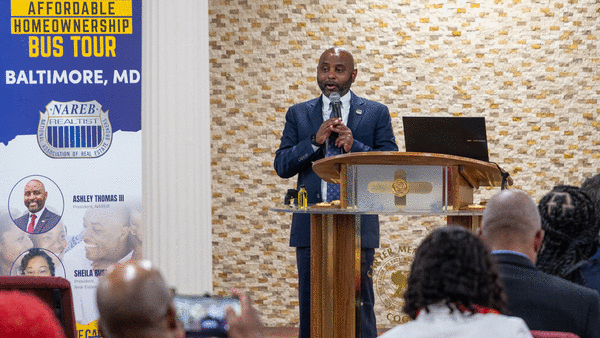
BALTIMORE — Black residents in Baltimore are still much less likely to own a home than white residents, despite years of efforts by the city and the private sector to correct racial inequities in homeownership rates.
Now, local leaders and realtors are hoping that outreach and education for potential Black buyers could be the key to reversing the trend.
Baltimore’s Black population has long had lower rates of homeownership than other racial groups in the city, despite making up nearly 60% of the population. That trend stems from decades of redlining and disinvestment in predominantly Black neighborhoods.
In response, Baltimore City officials created programs to boost affordable housing in various ways, including incentives to transform vacant homes. Yet, the disparity in Black homeownership remains an issue that leaders are trying to solve, without much progress over the last decade.
“The narrative has been that it’s really hard right now — interest rates are high, affordability is very low, and it’s a challenge,” said Ashley Thomas, president of the National Association of Real Estate Brokers. “I think a lot of people that do qualify stop themselves without even knowing.”
Thomas joined Baltimore City officials, realtors and lenders at Carter Memorial Church in the Hollins Market neighborhood on Sunday to share resources with Black residents on how to start the home-buying process.
In Baltimore, only 43% of mortgages go to Black residents, despite Black people making up 57% of the population, according to the National Association of Real Estate Brokers’ 2025 State of Housing in Black America report.
Similar measures of homeownership have remained low for the past several years; a 2020 report by the Abell Foundation found that the city’s Black homeownership rate dropped from 45% in 2007 to 42% in 2017.
Additionally, recent developments, such as a surge of investors buying homes in predominantly Black neighborhoods and then leaving them vacant, cut into the supply of available homes and inflated the cost of buying a home in the city.
Over time, patterns like these have discouraged Black residents from looking into buying a home, said Shelia Russell-Williams, president of the Real Estate Brokers of Baltimore.
“Oftentimes, because of past history, or how they were brought up, people don’t even know they can (buy a home) until someone shows them they can,” Russell-Williams said.
Mayor Brandon Scott has touted housing policies aimed at reversing these patterns. In February, city officials pitched a plan to pair vacant properties with local developers to rehab them into affordable housing units.
That approach, paired with more outreach to Black residents, may help increase the city’s affordable housing stock and close the gap in Black homeownership, though some city council members have urged a more aggressive push on affordable housing.
NAREB announced last week that Scott would attend Sunday’s event, but he was unable to participate. The mayor’s office later confirmed that he was flying to Madrid on Sunday afternoon for the Bloomberg CityLab conference, where he’s scheduled to speak on Tuesday about housing initiatives in Baltimore.
Currently, Baltimore City offers five different incentives to prospective homebuyers, including inducements for first-time homebuyers and residents moving into formerly vacant properties.
Other programs like Buy Back the Block offer grants to prospective homebuyers in specific census tracts.
“Folks are now beginning to understand it and know more about it because we’re doing a lot more advertising,” said Andrene Nyarko, a loan processor with the city’s Department of Housing and Community Development. Especially in the past two years, the number of inquiries about the city’s down payment assistance grants has “increased tremendously,” Nyarko said.
The National Association of Real Estate Brokers is touring eight U.S. cities this week, including Baltimore, and hosting informational sessions about affordable homeownership. The tour focuses on cities where Black residents have disproportionately low rates of buying homes.
Nikki Brandon, a Baltimore County resident and a member of Carter Memorial Church, said she came to Sunday’s event in hopes of sharing information about the city’s incentives with church members.
“Most people in my church are renting, and financial literacy is a new space, and homeownership is one of the exciting rewards of being financially literate,” Brandon said. “This is the target population, so (NAREB is) aware of the challenges, the barriers that face the Black community, and they’re actively engaged in resolving those issues.”
_____
©2026 Baltimore Sun. Visit baltimoresun.com. Distributed by Tribune Content Agency, LLC.





Comments