Venezuelan leader's brooch during Caribbean visit sparks fight with Guyana
Published in News & Features
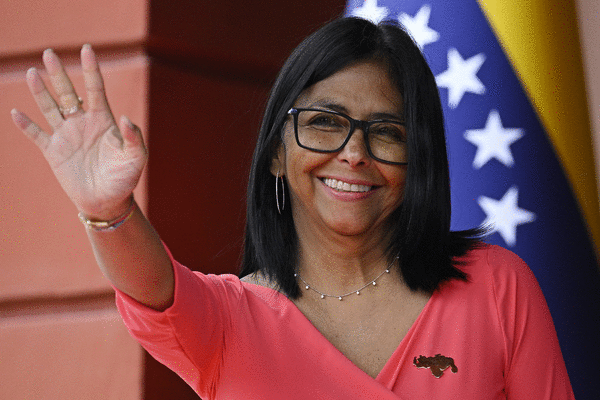
What was supposed to be a solidarity visit to Caribbean nations by Venezuela’s acting president, Delcy Rodriguez, has instead ignited a diplomatic row that risks widening divisions within the 15-member Caribbean Community bloc known as CARICOM.
Guyana’s president, Irfaan Ali, and the CARICOM secretariat on Tuesday issued separate statements condemning Rodriguez’s recent actions during an official visits to Barbados and Grenada, where she displayed a map depicting the long-contested, resource-rich Essequibo region of Guyana as part of Venezuela. The visit to Barbados took place on Sunday and Monday, while the Grenada visit was earlier in the month on April 9.
During both visits, Rodriguez wore a brooch with a map of Venezuela and the disputed region included.
“This is not a matter of symbolism alone,” Ali said in a statement to the addressed to the chairman of CARICOM, Dr. Terrance Drew, the prime minister of St. Kitts and Nevis. “It is a calculated and provocative assertion of a claim that Guyana has consistently and lawfully rejected, and which is before the International Court of Justice for final adjudication.”
“Venezuela cannot, while the case is before the Court, seek to normalize by symbols, maps, legislation, appointments or official display, what it has failed to establish in law,” Ali said. “Such conduct does not strengthen Venezuela’s case; it undermines confidence in its stated commitment to peaceful settlement, international law, and good neighborly relations.”
Caracas dismissed the criticism, with Rodríguez defending the symbol as a reflection of what she described as Venezuela’s historic territory.
“Now they are even bothered by how one dresses,” Rodríguez said during a public event, reiterating that Venezuela considers the Essequibo part of its national map.
Venezuelan Foreign Minister Yván Gil also rejected Guyana’s protest, describing it as an attempt to distract from what he called the “historical truth” of Venezuela’s territorial claim.
Tensions between the two countries had eased somewhat earlier this year following Maduro’s capture, which ushered in Rodríguez’s interim government. The political transition raised cautious expectations among regional observers that Caracas might adopt a less confrontational stance on longstanding disputes, including Essequibo.
However, Rodríguez’s public use of the map-shaped pin has been widely interpreted in Georgetown and among regional diplomats as a signal that the new administration has not abandoned Venezuela’s territorial claims. Instead, the gesture suggests continuity in Caracas’ position, even as it seeks to re-engage diplomatically and economically with neighboring countries.
The dispute over the Essequibo, which is about the size of Florida, dates back to 1899 when Guyana was awarded the region in an arbitration ruling, which Venezuela has never recognized. Claim to the region has long united both Venezuela’s opposition and government, and been a crux in the Caribbean Community’s inability to rally behind the opposition’s efforts in years past to oust President Nicolás Maduro before he was sized in a middle-of-the night raid by the Trump administration.
While the dispute dates back nearly two centuries, it intensified after Guyana discovered oil over five years ago, and ExxonMobil began drilling.
In December 2023, Maduro held a controversial referendum that claimed 98 percent public support for asserting sovereignty over the region — a vote widely criticized for alleged fraud and lack of transparency. Before running afoul of the Trump administration in January, Maduro had continued to double down on the claim while bolstering military support in the region.
In his letter to Drew, Ali noted that Guyana has consistently maintained that the boundary dispute was settled by the 1899 arbitration award.
“Venezuela’s revival of the claim decades later, and its more recent measures purporting to annex the Essequibo and appoint officials for that territory, form part of a pattern of conduct inconsistent with international law and the process to which the matter has been submitted,” he wrote.
The new controversy comes at a moment when the region is already grappling with internal divisions. In February, Trinidad and Tobago Prime Minister Kamla Persad-Bissessear publicly accused fellow Caribbean leaders and the secretariat of failing to support her twin-island and Guyana amid threats from Venezuela during the U.S. pressure campaign toward the Spanish-speaking nation.
She later followed up by publicly calling for the resignation of CARICOM’s secretary-general, Belizean economist Carla Barnett.
Ali did not name any specific leader in his letter, but the incident is sure to cool relations between him and his fellow leaders, with whom he has been quietly building ties. He reminded fellow heads of government in the letter of “their repeated and unequivocal support for Guyana’s sovereignty and territorial integrity, and for the resolution of the controversy through the judicial process before the Court.”
In a press conference, Mottley and Rodriguez later exchange gifts. Rodriguez said the visit advanced “many, many important topics for the well-being of our people,” including plans for Barbados to partner in agricultural production in Venezuela.
In a statement Tuesday, the Caribbean Community said it had taken note of Ali’s “grave concern.” The secretariat also noted the controversy involving Rodriguez’s visit where “material asserting Venezuela’s claim to Guyana’s Essequibo region was on public display.”
While each member state retains the sovereign right to conduct bilateral relations with external partners, CARICOM, echoing Ali, said they should also “remain mindful of their collective responsibilities” and “uphold the principles of international law, respect for judicial processes and good neighborly relations.”
The statement added: “The Community’s longstanding and unequivocal support for the sovereignty and territorial integrity of Guyana, and for the peaceful resolution of the controversy through the Court remains firm and unchanged.”
©2026 Miami Herald. Visit at miamiherald.com. Distributed by Tribune Content Agency, LLC.





Comments