Ecuadorian lawyer admits to drafting Haiti warrant to arrest Moïse ahead of killing
Published in News & Features
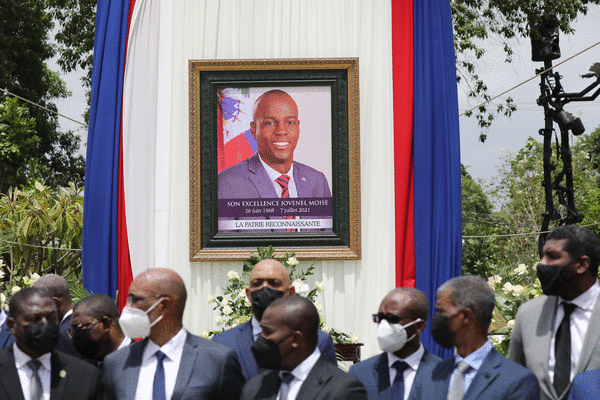
MIAMI — An Ecuadorian lawyer told a federal jury in Miami that he drafted a Haitian warrant for the arrest of President Jovenel Moïse before his assassination nearly five years ago, while he also prepared immunity documents for the owners of a Miami-area security firm standing trial on conspiracy charges of hiring former Colombian soldiers to kill him.
The lawyer, José Antonio Corrales, testified that he drafted several documents central to the plot, including the arrest warrant, which he had hoped to have signed by a Haitian Superior Court justice, Windelle Coq Thélot. His clients at the security firm had designated the judge as the heir apparent to Moïse after abandoning a South Florida pastor in his monthslong quest for the presidency.
Corrales said he drew up the warrant after reviewing a photograph of a handwritten arrest warrant used in a foiled Feb. 7, 2021, coup before Moïse’s assassination — concluding that given the president’s position and his belief that Moïse was a dictator, “you needed to have a more compelling, forceful document.”
“It seemed to me to be impossible to get a president arrested using a common, everyday arrest warrant,” Corrales testified in video testimony. “So I, wrote this draft so that then the Haitian attorneys and Madame Coq could have a stronger position given that ... his position was ... president.”
Jean Roger Noelcius, the Haitian investigative judge who signed the initial arrest warrant for Moïse has testified that his document was illegal. He had no authority to remove a sitting head of state, he testified, also via video played for the 12-member jury.
On Friday, after 8 1/2 weeks of testimony, the U.S. trial over the assassination, which plunged Haiti into one of the world’s worst humanitarian crises, finally concluded.
Before doing so, the defense introduced drone footage of the night the president was killed.
A forensics expert for the defense also raised questions about the Haitian government’s autopsy. Dr. Emma Lew, a former medical examiner for Miami-Dade County who specializes in autopsies, had questions about one of two bullets the Haitian pathologist retrieved from one of the president’s arms. Some Haitians in the packed courtroom shook their heads and teared up as they viewed the images of Moïse’s blood-soaked shirt and bullet-riddled body for the first time.
The arrest warrant defense
The owners of Counter Terrorist Federal Academy and Counter Terrorist Unit Security, collectively known as CTU, are accused of hiring a squad of former Colombian soldiers who stormed the president’s home in the hills of Port-au-Pince on July 7, killing him and wounding his wife, Martine Moïse, while their college-age children hid in a downstairs bathroom with their dog.
The CTU owners, Arcángel Pretel Ortiz and Antonio Intriago, and co-defendants James Solages and Walter Veintemilla are on trial for conspiring to kidnap or kill the president. Their lawyers have insisted that Moïse was already dead by the time the Colombians and Solages, who was in Haiti, arrived at the president’s home. They have also maintained that the commandos were accompanying Haitian authorities to carry out an arrest, insisting on the legality of the Noelcius arrest warrant.
Why CTU turned to an Ecuadorian lawyer and not a Haitian attorney for consulting is one of the mysteries of the case. But Corrales, who represents a former Haitian police officer accused of money laundering in Ecuador, defended his role when asked by a prosecutor how he was able to give opinions on something that was happening in Haiti when he wasn’t licensed to practice law in the French-speaking Caribbean country.
“I work with many international law firms,” he said. “I also work with companies and I recommend them to also hire local attorneys to confirm the legislation of the country in which they will be operating in.”
Still, he did not consult with any Haitian lawyers on his draft arrest warrant, he admitted, “because it would have been too dangerous.”
Corrales, who testified that his draft arrest warrant was never used, said Pretel and Intriago were negotiating with Thélot over Moïse’s arrest. He said the two also insisted on adding immunity clauses to other documents he worked on for them in relation to the president’s ouster. Thélot’s signature later appeared on a written request for assistance to arrest Moïse that “purported to provide Haitian immunity” to CTU’s owners.
That request in a consulting agreement and promising immunity has figured prominently in both the killing and the trial alongside the arrest warrant. Solages, a Haitian American who left his maintenance job to work for CTU in Haiti, traveled from Port-au-Prince to Miami in late June 2021 to deliver the consulting agreement to Intriago.
Corrales was called as a witness by Veintemilla’s lawyers, who sought to persuade jurors he had no role in the president’s death. Prosecutors have accused him of financing the plot.
“Your understanding from speaking to Walter Veintemilla is that ... because of him and his investors, he wants everything to be done in order and lawfully,” Marissel Descalzo, one of his lawyers asked.
“Exactly,” Corrales replied. “That is correct.”
Corrales also testified that in discussions with Pretel, an FBI informant, and Intriago and others about his draft arrest warrant he urged them “to have a constitutional and judicially based process so that there could come to pass a rebirth” of the people of Haiti.
“My advice to them was that they should enlist the aid of their attorneys, and Madame Coq, so that it could have legal effect,” he said.
Haitian bloggers
The four defendants are among 13 people in South Florida accused in the killing. Five have pleaded guilty to the main conspiracy charge, and one to a lesser charge of shipping ballistic vests to Haiti. Two others have also pleaded guilty to money laundry related charges.
Closing arguments are expected Monday and Tuesday, with the case going to the jury after that.
While the trial drew few people to the courtroom when it first began, in recent days the courtroom has filled with Haitian bloggers, Moïse supporters and Haitian spectators who have described the proceedings as “history in the making.”
Also present in the last two weeks have been representatives of the Haitian Consulate in Miami, who have been asked to report back to Haiti, where one of the prime figures in the case, former government official Joseph Félix Badio, is under tight security. Badio, who spent two years on the lam after the killing, has figured prominently in both the defense and government’s case. Indicted in a parallel Haitian investigation, he is described in U.S. documents as an unnamed co-conspirator.
On Friday, U.S. District Judge Jacqueline Becerra read to the jury a list of facts the defense and prosecutors have agreed to. Among them that the U.S. government received information: that former President Michel Martelly and former Prime Minister Ariel Henry “allegedly were aware of Badio’s living situation in Haiti and were helping him remain hidden”; and that “the U.S. government has unverified information” that Badio was living with Henry in December 2021, months after the assassination. The stipulations also suggested that the parallel Haitian investigation — which remains ongoing, currently — was impeded by Henry’s firing of Cabinet ministers and judges, and the appointment of a new prosecutor “who have allegedly slowed down the investigation.”
Martelly, who lives in Miami, was never called to testify. Henry, who was subpoenaed by the defense, wasn’t called and has long denied allegations he tried to stymie the investigation or protect Badio. He has noted that on the night of the assassination his own security had been pulled, and he did not live in his own home during his rocky tenure as prime minister before being forced by the U.S. to resign amid a gang uprising to overthrow his government.
Another name that emerged at the trial, Dimitri Hérard, is the former head of Moïse’s presidential guards. Hérard, though not charged in the United States, has been indicted in Haiti, where he escaped from jail during a gang-orchestrated prison break in 2024.
Guards under his Hérard’s command were allegedly paid $1,000 to drop their weapons when the squad of Colombian commandos entered the president’s residence.
After Corrales’ testimony, drone footage was introduced of the night Moïse was killed. The operator of the drone, Wilhelm Gaetjens, a former South Florida resident, said he had been called by Hérard in the middle of the night to send his drone up.
Haiti documents
The defense has maintained that Moïse was killed by his own presidential guards and has said the Colombians, along with Solages and a co-conspirator, Joseph Vincent, who has pleaded guilty, were accompanying Haitian police to execute a lawful warrant.
Prosecutors have sharply disputed the defense’s arguments. The defendants moved to overthrow Haiti’s government while leading others to believe they had authorization from Haitian authorities to execute an arrest and the support of the United States, prosecutors have insisted throughout the trial.
They have presented hundreds of pages of text messages and voice recordings that they say undermine the defendants’ claims. The messages show discussions not only of removing Moïse from power but also of portraying the operation, after the fact, as the execution of a legal arrest warrant, even as the squad of Colombian commandos entered his residence.
Prosecutors have also said the operation lacked any legal basis. The warrant was invalid, they argued, and Haitian law generally prohibits arrests after 6 p.m. unless a violent crime is in progress.
“The only quasi lawyer that they consulted was Mr. Corrales,” prosecutor Jason Wu said, “who’s neither U.S. nor a Haitian lawyer.”
Corrales described himself as consultant for CTU, for which he was paid about $800. The arrest warrant and other documents he prepared have emerged as key elements in the prosecution’s case.
In his testimony, Corrales acknowledged that he does not speak French or Creole, was not licensed to practice law in Haiti and was not fluent in English, even as he advised CTU on agreements that the group hoped would position it for lucrative government contracts after a change in leadership.
Throughout his questioning, Corrales repeatedly invoked the experiences of other Latin American countries, describing Moïse as a dictator who was close to drug traffickers.
“Never ever did anyone talk about killing anyone,” he said.
On the morning Moïse’s death was announced, Corrales sent a photo of himself at 11:17 a.m. to Pretel. “This is how I woke up today,” he said. The photo showed him saluting.
Ten minutes later, he sent Pretel another text.
“The death of a dictator is an opportunity for the rebirth of the people,” it read.
Asked by the prosecutor if he was speaking of Jovenel Moïse, Corrales testified that he meant “in general, any dictator.”
_____
©2026 Miami Herald. Visit miamiherald.com. Distributed by Tribune Content Agency, LLC.

Comments