Operation Epic Fury against Iran 'is over,' Rubio says
Published in News & Features
WASHINGTON — The U.S. military campaign that launched the war with Iran, Operation Epic Fury, “is over,” Secretary of State Marco Rubio said Tuesday, telling reporters that a new defensive phase had begun to secure the Strait of Hormuz.
The declaration of an end to offensive operations comes as President Trump continues to threaten a new round of strikes against the Islamic Republic, which persists in disrupting commercial shipping traffic through the vital waterway.
But Rubio, who is also the national security adviser, suggested the Trump administration is reluctant to return to full-scale war.
“The operation, Epic Fury, is concluded. We achieved the objectives of that operation,” Rubio said at a news briefing at the White House.
“This is the first step toward reopening the strait,” he added. “We are doing it not only because we were asked, but because we are the only ones that can.”
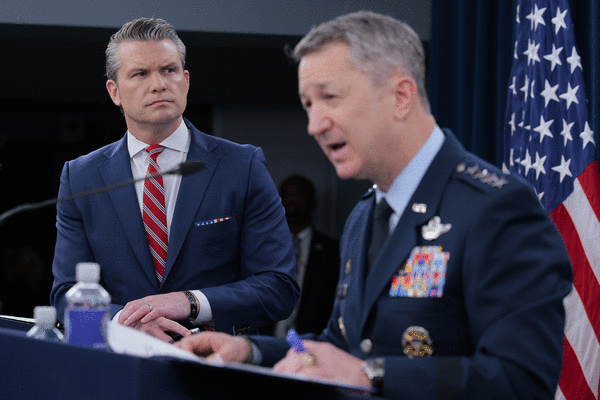
At a separate news conference Tuesday at the Pentagon, Defense Secretary Pete Hegseth said the new initiative — dubbed Operation Project Freedom — is a temporary and defensive operation meant to resume the flow of traffic through the international waterway as hostilities have continued in the region.
“We are not looking for a fight, but Iran cannot be allowed to block innocent countries and their goods from an international waterway,” Hegseth said, while calling Iran’s tactics “international extortion.”
The operation comes nearly a month after the United States reached a fragile ceasefire with Iran, a truce that Hegseth said remains in effect even though Tehran has continued to attack U.S. forces and commercial vessels.
“The ceasefire is not over,” Hegseth said.
Gen. Dan Caine, the chairman of the Joint Chiefs of Staff, said that since the ceasefire took effect, Iran has fired at commercial vessels nine times, seized two container ships and attacked U.S. forces more than 10 times. All of these instances, he said, are “below the threshold of restarting major combat operations at this point.”
Those attacks have left more than 1,550 vessels trapped in the Persian Gulf and unable to transit, disrupting global trade and pushing energy markets toward crisis, with fuel prices climbing and shipping costs surging.
Later on Tuesday, President Trump was asked what Iran needed to do for him to deem Iran in violation of the ceasefire agreement. He said the public will “find out because I’ll let you know.”
“They know what to do. They know what not to do, more importantly actually,” Trump said during an appearance in the Oval Office.
Trump, however, acknowledged that Iran has continued to fire at ships from “little boats,” which he described as fast but not as “fast as a missile.”
“They are looking around for little boats to try and compete with our great Navy,” Trump said as he dismissed the hostilities.
The new U.S. mission on the strait was cast as separate from the broader military campaign over Iran’s nuclear program. As negotiations to denuclearize Iran continue, Caine said commercial vessels wanting to cross the strait will now “see, hear, and frankly, feel the U.S. combat power around them, on the sea, in the skies and on the radio.”
Rubio said that the future of Iran’s nuclear stockpile — which remains buried under rubble from U.S. strikes conducted last year — remains the subject of a U.S. diplomatic effort with Tehran that so far has made little headway.
“What the president would prefer is a deal,” he said. “That is, so far, not the path that Iran has chosen.”
Two U.S. commercial vessels, escorted by Navy destroyers, have already moved through the strait, Hegseth said.
“We know the Iranians are embarrassed by this fact,” Hegseth said. “They said they control the strait. They do not.”
Hegseth called the operation a “direct gift from the United States to the world,” aimed at resuming traffic through one of the world’s most vital waterways.
“To what remains of Iran’s forces: If you attack American troops or innocent commercial shipping, you will face overwhelming and devastating American firepower,” Hegseth said. “The president has been very clear about this.”
Iranian parliamentary speaker and top negotiator Mohammed Ghalibaf said in a statement on X on Tuesday that a “new equation” was being “solidified” in the strait, adding that the maritime traffic was jeopardized by the U.S. and its allies “through the violation of the ceasefire and the imposition of a blockade.”
“Of course, their evil will diminish,” he wrote. “We know full well that the continuation of the status quo is intolerable for America, while we have not even begun yet.”
On Tuesday evening local time, the United Arab Emirates’ defense ministry said in a statement on X that the country’s defensive systems “are actively engaging with missiles and (drone) threats” and that “sounds heard across the country are the result of ongoing engaging operations.”
Tuesday’s barrage marks the second consecutive day of attacks targeting the UAE since the U.S.-Iran ceasefire took hold on April 8. On Monday, the UAE said it engaged a total of 12 ballistic missiles, three cruise missiles and four drones launched from Iran.
For its part, Iran said it had no “pre-planned program” to attack the UAE’s oil facilities, but that attacks were prompted by the United States’ plans to reopen the Strait of Hormuz, according to an unnamed military official quoted by Iranian state TV.
“What happened was the product of the U.S. military’s adventurism to create a passage for ships to illegally pass through” the strait, the official said, adding the U.S. military “must be held accountable for it.”
_____
(Ceballos and Wilner reported from Washington, and Bulos from Beirut.)
_____
©2026 Los Angeles Times. Visit at latimes.com. Distributed by Tribune Content Agency, LLC.





Comments