Iran evaluating US proposal to end war as China calls for peace
Published in News & Features
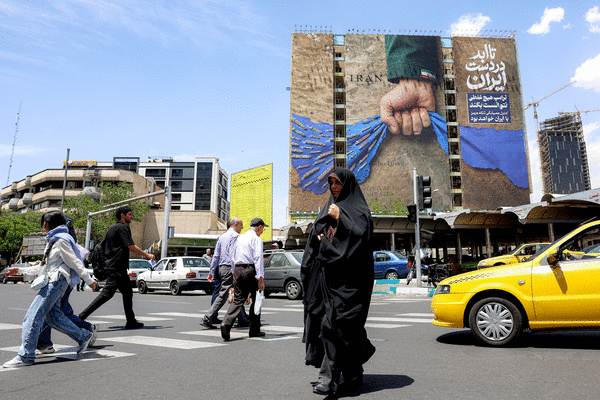
Iran is evaluating a new proposal from the U.S. to end their near 10-week war, according to a person familiar with the matter, as China added its voice to global pressure to wrap up the conflict.
Washington’s one-page memorandum of understanding will, if Iran accepts it, lead to the gradual reopening of the Strait of Hormuz and lifting of the American blockade on Iranian ports, according to the person, who asked not to be identified discussing sensitive information. Nothing has yet been agreed, the person said, and detailed negotiations on Iran’s nuclear program will come later in the process.
Oil prices plunged on the news, while global stocks and bonds rallied.
The plan includes provisions for the removal of sanctions on Iran and a moratorium on the country’s uranium enrichment program, the person said. All conditions can be reversed if a wider nuclear deal can’t be reached, they said.
Tehran is expected to send a response via mediator Pakistan in the next two days, the person said. Axios first reported on the proposal.
The U.S. will end its military campaign and lift its blockade of Hormuz “assuming Iran agrees to give what has been agreed to, which is, perhaps, a big assumption,” U.S. President Donald Trump posted on social media on Wednesday, without giving details of the proposal. “If they don’t agree, the bombing starts, and it will be, sadly, at a much higher level and intensity than it was before.”
Trump said it’s “too soon” to start thinking about face-to-face talks, the New York Post reported, citing an interview.
At a meeting in Beijing, China’s Foreign Minister Wang Yi urged Iranian counterpart Abbas Araghchi to keep negotiating, saying “a resumption of hostilities is inadvisable.” China maintains close economic and diplomatic ties with Iran, absorbing some 90% of its oil exports.
Brent crude dropped more than 10% to below $100 a barrel for the first time since late April.
News of the potential breakthrough came as Trump comes under increasing pressure to end the war he started alongside Israel at the end of February. The shuttering of Hormuz has blocked a key transit point for global energy supplies, triggering a surge in U.S. gasoline prices to above $4.50 a gallon for the first time since July 2022. That’s piled pressure on the Republican Party ahead of Midterm elections this November.
In Israel, the prospective agreement caused consternation, with Prime Minister Benjamin Netanyahu’s government wanting Iran totally defeated and its nuclear, missile and proxy militia programs dismantled.
“Israel’s position is that the pressure must continue,” Energy Minister Eli Cohen told Army Radio when early reports of a deal surfaced. “If Iran does not accept all of the U.S. demands, in coordination with Israel, then of course action must be taken — to strike Iran and continue both economic and military blows. I believe we must continue with full force — either until all conditions are fully met, or until the regime is broken.”
Trump on Tuesday suspended a military initiative to guide stranded ships though Hormuz after only one day of operations. The plan — which the U.S. president dubbed Project Freedom — resulted in clashes with Iran and missiles fired at the United Arab Emirates. That forced Washington to insist an almost month-long ceasefire remains in place.
Trump said the decision to pause Project Freedom was made at the request of Pakistan — which is helping mediate talks between Washington and Tehran — as well as other countries. He added that a U.S. blockade of ships transiting to and from Iranian ports would “remain in full force and effect.”
Iran will ensure “safe, stable passage” through the Strait of Hormuz with the “aggressor’s threats neutralized & new protocols in place,” state-owned Press TV reported Wednesday. It didn’t say what those protocols are or suggest a significant change in the status quo.
Trump has repeatedly said significant progress has been made in negotiations with Iran to end the war, only for nothing substantial to emerge. On Tuesday, Iran’s President Masoud Pezeshkian called the U.S. position unrealistic, saying Tehran wouldn’t “ultimately submit to its unilateral demands.”
Disagreements remain over key issues such as control of Hormuz, where a fifth of the world’s oil and liquefied natural gas flowed before the war brought traffic to a standstill. The U.S. is also demanding an end to Tehran’s nuclear enrichment program.
Washington has made clear it wants to avoid another flareup in violence like the one seen during Project Freedom’s brief spell in operation. Before Trump’s announcement, Secretary of State Marco Rubio told reporters at the White House that offensive operations against Iran were over.
The shipping industry is waiting for a way to guarantee safe passage through Hormuz without ships risking harassment by Iran or any other party, Dimitris Maniatis, the chief executive officer of Greek maritime risk company Marisks, told Bloomberg TV on Wednesday.
The U.S. said the shutdown around Hormuz has left more than 1,550 commercial vessels, carrying some 22,000 sailors, trapped in the Gulf.
Trump and top administration officials have said divisions within Iran are making talks more challenging. Getting a response to a U.S. proposal can take up to a week, Rubio said.
“Their system has always been multilayered in this way. It’s obviously become more complex because of the damage they suffered during the war,” he said.
More related to the war
•The United Arab Emirates said on Tuesday that its air forces responded to a missile threat, the first such announcement after Iran launched around 20 missiles and drones at the country the previous day. There were no reports of clashes on Wednesday.
•The U.S. and its allies backed a draft United Nations Security Council resolution that would open the door to sanctions or even military action if Iran doesn’t ease its chokehold over the strait. The proposal would require support from China and Russia to pass.
--------
—With assistance from Ethan Bronner, Carla Canivete and Jennifer A. Dlouhy.
©2026 Bloomberg L.P. Visit bloomberg.com. Distributed by Tribune Content Agency, LLC.




Comments