Obama Presidential Center museum tickets now on sale as June opening approaches
Published in News & Features
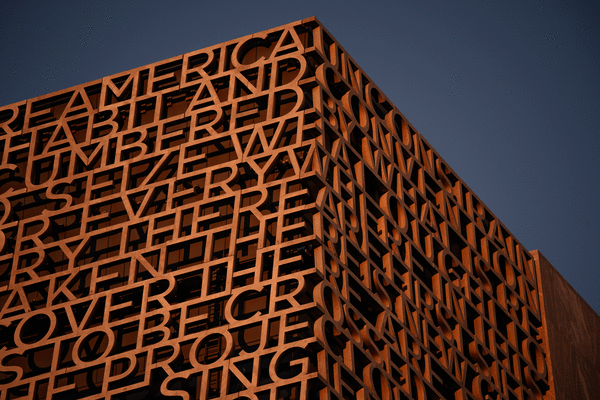
CHICAGO — Tickets are now on sale for the Obama Presidential Center museum and eager ticket buyers flooded the website Wednesday morning ahead of the campus’ June 19 opening.
The four-floor museum will focus on civic participation and U.S. history from the country’s early days through Barack Obama’s presidency. It will feature a full-scale Oval Office replica, Michelle Obama’s fashion, views of the city via the Sky Room and donated artifacts, according to a news release. Tickets allow for a timed entry to the museum. The rest of the campus — located in Jackson Park on the South Side — will be accessible without a ticket.
Tickets can be purchased through an online queue for opening day through Nov. 30. Tickets for ages 12 and older cost $30 for non-Illinois residents and $26 for Illinois residents. For children ages 3 to 11, tickets cost $23 for non-Illinois residents and $15 for Illinois residents. Children under the age of 3 can enter the museum for free. All Illinois residents will be able to visit the museum for free on Tuesdays.
At 9 a.m., some ticket buyers saw wait times up to an hour. But by mid-morning, the website showed plenty of tickets available.
Paul Ruffolo, a filmmaker living in Lincoln Square, said he entered the queue as soon as tickets opened at 9 a.m. At first, the screen showed an hour-long wait, but Ruffolo said he was able to secure three tickets for himself and his family to visit the museum on July 7 after around 25 minutes of waiting.
Ruffolo said he’s excited that more people will come to Chicago to experience the center and is looking forward to teaching his son more about Obama’s presidency.
“Barack’s presidency was very exciting, and we feel so far removed from that,” Ruffolo said. “For my 14-year-old who was very young at that time, to be able to relive some of the moments in some way with a more mature sensibility would be very cool.”
Free and discounted tickets are also available for certain groups. Active-duty military, veterans, Chicago-based first responders, Illinois PreK-12 teachers and Illinois K-12 students and teachers on school trips are eligible for free admission. The museum will also participate in the Museums for All and Blue Star Museums programs, which allow free admission for those presenting an Electronic Benefits Transfer or a Women, Infants and Children card and free summer tickets for military families, respectively.
In addition to the museum, the Obama Presidential Center campus — spanning over 19 acres — will include an auditorium, a recording studio, restaurant, café, Chicago Public Library branch, fruit and vegetable garden, a 45,000-square-foot athletic and community space, and a 21,000-square-foot accessible public playground, according to a news release.
The center, which has cost over $800 million to build and was originally scheduled to open in 2021 and then 2025, anticipates over 750,000 annual visitors. The museum will be open 1 p.m. to 8 p.m. on Mondays and 10 a.m. to 5 p.m. Tuesday through Sunday.
Mike Strautmanis, the chief corporate affairs officer at the Obama Foundation, said the center represents the movement full of people wanting to better their community that elected Obama to the White House.
“(The center) will mean that hope has a home, and fittingly, it’s right here in the city of Chicago,” Strautmanis said.
The center is located in a city of significance for the Obamas. Obama moved to Chicago in 1985, as a 23-year-old community organizer during the Council Wars era of City Hall conflict between the city’s first Black mayor, Harold Washington, and a bloc of mostly white aldermen.
He worked with residents in Roseland and Altgeld Gardens on the Far South Side, advocating for asbestos removal and a local job-training office, before leaving for law school.
“It was in these neighborhoods that I received the best education I ever had,” Obama said when launching his 2008 presidential campaign.
He returned after getting a law degree from Harvard University and met Michelle Robinson in 1989, when he worked as a summer associate at a prestigious Loop law firm and she was his supervisor. Michelle, an Ivy League-educated attorney herself, gave the future president deeper roots in the city.
Michelle’s father, Fraser, was a pump operator for the city and the family lived in a brick bungalow. She went on to become assistant commissioner of planning and development in City Hall before becoming an administrator at the University of Chicago medical center. The family joined Trinity United Church of Christ.
South Side Ald. David Moore, 17th, knew Obama long before he was a United States senator. He recalled supporting Obama when the future president unsuccessfully challenged U.S. Rep. Bobby Rush in the 2000 Democratic primary.
During the campaign, Moore took Obama to coffee shops on campaign stops.
“I remember my mother telling him he could be president,” Moore said.
Of the presidential center’s meaning for the community, Moore said, “I think it’s hope.”
“When I talk to people, it brings back a connection to him,” Moore said. “He’s not living here full-time in the city, but it brings that connection to them. Those are the two primary things this Obama Center does for the residents of the city of Chicago.”
Of course, there are critics of the center, which is expected to potentially drive gentrification in the Woodlawn and South Shore neighborhoods. Activists made efforts to implement a community benefits agreement to prevent displacement, but the results have been more modest.
Ald. Jeanette Taylor, 20th, whose ward includes the center, said: “I’m excited for the first Black president of the United States to have his space, but at what cost?”
_____
©2026 Chicago Tribune. Visit chicagotribune.com. Distributed by Tribune Content Agency, LLC.



Comments