After nests washed out by 'rogue wave,' how are the birds in Florida's Fort De Soto doing?
Published in News & Features
TAMPA, Fla. — It’s hard to spot the least terns skittering around Fort De Soto Park.
But there are dozens of them.
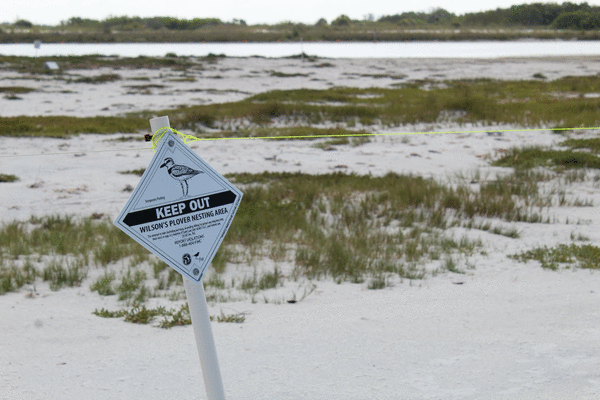
The itty-bitty shorebirds look like little vigilantes, with black masking their eyes, scurrying around grass and sand mounds, largely behind a sign that says “DO NOT ENTER.”
The roped-off areas of the park are nesting sites for threatened shorebirds.
A couple of weeks ago, the area was flooded by a rogue wave that took beachgoers and park rangers by surprise.
It flooded the shorebird nesting site on the northern end of the beach, razing several nests.
On Friday morning, Lorraine Margeson was out doing volunteer survey work for the Florida Shorebird Alliance, nearly two weeks after the wave.
She’s quick to tell you to stay far from the roped area. You’ll startle the birds, she said. They’re fragile creatures, battling predators, traipsing beachgoers and, now, massive waves.
The Tampa Bay Times visited the park Friday to see how the shorebirds were recovering. Had nature wiped out the chances of nesting for some of Florida’s most threatened birds? Or had they come back?
“It was rockin’,” Margeson said of the shorebirds’ earlier nesting season. “Then that stupid wave came in.”
Margeson is out at the park about four times a week. The morning after the wave, she was there to volunteer when she realized something was wrong.
A beloved oystercatcher couple, AE and Archie, were on the other side of the beach.
“There’s no way they wouldn’t be around the nest,” Margeson said. “Unless the eggs were gone.”
A ‘rogue wave’ floods Fort De Soto
It was around sunset on April 25, and the water was around Letty Parrish-Shasteen’s ankles. She had walked about 10 feet out into the water to look for shells.
Within seconds, the water rose to her hips. Her husband, who’d been shelling beside her, ran for the shore, worried for his phone and car keys jangling in his pockets.
A report made by a park ranger said the wave rolled in around 7:40 p.m., affecting most of the west side of the park, or the Gulf of Mexico side of the beach.
The ranger estimated that the wave rolled in about 200 feet farther than the highest tide. Only about 30 feet of beach was untouched by the wave. It’s unclear how high it crested.
Fort De Soto officials called the wave a “sneaker” or “rogue” wave. Luckily, no one was hurt, Anna Yu, an environmental program manager for the county park, previously told the Times.
Yu had never seen a rogue wave strike the beach before, and to her knowledge, neither had her colleagues.
It was the oddest thing, Parrish-Shasteen said. The water was calm as it rose, with no waves riding atop it. Just water, rising, rising, rising.
Even the nesting birds seemed to know something was amiss. They flew off before the wave reached them, Parrish-Shasteen said.
Parents hoisted children playing in the sand. Other beachgoers grabbed for floating towels and chairs. An entire bag of nacho cheese Doritos floated by Parrish-Shasteen.
Everyone seemed to be “watching the water in awe,” she said.
It’s still unclear what caused the wave.
A University of South Florida study from 2022 said rogue waves are typically twice as big as normal waves. They can occur in the open ocean or coastal waters.
They can happen randomly, according to a university post about the study.
From 2015 to 2019, a wave buoy about 10 miles offshore of Egmont Key found that about 10% of recorded waves were above the median wave values. Of those, 32 were over 13 feet. Four of those waves likely were generated around the time of powerful Hurricane Michael in 2018.
One wave, the tallest of the data set, reached 27 feet.
A Facebook commenter posted a video in response to a Times article about the wave. She was camping on Shell Key when the water rushed in.
The video shows washed-out tents and beachgoers salvaging their camping gear.
After the wave, which took a couple of minutes to recede, everyone grabbed for their things and packed up, Parrish-Shasteen said. People helped each other as much as they could, she said.
It was a cumbersome walk back to cars. Everyone carried waterlogged towels and bags, now much heavier.
Shorebirds take the brunt of the wave
During the rogue wave, the park lost “quite a few nests,” Yu said.
Among the lost was the nest belonging to AE and Archie, the famous oystercatcher pair. Like the least terns, they are a threatened species.
Lynne Harding, 82, an Audubon Florida volunteer, sat in a chair Friday morning, chatting with beachgoers, other volunteers and Margeson.
Harding said one person at the beach during the wave saw the water pick up AE and Archie’s eggs. They tried to grab them, but they were swept out.
For now, the pair have been spotted around the park, but they haven’t nested. Yu said last week she hopes they’ll try again. There’s still time this season.
Yu said a couple of Wilson’s plover nests were also lost, among others in the park’s bird sanctuary.
Plenty of nests made it, said Yu. Some of the least terns’ eggs washed out, but they were already making a resurgence.
“Two days later, they are back. They are scraping again, making new nests.”
It is the first least tern colony since 2021 at Fort De Soto, Harding said Friday as she stared out at the nesting area.
It’s a big deal to see them back and thriving, she said.
Another rogue wave may have struck the same area Saturday, according to Margeson, who didn’t witness the wave but saw high water marks the next morning.
This time, however, the least terns had already begun nesting farther away from where the large wave previously reached.
“The birds got smarter,” Margeson said.
As of last count, the least terns have about 34 nests. It’s unclear when chicks may appear.
The birders who visit the park each day are protective of the shorebirds. They don’t want the flood of people who will inevitably flock to see the babies.
On Friday morning, the area around the shorebirds along the far northern area of Fort De Soto was calm. Few beachgoers were out.
Harding said the weekends are different and packed with people.
But volunteers will be there to remind visitors to be cautious of the birds that have already had a tough go. And Margeson, who’s been visiting the park since 2007, will almost certainly be there, too.
She called the park unique, with beautiful species and volunteers who care deeply about them.
“It’s one of the most special places on the planet, which is why I’m here all the time,” she said.
_____
©2026 Tampa Bay Times. Visit tampabay.com. Distributed by Tribune Content Agency, LLC.






Comments