Pushing back South Carolina primaries is possible, but difficult, state election director says
Published in News & Features
COLUMBIA, S.C. — As lawmakers consider moving South Carolina’s congressional primaries back two months to redraw its maps, the state’s Election Commission leader said such a last minute change would be possible, but difficult.
“The voters are the ones that will be confused with things moving forward,” said Election Commission executive director Conway Belangia. “Just the fact that we’re here today will cause voter confusion. It’s not going to be an easy process either way.”
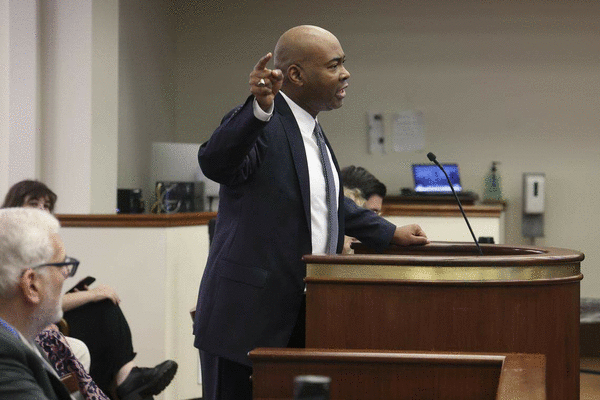
House lawmakers began the process of redrawing its congressional maps just more than a month before the primary elections, where South Carolina residents are expecting to cast their votes for U.S. House representatives. Opponents of redrawing, who filled the hearing room, clapped, read Bible verses and said the redraw would dilute Black voting power in the state.
In addition to hearing from the public about a proposed map, a House Judiciary Committee also weighed pushing just the congressional elections to August. Statewide, local and state House elections would still occur June 9, under the House proposal.
Holding elections in August would cost between $2.2 million and $2.5 million, according Belangia.
The House also proposed setting aside $2 million in the state’s upcoming budget to cover expected litigation over a new map.
Recruiting poll workers in late summer, when many are on vacation, may also be a challenge, Belangia said in an interview Wednesday. Several counties already have poll worker shortages for the June 9 statewide primary, according to a Tuesday news release from the Election Commission.
If congressional elections are delayed to August and the other elections occur June 9, the U.S. House candidates will still appear on the earlier ballots, Belangia said.
The June 9 ballots were finalized ahead of a 45-day deadline to allow military and overseas citizens to vote, he said.
“That ballot will have congressional candidates listed on it, and the voter, unless they do outside research, will not have any notice on the face of the ballot that that is not a valid vote,” state Rep. Spencer Wetmore, D-Charleston, said.
Absentee ballots are sent out daily and about 300 have already been returned, Belangia told lawmakers.
Moving elections would require outreach to voters about changes, but many might still believe they already voted in congressional races if the races are moved to August, Wetmore said.
House lawmakers voted to potentially come back to redraw congressional maps after the May 14 legislative deadline earlier this week. It’s unclear whether the Senate will agree to return and redistrict between censuses.
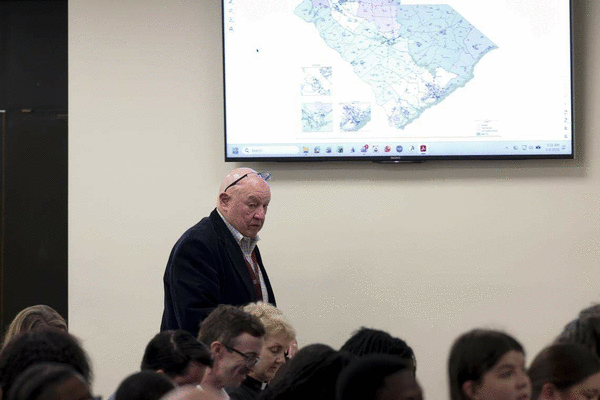
The proposed congressional map was drawn to create seven safe Republican seats, said state Rep. Jay Jordan, R-Florence, and a map consultant testifying Friday morning.
Late last month, the U.S. Supreme Court case struck down a Louisiana congressional map, arguing a second majority Black district was illegal racial gerrymandering. The decision created interest in redrawing, House leaders said Wednesday.
“Mid-decade redistricting used to be rare, but it’s not now,” said John Morgan, an attorney who specializes in redistricting. “And it’s not surprising because the law has changed. The situation has changed, so it’s not unexpected that the redistricting authorities would take the actions its taking now.”
“I think a plan like this is likely to elect seven Republicans,” Morgan continued.
After Jordan, who led the hearing, said proposed maps were drawn to create seven reliably Republican districts, the crowd erupted. Someone in the audience said “you said it out loud.”
The House plan also would push the congressional primaries to Aug. 11, with runoffs if necessary on Aug. 25. Filing for those elections would run from June 8 through June 15.
If only the congressional elections are pushed back, and other primaries are held June 9, those who lose in the June 9 primaries for statewide office or state House seats and other elections taking place could decide to run to for Congress. Two of South Carolina’s current congressional members are running for governor in the Republican primary.
Republican House members are pushing for a redraw amid a continued effort from President Donald Trump following a U.S. Supreme Court case out of Louisiana that struck down a second Black district in that state. Trump and Republicans are using that decision to renew a push for mid-decade redistricting to minimize expected GOP losses in the upcoming midterm elections.
In 2024, the U.S. Supreme Court upheld the state’s congressional map as a partisan gerrymander. Lawmakers said they used partisan voting data to create a reliably 6-1 map. The state Supreme Court also has upheld the state’s congressional map.
While proponents of redrawing pointed to the U.S. Supreme Court’s decision, South Carolina GOP leaders also said Trump and White House staff have pushed them to consider new maps ahead of the 2026 midterms.
The party that controls the White House historically loses seats in Congress in the midterms. The GOP also faces the prospect of an unpopular president potentially hurting Republicans running for Congress and prospect of high gas prices amid an unpopular war with Iran.
Speakers on Friday broadly opposed the effort to redistrict mid-decade. Many in the audience clapped and cheered after hearing testimony opposing the new maps.
South Carolina Democratic Party leaders, including chair Christale Spain and former DNC chair Jaime Harrison, spoke to the panel of lawmakers.
Both said the maps were an attempt to dilute the political influence of Black voters in South Carolina.
“After military ballots have already gone out, we are considering an unprecedented mid-cycle redistricting effort that appears designed to weaken Black voting strength, to divide communities of interest and to create chaos in the middle of a new election cycle,” Harrison said.
Harrison also criticized the proposed map and how it splits Richland County into three districts.
“Richland County now looks like a political jigsaw puzzle, split into three distinct districts. Communities that share common schools, economies, transportation, churches and districts are being carved apart all for political purposes,” Harrison said.
_____
©2026 The State. Visit thestate.com. Distributed by Tribune Content Agency, LLC.





Comments