New congressional districts will reshape South Florida politics -- for voters and candidates
Published in News & Features
FORT LAUDERDALE, Fla. — Politicians are polling, strategizing — and agonizing. But the impact of Florida’s new congressional districts extends well beyond the political class. Every voter in the state will be affected, even if they don’t yet know it.
In Delray Beach, many people will find their next member of Congress is someone whose district stretches south along the coast to Miami Beach, and who consequently might not be completely attuned to what’s going on in Palm Beach County.
The district for residents of Parkland, Weston and Wellington will stretch across vast swaths of the Everglades, extending to Marco Island and the Gulf of Mexico.
Those are some of the major changes in South Florida congressional districts under a just-enacted redistricting plan, approved by Republicans in the Florida Legislature over the vociferous objections of Democrats who said it was unfair and unconstitutional. One indication about the expected results: At the conclusion of the vote in the state House of Representatives, lawmakers in the Republican majority stood, clapping and cheering.
Several of the new South Florida districts are far more spread out than the districts they replaced. Statewide, the new maps chop up more cities and counties.
The new map “splits my city in half,” state Rep. Rob Long, D-Delray Beach, told his colleague in the Florida House before the majority voted its final approval. His home, along with many others, was attached to the narrow, elongated 25th District that runs along the coast to Miami Beach.
“This is bigger than my city,” Long said. “We’re debating a map that by every traditional metric is worse than the one we have.”
State Sen. Tina Polsky, a Democrat who represents northwest Broward and southern Palm Beach counties, said there is no logical reason — other than trying to create a Republican-friendly district — to have one that is stretched out so much and takes in parts of three heavily populated counties along the coast.
The new map splits 19 counties, instead of the 17 that were split in the 2022-2024 map, Long said, and splits 30 cities, instead of 16 in the previous map.
The sprawling nature of some newly crafted districts is apparent from looking at the map, which was proposed by Gov. Ron DeSantis on April 27, ratified by the Republican-controlled Legislature on April 29, and signed into law by DeSantis on May 4.
The House sponsor of the DeSantis plan, state Rep. Jenna Persons-Mulicka, R-Fort Myers, said during debate on the map she doesn’t see it that way. “I think this map that is before us is just as compact as the current map,” Persons-Mulicka said. DeSantis, at a news conference Friday in Miami, said when he looks at the map the districts appear compact.
Statistics posted by the Florida Senate’s professional staff show that two of the mathematical formulas used by redistricting experts and recognized by courts indicate the new districts are less compact than the ones they replaced. A third formula shows no difference, Persons-Mulicka said.
The Polsby-Popper test and the Reock Ratio compactness formula show the new coastal Broward, Palm Beach, Miami-Dade county 25th District is the least compact in the state. It’s in the bottom four in the Convex Hull test.
Chris Marino, chair of the Broward Republican Party, said there are common interests among communities that make up the district.
“The new 25th is one of the most interesting seats in the state because the map turned it into a true South Florida coastal district. It now runs through communities in Palm Beach, Broward, and Miami-Dade that share many of the same concerns: affordability, insurance, flooding and storm resilience, infrastructure, public safety, and quality of life,” Marino said via email.
The new districts and their boundaries have even confused candidates and their campaign staffers.
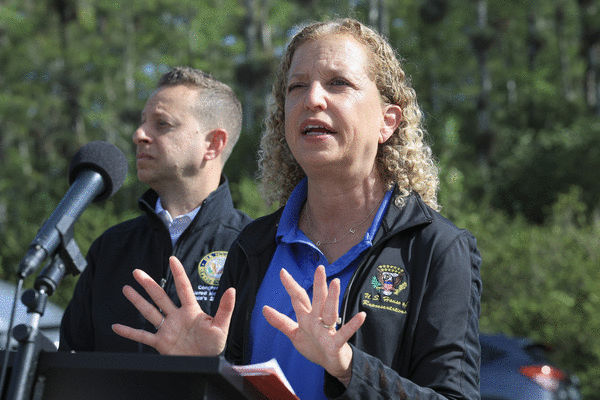
Michael Carbonara, a Republican who’s been running for eight months for his party’s nomination to challenge U.S. Rep. Debbie Wasserman Schultz, D-Weston, issued a news release 48 hours after the Legislature passed the maps declaring that he’s still running.
His plan: run in the new 22nd Congressional District, the one that goes all the way to the Gulf of Mexico and that the campaign’s news release said includes “Carbonara’s home community of Southwest Ranches.”
It doesn’t. Southwest Ranches, including the address where he’s registered to vote, is in the new 26th District, where Republican U.S. Rep. Mario Diaz-Balart is seeking reelection.
Political impact
Voters, especially in South Florida, will have to get to know a new crop of political leaders as they find themselves living in new congressional districts. Democratic voters in the party’s remaining strongholds in Broward and Palm Beach counties may also have to get used to something unfamiliar — being represented in Congress by a Republican.
Congressional careers could end for some prominent Florida Democrats. And Republicans will see new paths to winning elections.
That’s by design.
DeSantis pushed through the new district map after President Donald Trump told Republican states to change congressional district boundaries to get more Republicans and fewer Democrats elected in November. Many states complied and some Democratic states have responded in kind.
Mid-decade redistricting is unusual. Normally, boundaries are redrawn every 10 years to reflect population changes uncovered in the decennial census.
The DeSantis camp provided the first look at the new district map — with districts color coded red for Republican districts and blue for Democratic districts — to Fox News, the favored news source for Republicans, before providing it to lawmakers.
The partisan tilt of the new map: 24 Republican and four Democratic districts.
Florida currently has 20 Republican and eight Democratic districts, already viewed by experts as skewed to disproportionately benefit Republicans.
A 24-4 split works out to a congressional delegation that’s 86% Republican. In 2024, which was a banner year for Republicans in Florida, Trump won 56% of the vote to 43% for Democrat Kamala Harris.
The state’s active registered voters are 42.3% Republican, 30.2% Democratic, 24.9% no party affiliation/independent, and 3.6% minor parties.
Four incumbents — Wasserman Schultz and U.S. Reps. Jared Moskowitz of Parkland, Kathy Castor of Tampa Bay, and Darren Soto of Central Florida — face hurdles to reelection under the new districts.
All have announced plans to run in reconfigured districts.
Broward and Palm Beach counties currently have five Democratic districts and one Republican district. Under the new map, the two counties would have three Democratic and four Republican districts.
“We are losing two Democratic seats in Broward County,” state Sen. Rosalind Osgood, D-Fort Lauderdale, told her colleagues. “It’s like if I have my hand. And somebody just cut off two fingers for no reason. Whole hand working, no complaining, good strong hand, and then I just loose two fingers for no apparent reason. I can’t explain that to the voters.”
DeSantis’ mapmaker put Wasserman Schultz’s and Moskowitz’s homes in the same district, the new 22nd. Under the Constitution, U.S. representatives must live in their states, but not their districts, and there’s a long tradition of Democratic and Republican lawmakers in Florida and elsewhere not living within the borders of their district.
Jason Poreda, the DeSantis aide who testified before legislative committees that he was the one who drew the new boundaries, acknowledged that partisan data was one of the things he used to devise the new lines.
Democrats said that shows the maps violate the Fair Districts Amendments that voters added to the state Constitution. Fair Districts prohibits drawing of district lines to benefit a political party, requires that districts be compact, and calls for using existing political and geographical boundaries when it is feasible.
Asked Friday at a news conference in Miami if the new map violates the Constitution, DeSantis said, “It doesn’t.” The governor’s general counsel said in a memo to the Legislature that he believes the Fair Districts Amendments should be invalidated.
Court challenges are certain, but it’s uncertain if the issue can be resolved before this year’s elections, and if the new map will go into effect during the wait. And at the Florida Supreme Court, which will consider key questions, DeSantis appointed six of the seven justices.
Apparently mindful of warnings that comments during debate could be used in court challenges — three were filed shortly after DeSantis signed the map into law — the only Republicans who spoke about the map during the legislative debate were the sponsors, Persons-Mulicka, and state Sen. Don Gaetz, a Panhandle Republican.
Gaetz rejected the Democrats’ assertions. “I am not persuaded that this map is necessarily beneficial to the Republican Party,” he said.
Polsky said the intention was obvious. “Donald Trump issued an explicit call to Republican governors across the country … an explicit call to redraw congressional lines” to benefit his party’s candidates, she said. “Now the governor of Florida has been careful not to repeat those words. He’s too savvy for that. But his justifications, every single one of them, have crumbled under the slightest scrutiny.”
The consequences of the new districts might not be as far-reaching, at least in 2026, as the topline numbers of Trump-voting and Harris-voting districts indicate.
The first election after a presidential election is often bad for the party that occupies the White House. Public opinion polls show voters’ assessments of Trump’s performance has declined, especially since the start of the war with Iran.
And Democrats have been winning special elections and mayor’s races in Florida — or increased their percentage of the vote even if they lost — since Trump began his second term.
So numbers showing Trump did well in the new districts doesn’t guarantee people will vote for Republican congressional candidates in November.
The latest analyses from the nonpartisan Inside Elections and from Sabato’s Crystal Ball, from the Center for Politics at the University of Virginia, shows some uncertainty.
The new coastal 25th District is rated as a “toss up” between Republicans and Democrats by both Inside Elections and the Center for Politics. In 2024, the district favored Trump over Harris 54%-45%, according to an analysis published by Democratic data analyst Matthew Isbell. In 2020, Democrat Joe Biden won the territory 52%-47%.
And the new 22nd District that takes in Moskowitz’s and Wasserman Schultz’s homes is rated “tilt Republican” by Inside Elections and “leans Republican” by the Center for Politics. Those assessments mean the party has an advantage, but it’s not overwhelming.
Trump won the territory in the 22nd District 55%-44% in 2024; Biden won it 51%-48% in 2020.
Marino, the chair of the Broward Republican Party, said the new 25th District is a good opportunity for the Republicans, but cautioned against over-confidence.
“The new lines appear to create a more favorable district, but no one should assume anything in South Florida. Whoever our nominee is will still need to run a strong campaign, raise the resources to communicate across three counties, and speak to voters on the practical issues they care about most,” he said. “Bottom line, the new 25th is a genuine Republican opportunity, and Democrats know it.”
©2026 South Florida Sun Sentinel. Visit sun-sentinel.com. Distributed by Tribune Content Agency, LLC.




Comments