Starmer faces fresh leadership threat after heavy election loss
Published in News & Features
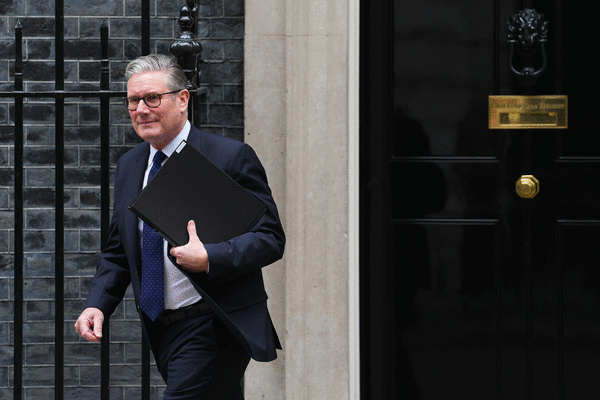
A Labour Party lawmaker threatened to trigger a leadership contest to replace Keir Starmer, casting a shadow over the U.K. prime minister’s efforts to shore up his party after heavy election losses by appointing Gordon Brown as special envoy on global finance.
Catherine West, a former junior Foreign Office minister under Labour, said in an interview with the BBC that she would challenge Starmer unless Cabinet ministers take steps to remove the prime minister by Monday. West noted that she currently has 10 people who would back her, but she is “confident” that she will gather enough support to force a contest.
Her announcement comes hours after Brown was appointed a special envoy as part of Starmer’s attempt to patch up the rival factions in his Labour Party after it suffered dismal local election results.
Brown, who served as Labour chancellor and then premier from 1997 until 2010, is set to develop new international finance partnerships to support defense and security-related investment with a particular focus on European ties, Starmer’s office said Saturday. That includes establishing multilateral finance mechanisms — something Chancellor Rachel Reeves has been pursuing with limited success in recent months.
The appointment is part of Starmer’s efforts to signal to his ruling Labour Party and the wider public that he wants to unite the party, after around 30 MPs called for him to set out a timetable for his departure. Some named Greater Manchester mayor Andy Burnham as their preferred successor and said he should be allowed to stand for parliament.
Former Deputy Prime Minister Angela Rayner and Health Secretary Wes Streeting had also been weighing leadership bids ahead of the local elections. Rayner is yet to make a statement, and Streeting indicated he wouldn’t make an immediate challenge while refusing to explicitly endorse Starmer.
“Across the country we’ve seen some extremely bad results for the Labour Party,” Streeting said. “We have to respect the voters, take the feedback on the chin and accept that the government nationally bears a huge amount of responsibility losing through no fault of their own.”
Other Cabinet ministers urged MPs to not challenge Starmer’s authority, while Ed Miliband, Lisa Nandy, Shabana Mahmood and Yvette Cooper offered more tepid support. Miliband recently suggested to Starmer in a private meeting that he should consider an orderly transition of power, The Times reported Thursday.
Starmer on Saturday also appointed another influential Labour grandee, Harriet Harman, as his adviser on women and girls.
While Harman and Brown are highly respected among the Labour parliamentary party, reaching for the old guard in an effort to signify change is likely to have limited effect. A number of Labour MPs privately criticized the decision to the BBC.
It will also be seen as an attempt to stave off any leadership challenge: Party grandees have often played a pivotal role in ousting and electing leaders across the political spectrum. Brown has already been influential in pushing the government to introduce measures to alleviate child poverty.
Brown’s primary job will be to rally support among allies to join Reeves’ finance initiative to drive joint procurement and munitions and accelerate defense investment, with the mechanism due to be set up in 2027. Only Finland and the Netherlands have signed up so far, while Canada continues to lobby the U.K. to instead join its own similar initiative.
Reeves hopes the initiative will help plug a defense funding gap without having to borrow more by taking defense spending outside her fiscal rules, something Brown and Burnham have suggested doing but she opposes, people familiar with the matter said. Brown will also help relaunch negotiations to join the European Union’s SAFE weapons fund, which the EU effectively blocked Britain from joining last year by demanding a high fee, they said.
Labour is on course to lose more than 1,400 of the roughly 2,500 council seats it was defending across England as a result of a surge in support for Nigel Farage’s Reform UK. Labour also lost support in Wales, and Scotland, and saw many London seats fall to the Greens.
Starmer plans further announcements and a speech on Monday to set out what his office described as “the next steps in his plan to build a stronger and fairer Britain.”
In an article for the Guardian, Starmer took responsibility for the result and was prepared to reflect on the outcome, though warned that the “right approach” for the party and country was to be “unifying rather than dividing.”
“While we must respond to the message that voters have sent us, that doesn’t mean tacking right or left,” Starmer wrote. “It means bringing together a broad political movement, being assertive about our values, bold in our vision and addressing people’s demands.”
©2026 Bloomberg L.P. Visit bloomberg.com. Distributed by Tribune Content Agency, LLC.






Comments