Starmer vows to prove critics wrong in speech to save job
Published in News & Features
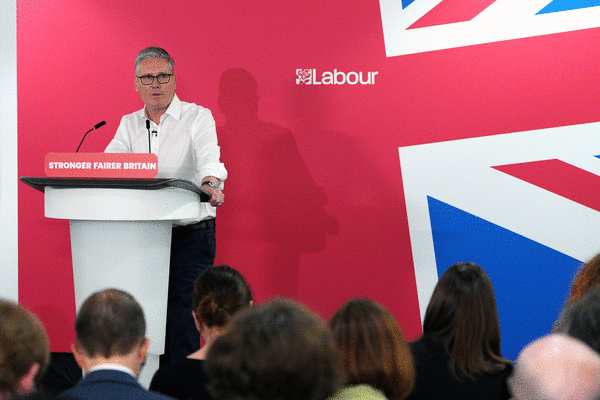
U.K. prime minister Keir Starmer said he would contest any leadership challenge, as he battled to save his premiership in a speech that appeared to do little to subdue the rebellions brewing within his party.
“I know that people are frustrated by the state of Britain, frustrated by politics, and some people frustrated with me,” Starmer said in London on Monday. “I know I have my doubters, and I know I need to prove them wrong.”
Starmer is fighting to stay in 10 Downing St. after a drubbing in local election results triggered a wave of Labour MPs to call for his departure. He had a brief moment of respite on Monday when a former minister, Catherine West, withdrew her threat to force an immediate leadership contest, though she said she’d still push for a timetable for Starmer’s exit.
“I am hereby giving notice to No. 10 that I am collecting names of Labour MPs to call on the prime minister to set a timetable for the election of a new leader in September,” West said in a statement. “What is best for the party and country now is for an orderly transition.”
Gilts fell, with the 10-year yield rising as much as 8 basis points to the day’s high of 4.99%, while the pound eased against the dollar and the euro.
The call for a September leadership election, which would put it around the same time as Labour’s annual conference in Liverpool, puts pressure on Starmer’s health secretary, Wes Streeting, to decide whether to challenge his boss for the job before other candidates emerge. Streeting, who is seen as a standard-bearer for the right of the party, is said to be weighing his options.
Labour MPs told Bloomberg they were waiting to hear the contents of Starmer’s speech before deciding whether to push for him to go. After it, several said on the condition of anonymity that they didn’t see the prime minister’s performance as improving his chances.
Starmer’s speech was light on new policy. The prime minister announced the government would legislate to take full ownership of British Steel, which is already under temporary government control. He also announced more investment in education programs like apprenticeships, technical colleges and in special educational needs.
Starmer sharpened his rhetoric against the populist parties who made strong gains at last week’s elections, warning that the country risks going down a “dark path,” as he stood behind a podium that read “Stronger Fairer Britain.”
“We are not just facing dangerous times but dangerous opponents,” he said, name-checking both Reform U.K. leader Nigel Farage and the Greens’ Zack Polanski. “If we don’t get this right our country will go down a very dark path.”
Starmer is having to embrace a bolder program, which includes a focus on the cost of living and national security, after the party led by one-time Brexit campaigner Farage racked up nationwide wins on May 7. The results confirmed for many in Labour that the party needs a change at the top before the next general election, which must be held by August 2029.
Starmer also said he wanted to put Britain at the “heart of Europe,” though he didn’t signal any new policy positions regarding relations with the European Union. Starmer’s spokesman, Tom Wells, told reporters on Monday after the speech that Labour’s election manifesto promises not to rejoin the E.U.’s customs union or single market were in place for “this parliament,” which is due to end in August 2029 at the latest, and that “the next manifesto is a matter for the party.”
Over the weekend, Starmer saw his first direct challenge as West, a little-known member of Parliament from north London, announced she would seek the top Labour job if no one else stepped forward. While few considered West a serious contender, her bid looked set to force the hand of more Starmer rivals with deeper support, such as former Deputy Prime Minister Angela Rayner and Streeting.
By stepping back and calling for an orderly transition, West appears to be rowing in behind the camp backing Greater Manchester Mayor Andy Burnham, who is preferred by many MPs but can’t currently contest the leadership because he doesn’t have a seat in Parliament.
Starmer said he works well with Burnham, but that such a decision to allow him into the House of Commons will be up to the Labour party’s executive body.
Rayner, who has said little since the election results, laid out the stakes for Starmer in a statement Sunday evening. Although she stopped short of declaring any intention to seek his job, her remarks included a broad enough critique of Labour policy to signal her desire to decide to shape its future.
“The prime minister must now meet the moment and set out the change our country needs,” Rayner said. “What we are doing isn’t working and it needs to change. This might be our last chance.”
©2026 Bloomberg L.P. Visit bloomberg.com. Distributed by Tribune Content Agency, LLC.





Comments