Months later, critics decry length of St. Paul review of police in November ICE protest
Published in News & Features
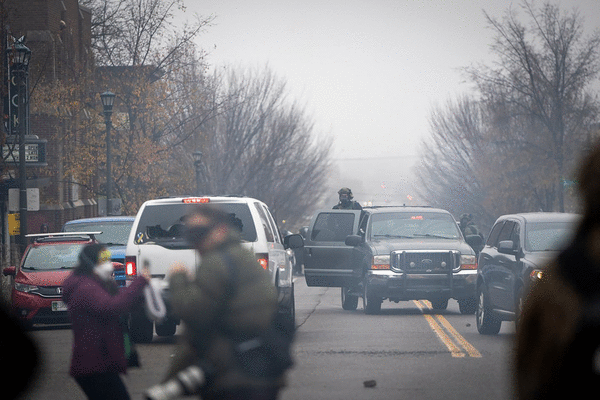
ST. PAUL, Minn. — Nearly six months after St. Paul police officers deployed less-lethal munitions and sprayed chemical irritants on a crowd of protesters and journalists, there is still no clarity around when the department’s review of the incident will be made public.
The chair of the police civilian review commission hopes for results this year, but the perceived slowness of the investigation has worried activists, who already question the sincerity of internal affairs investigations after more than a decade of scrutiny of police violence in Minnesota and around the country.
Many are also concerned about Mayor Kaohly Her’s approach to police accountability, particularly after she stated that she would not call for an external investigation until other inquiries are finished, including those by the state police standards board and the St. Paul Police’s internal affairs investigation and civilian review.
Erin Hayes, one of the co-chairs of the Police Civilian Internal Affairs Review Commission, urged patience. The review will take time, she said, but no one wants to see it delayed.
“Everybody — from community, through rank and file officers to command — they all want to see what this investigation shows," she said.
In a statement, the St. Paul Police Department said the review is nearing completion.
“Our department understands the community’s desire to see the results of this investigation, and we share that want. We are committed to this being a thorough and complete investigation and unfortunately, that takes time.”
The department’s statement said the review is time-consuming in large part because of how much video there is to review. With dozens of officers and hundreds of residents at the scene, the investigation includes hundreds of hours of video from many angles, along with written reports and complaints.
Chief Axel Henry has said all complaints will be submitted to the civilian board for review once the department’s internal investigation is done.
On Nov. 25, federal agents targeted a house on Rose Avenue, on St. Paul’s East Side, and protesters flocked to the scene.
This was before Operation Metro Surge officially began, but well after immigrant communities noticed an uptick in enforcement activities in the Twin Cities. A raid at a St. Paul factory the week prior had many on edge.
St. Paul officers were called to the scene by Homeland Security Investigations officers who claimed protesters were throwing rocks and bricks as they tried to arrest someone. Police sprayed chemical irritants and shot less-lethal projectiles into the crowd, leaving a cloud of gas hanging in the neighborhood and hospitalizing a Minnesota Public Radio journalist.
Even as Operation Metro Surge spread across Twin Cities, the Rose Avenue raid has remained a defining event of the surge in St. Paul.
Since since the raid and the police melee late last year, several emotional community meetings on the East Side have drawn hundreds of people concerned about officers’ actions.
For weeks this winter, people attended City Council meetings to talk about their disappointment in the police. Many said the Rose Avenue incident led them to conclude St. Paul Police were allied with federal agents, and said they hoped police would be held accountable for what activists saw as a disproportionate response to a protest.
The incident has already inspired the City Council to pass new ordinances requiring more training for city employees, including police, about the St. Paul law that generally prohibits city police from enforcing federal immigration law.
The scale of the Rose Avenue incident is unprecedented for the civilian review commission, Hayes said, in terms of the number of officers involved and the amount of evidence to review.
The St. Paul Police Department received 16 complaints about the affair, though not all the complaints resulted in investigations, and some people made complaints about multiple officers. More than 70 St. Paul officers were on the scene that day, according to the St. Paul Police Department.
The Internal Affairs unit consists of two investigators and a commander, Hayes said, charged with sifting through hundreds of hours of bodycam footage and witness’ accounts. Once the Internal Affairs review is done, the complaints will come before the civilian board.
“The cases do take a while to investigate, even when it’s not at this scale,” Hayes said. “It’s not uncommon for cases to take five months.”
The civilian board will review the investigation of the incident and recommend any discipline to Police Chief Axel Henry, who has the final say about whether any officers are disciplined.
This is one of two parallel investigations underway. The St. Paul Police Department’s internal affairs unit is also reviewing officer conduct to determine if any officers broke department policy.
Separately, the City Council ordered a review by the Minnesota Police Officer Standards and Training board, which will determine if any officers should lose their police licenses over their conduct.
It would fall to the Ramsey County attorney’s office to determine if officers’ use of force was criminal.
As long as those investigations remain open, police records of the raid including bodycam footage will not be released to the public.
Members of the public and members of the civilian review board have also asked about hiring an external investigator to review the police response.
In a letter to the commission, Her declined to appoint another investigator until other reviews are done.
“Hiring an independent investigator risks compromising the investigative process and any resulting discipline,” Her wrote. It can also complicate and increase labor and legal disputes, which could further jeopardize our shared goals of accountability and transparency.”
Her, who herself served as a member of the Police Civilian Internal Affairs Review Commission before her time in elected office, said she would be open to an outside investigator, but wanted to be careful to work around the various investigatory jurisdictions.
“If you are interested in working to develop a process around engaging an independent investigator in the future,” Her wrote, “I would welcome the opportunity to work with you all on how best to do so, in a way that fully considers and mitigates risk.”
_____
©2026 The Minnesota Star Tribune. Visit startribune.com. Distributed by Tribune Content Agency, LLC





Comments