Iran war truce fragile as US rejects Tehran's latest offer
Published in News & Features
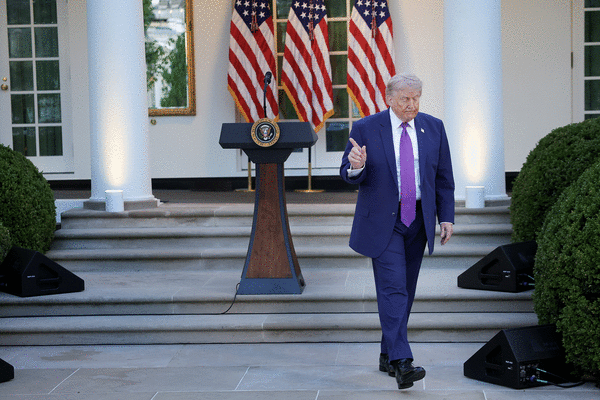
U.S. President Donald Trump is showing signs of frustration at a lack of progress in negotiations to end the 10-week war with Iran, as the Strait of Hormuz remains all but closed to vital energy supplies and oil prices continue to rise.
After rejecting Iran’s latest offer, Trump told reporters the response from Tehran was a “piece of garbage” and said the ceasefire was on “life support.” He fell short of threatening to resume military attacks, however, instead saying a diplomatic solution is “very possible.”
But Tehran has given no indication that it’s willing to back down or budge on some of its key demands, such as the lifting of the U.S. Navy’s blockade and sanctions relief, as well as maintaining a degree of control over traffic through the strait, according to a person familiar with the matter.
“The U.S. and Iran remain too far apart for a deal,” Bloomberg Economics’ Dina Esfandiary and Becca Wasser said. “If neither side is willing to make concessions, then a lasting peace deal will remain elusive, sporadic increases in intensity and protracted war the most likely scenario.”
The spokesman for the Iranian parliament’s commission for national security and foreign policy said the country is considering the option of raising uranium enrichment to 90%, if it’s attacked again, the semi-official Fars news agency reported. Any decision to enrich uranium to weapons-grade level would require the approval of the Islamic Republic’s top leadership.
Brent crude climbed 3% to trade above $107 a barrel on Tuesday, as the impasse prolongs the disruption of crude flows through the strait.
Trump’s comments came as he prepares to meet Chinese President Xi Jinping in Beijing on Thursday — a high-stakes meeting that he will enter under economic and political strain back home.
The president said Monday he’d seek a gasoline tax holiday to ease some of the burden on consumers, who’ve seen prices at the pump jump to seasonal records as a result of disruptions in international oil markets. It was unclear how much of the tax cut, which would cost the country billions of dollars a month, would effectively reach drivers.
The U.S. said it’s releasing additional barrels of oil from its strategic reserves to help tame surging prices. The U.S. Energy Department said 53.3 million barrels were awarded to companies including oil trader Trafigura Group and U.S. refiner Marathon Petroleum Corp.
The impact of the energy crisis is starting to show up in gauges of supply-chain stress that flashed red during the pandemic, adding to reasons for central banks to be on guard for an energy-driven wave of inflation. Bonds are under pressure, with the 10-year Treasury yield rising one basis point to about 4.42%.
Traffic through the Strait of Hormuz remains broadly halted, with sporadic attacks on tankers keeping shipowners wary of attempting to exit the Persian Gulf. Qatar is asking ships at its main liquefied natural gas export facility to turn off their transponders, according to people familiar with the matter, with one calling it a safety measure. A cargo ship was targeted by a drone in Qatari waters last week.
An oil supertanker that exited the gulf on Sunday hauling a cargo of Iraqi crude appears to have stopped shy of the U.S. blockade line and is now turning back into the Gulf of Oman.
The Wall Street Journal, citing anonymous sources, reported that the United Arab Emirates had carried out assaults on Iran last month. U.S. Ambassador to Israel Mike Huckabee said Tuesday Israel sent Iron Dome missile defense batteries to the UAE during the war, according to comments at a Tel Aviv University conference reported by Israel’s Channel 12.
Here’s more related to the war:
•The U.S. sanctioned a dozen entities and individuals over the sale of Iranian oil to China, stepping up economic pressure ahead of Trump’s visit. Treasury blacklisted 12 firms and individuals, including some based in Hong Kong, the United Arab Emirates and Oman.
•The conflict with Iran will be on Trump’s agenda when he meets Xi later this week. Revenue that China provides to Iran as well as potential weapons exports would be among the topics discussed at the summit, according to a U.S. official who briefed reporters over the weekend. They spoke on condition of anonymity due to the sensitive nature of the preparations.
--------
—With assistance from John Bowker.
©2026 Bloomberg L.P. Visit bloomberg.com. Distributed by Tribune Content Agency, LLC.






Comments