Lake Oroville, California's second-largest reservoir, is 99% full and rising
Published in News & Features
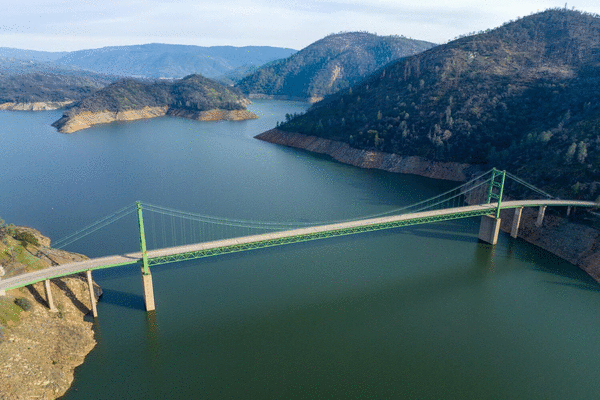
In a clear symbol that California is not facing water shortages or a drought this summer, Lake Oroville, the state’s second-largest reservoir and a key component of California’s water system, has nearly filled to the top.
The massive reservoir, contained behind America’s tallest dam, was 99% full on Tuesday afternoon, at 122% of its historical average for mid-May and still slowly rising, with just two feet to go to fill entirely.
“It’s great to have,” said Tracy Hinojosa, operations manager for the State Water Project, a huge network of reservoirs, canals and pumps operated by the state Department of Water Resources. “We’re very pleased we were able to capture what we could.”
The water from Oroville and the State Water Project is sent hundreds of miles to cities and farms across the state, serving 27 million people from San Jose to San Diego. When Oroville is full, it’s a good year for water supplies. When it’s low, water restrictions are a near certainty.
Not long ago, Oroville was in terrible shape.
In August 2022, at the tail end of a three-year drought, Lake Oroville was 22% full — the lowest point since the reservoir was constructed in 1968 during the administration of former Gov. Pat Brown, and so low that there wasn’t enough water to turn the electric turbines at the dam. Dramatic photos of the near-empty reservoir made national news, symbolizing California’s struggle with drought.
But three wet winters in a row followed. This winter was average. The result: A rare bounty.
This year is the fourth year in a row that Oroville has filled to capacity or near capacity. That has only happened twice before in its history — from 1995 to 1999 during famously soaking winters that caused widespread flooding across the state — and from 1971 to 1975 when it was first constructed.
“It’s noteworthy,” said Jeffrey Mount, a professor emeritus at UC Davis and senior fellow at the Public Policy Institute of California’s water center. “This is pretty impressive to have it full four years in a row. It is extremely unusual.”
Mount noted that part of the reason the lake filled this year was that it started the winter rainy season in October with more storage than in other years, due to the previous wet winters.
California received normal amounts of rainfall this winter. The 8-station Northern Sierra index, a key measure of precipitation at 8 watersheds in Northern California that fill many of the largest reservoirs in the state, on Tuesday was at 99% of average.
But because temperatures were warmer this winter — particularly during a record heat wave in March — much fell as rain, not snow. And much of the remaining snow has already melted. The statewide Sierra Nevada snowpack on Tuesday was just 14% of normal for that date.
The very low snowpack means that as Oroville and other massive reservoirs are slowly drawn down by cities and farms around the state, they won’t be topped up in the coming months by melting snow. So although this year is good news, experts say, another wet winter will be needed next year because by this fall, reservoir levels may be lower than normal.
Mount said many Californians may be starting to forget what severe droughts are like. Or what major flooding years bring. He recalled a famous line by John Steinbeck in his 1952 novel "East of Eden," about farmers in the Salinas Valley.
“It never failed that during the dry years the people forgot about the rich years,” Steinbeck wrote, “and during the wet years they lost all memory of the dry years. It was always that way.”
“That’s us,” Mount said with a chuckle. “That’s what we do. We’re in a wet period. It’s really great to take pressure off. Our hair hasn’t been on fire 24 hours a day because of water shortages. Now the Steinbeck effect is happening. The candidates for governor aren’t addressing water. We’ve had three wet years and one OK year in a row. Our disaster memory half-life is very short. Whether it is a flood or a drought, we forget very quickly.”
Oroville and Shasta are two of the state’s most prominent public works projects. Not as glamorous as the Golden Gate Bridge. But, in many ways, more important. Much of California, including San Jose, Los Angeles and Fresno, receives 13 inches of rain a year or less on average, the same as Casablanca, Morocco.
Without the huge systems of dams, pumps and canals to move water from the wetter northern areas to the central and southern parts of California, there would be no Silicon Valley, no Hollywood, no Central Valley agricultural powerhouse.
Oroville Dam is 770 feet high, taller than the Gateway Arch in St. Louis or the Washington Monument. The reservoir, holding back water from the Feather River, is 10 miles long, with 167 miles of shoreline. The reservoir holds 3.4 million acre-feet of water when full — nearly 10 times Hetch Hetch Reservoir, San Francisco’s main water supply; 21 times Los Vaqueros Reservoir in Contra Costa County, the East Bay’s largest; and 60 times Crystal Springs Reservoir along Interstate 280 on the Peninsula.
Over the past 25 years, Oroville has filled to the top or right near the top 12 times. Those were the wet years. In the dry years, it offered a symbol of shortage and aridity, its cracked mud shoreline looking like a giant bathtub ring.
Oroville made national news in 2017. That winter, the concrete spillway collapsed in one section during massive storms, prompting the evacuation of 188,000 people as water raged into the river below, and concerns grew that part of the dam might fail.
A $1 billion construction project rebuilt it and upgraded the dam a year later.
Hinojosa noted that state water managers worked with the Army Corps of Engineers this year to keep more water in the reservoir than normal in February when forecasts showed a stretch of dry weather. Often, dam operators release significant amounts to keep room to reduce floods. But increasingly, as technology improves, they are allowing more to remain stored if weather forecasts show no big storms are expected.
But overall, the good fortune in the past four years has come from lucky runs of winter weather, she noted, enough to break droughts but not enough to cause major flooding.
“We’ve had significant atmospheric river storms,” she said. “The storm door has been open. Those have been opportunities to capture more water. They have been really helpful.”
_____
©2026 MediaNews Group, Inc. Visit at mercurynews.com. Distributed by Tribune Content Agency, LLC.





Comments