Conflicting stories of sex, rape, power and shame presented to jury as Weinstein rape trial closes
Published in News & Features
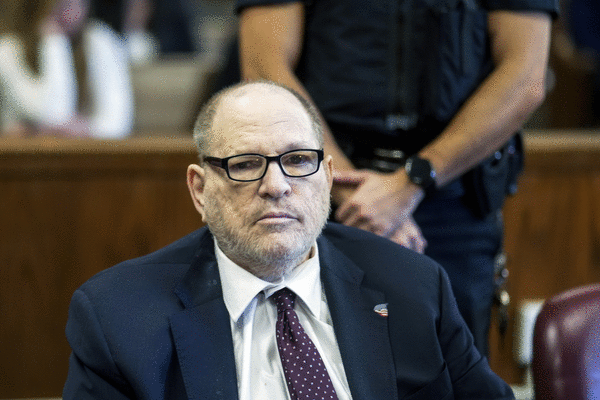
NEW YORK — Harvey Weinstein’s attorney on Tuesday said the woman at the center of his rape trial was either delusional or a liar, pulling pages from the defense playbooks of many a high-profile rape suspect in the #MeToo era.
Arguing Weinstein, 73, should be acquitted of third-degree rape, defense attorney Marc Agnifilo asked the jury to scrutinize why Jessica Mann didn’t cry out during the attack she alleged happened at the DoubleTree Hotel in Midtown on March 18, 2013, why she didn’t report it to the 17th Precinct and why she maintained a relationship with the once-prolific Hollywood kingmaker for years after the fact.
Delivered in his signature conversational cadence, Agnifilo posited that Mann was mentally unstable and had either misled herself or the court about an attack she couldn’t prove.
“She can’t, either because she’s lying,” Agnifilo said. “Or because she’s deluded herself, or because she’s deluding you.”
In the prosecution’s closing, Assistant District Attorney Nicole Blumberg raised themes that defined the #MeToo campaign triggered by Weinstein’s downfall, urging jurors to recognize how power imbalances and manipulation influence sexual abuse. She asked the panel to consider the little Mann had to gain.
“Jessica Mann has absolutely no motive to lie,” Blumberg said. “She has had absolutely no privacy from beginning to end of this process.”
The prosecutor said the panelists could not disregard the stark asymmetry of power that existed in 2013 between Weinstein — enormously wealthy and “one of the most influential producers of his generation” — and Mann, a victim of sexual assault raised in poverty on a Washington dairy farm, with no college degree or meaningful professional prospects.
The impressionable young woman saw “the genius in the defendant,” Blumberg said.
“He ran a multimillion dollar company. You saw all of the credits on IMDb. In fact, we’re asking you to take a look at all those things, because that’s part of the power and control he wielded, and that’s the part of him again she loved, the compassionate part, the supportive part,” Blumberg said.
“And the other side of Harvey Weinstein is what she saw inside of those hotel rooms when she said, ‘No, I don’t want to do this,’ and he did.”
The jury is expected to get the case Wednesday.
In closing, both sides sought to point to dozens of emails between Weinstein and Mann as proof of their positions; the disgraced filmmaker’s defense said they proved Mann was pursuing Weinstein and that he cared deeply for her.
The prosecution said the correspondence showed the opposite, a young woman being manipulated and walking on eggshells trying to navigate Weinstein’s larger-than-life ego.
“She missed the red flags, she missed the manipulation, the power, the control. She rationalized in her own mind the unwanted sex in the beginning,” Blumberg said. “She started to blame herself rather than the defendant.”
Agnifilo countered that Mann was the manipulator, accusing her of making up the assault to maintain a distorted self-image when an outpouring of allegations against Weinstein hit the headlines in late 2017.
Agnifilo said she had framed an innocent man who loved her out of fear people in her life would assume she’d slept with him to get ahead.
“She’s protecting herself at all costs, and she’s doing it every way available to her,” Agnifilo said. “I submit to you that what you’re seeing is someone that’s so invested in being seen a certain way that she’s willing to falsify the truth.”
During five days on the witness stand, her third time this decade providing an account of the DoubleTree encounter, Mann, 40, testified that she was visiting the city for the first time in March 2013 with friends and had made plans to have breakfast with them and Weinstein, the producer who’d taken a shine to her after they met at a party in Los Angeles several weeks prior.
She said Weinstein unexpectedly turned up early looking to get a room and got rough with her in the lobby as she pleaded with him not to, grabbing her arm to pull her aside and telling her to shut up. Once upstairs, Mann said her attempts to pacify Weinstein were made in vain, describing the scene as chaotic as a commandeering Weinstein blocked her exit and acted as though he couldn’t hear the words coming out of her mouth.
She said she remained in contact with Weinstein, who would come to resemble somewhat of a father figure, and didn’t tell anyone about the attack, feeling ashamed, riddled with confusion and at times blaming herself. In private writings shown to the jury, Mann grappled with her involvement with a married man. Weinstein’s then-wife, Georgina Chapman, was expecting their second child when they first met.
While Mann conceded to consenting to sexual encounters with Weinstein, she was adamant that the DoubleTree incident and an uncharged encounter in California happened against her will.
A jury credited her account when Weinstein first went on trial in Manhattan in early 2020 in convicting him of raping her in addition to assaulting former Project Runway assistant Miriam Haley.
New York’s Court of Appeals overturned the landmark conviction four years later in a decision finding the trial court judge shouldn’t have allowed testimony from separate women about incidents Weinstein wasn’t charged with.
Weinstein’s third New York trial, which has been sparsely attended, comes after a jury last year convicted him anew of sexually assaulting Haley but was unable to agree on whether he raped Mann.
Neither Mann nor Weinstein has anything to gain or lose from the verdict outside of what it will symbolize.
The charge only carries four years, more time than Weinstein has served. He’s yet to be sentenced for his 2025 conviction for sexual assault, which could result in a 25-year term, and he is less than halfway into a 16-year sentence for a separate rape conviction in California.
After last year’s partial mistrial, Mann had said she would “endure this as many times as it takes for justice and accountability to be served.”
Agnifilo asked the third jury to hear a case against Weinstein to discredit everything they heard from Mann and an expert clinical psychologist about the manifold ways trauma can manifest because she’d been paid for her time and opinion.
Blumberg said the testimony was critical in challenging “1950s attitudes” of how a rape victim should act.
“You know what, husbands rape wives, partners can rape each other, significant others can rape each other,” the prosecutor said. “‘No’ means ‘no’ to most people. You know who ‘no’ doesn’t mean no to? Harvey Weinstein. He’s a man who was never accustomed to having anyone say ‘no’ to him.”
Blumberg said multiple things could be true at once: that Mann loved Weinstein, that she made regrettable decisions, and that he raped her.
“You may think she didn’t make the best choices along the way,” Blumberg said. “But that doesn’t mean she deserved to be raped.”
_____
©2026 New York Daily News. Visit at nydailynews.com. Distributed by Tribune Content Agency, LLC.





Comments