Mayor Brandon Johnson decries further cuts to Chicago Public Schools in district's budget plan
Published in News & Features
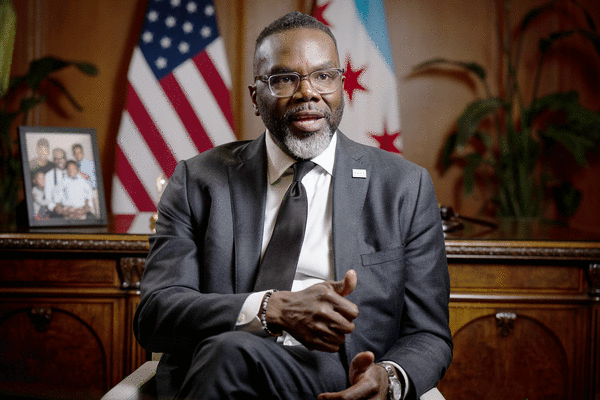
CHICAGO — Mayor Brandon Johnson on Thursday condemned further cuts to Chicago Public Schools following the district’s latest proposal to address a yawning budget deficit by eliminating teaching staff, arguing the fate of Black enrollment is at stake.
During an interview with the Tribune ahead of his three-year mark in office, the mayor responded to questions on planned cuts to teaching positions in the next school year by saying the nation’s fourth-largest school district needs to spend more, not less. Throughout the sit-down, Johnson also stuck to his talking points on Chicago needing more progressive taxation while continuing to refuse to say if he will run for a second term next year.
“You’re not going to be able to cut your way to success,” Johnson said. “Again, you have more white families in our public schools, but the loss of population has been Black students. That’s where the attacks have been. That’s where the cuts have gone. And I don’t believe that that’s the policy that we should continue to move forward on.”
Yet Johnson showed no inclination to try to lean on CPS CEO Macquline King, whom he appointed and who proposed the budget, or on the Chicago Board of Education, which he controls, to make changes to the plan. Instead, he hewed to his well-worn argument that Springfield needs to do more to fund Chicago schools, which is unlikely to happen.
Black students now make up roughly a third of the district, down from 39% a decade ago. The share of white enrollment has increased from 10% to 12% over the same period, while the percentage of Latino and Asian enrollment has remained relatively steady.
CPS officials released school-level budgets to principals earlier this week, likely increasing class sizes by raising the student-to-teacher ratio it uses to allocate funding by one student. Cuts would be capped at six staff positions per high school and four per elementary school — an outcome that Chicago Teachers Union President Stacy Davis Gates said would be “dead on arrival.”
Johnson, for his part, stressed “the only group that continues to fall are Black students” as it pertains to enrollment and that the time is now for Springfield to cough up more CPS funding.
But the state is also cash-strapped, and Illinois Democrats last month failed to advance a so-called millionaires tax resolution that could have channeled hundreds of millions to CPS. Absent that, the district’s projected $732.5 million shortfall will likely require belt-tightening and other budget maneuvers — even if the city gins up more than the $100 million in TIF surplus funding the district is projecting for this year.
Johnson also addressed concerns within the Chicago Department of Public Health over his commissioner, Dr. Olusimbo Ige, returning tens of millions of dollars in COVID-19 grants to the federal government months before expiration by announcing a forthcoming internal review.
The Tribune reported this week that Ige terminated staffers during the last budget cycle and ended programs under federal grants that were not set to expire until this summer. Johnson did not say whether Ige still had his full confidence but indicated his team would crack down on similar personnel decisions across city departments in the future.
“These department heads have autonomy over their particular division of labor,” Johnson said. “I think that there’s a way in which we can review that process, to strengthen it, so that decisions like that are not made in isolation.”
Meanwhile, Johnson remained noncommittal on interim CTA President Nora Leerhsen’s prospects of nabbing the permanent post before the mayor’s control over the transit agency expires this year. A new state law that shifts some CTA oversight authority away from the mayor takes effect June 1.
“Perhaps there are names and resumes that have not made it to my desk, (and) that if and when that happens, I’m going to look at it closely,” Johnson said when asked if the next CTA leader is already being vetted by his administration.
Discussing the City Council, Johnson argued time has shown that aldermen budgeted irresponsibly when they passed a 2026 city spending plan over his objections, but he did not say whether the moves they passed that he opposed will lead to layoffs.
The mayor singled out the plan backed by aldermen to sell debt owed by Chicagoans to the city for $90 million as “a poor way to balance the budget” and said its revenues so far are falling below budget.
According to data shared by Johnson’s administration, the city’s actual revenues are only slightly trailing projections in its $16.6 billion spending package. The city has brought in just over $3 million less than expected this year, preliminary figures through March show.
The city’s monthly revenue reports through the end of March show the sale of city debt has not brought in any money. Advertising revenue and money from licensing city property for augmented reality — two other budget proposals from aldermen — similarly had no reflected returns. Top Johnson budget officials said in a recent presentation that the administration is reworking proposals for both measures.
Those losses dragged down year-to-date revenues for fines, forfeitures and penalties to 18.6% below projections and leases, rentals and sale 68% below projections, revenue reports show.
“We could potentially have to deal with loss,” he said. “What we are expecting is what we projected, that if we do not meet those revenue projections, we will have to make hard decisions.”
Johnson did not rule out another go at the head tax in the fourth — and final — budget of this term and promised to continue proposing budgetary “measures that respond to the structural damage I inherited.”
“That includes challenging corporations to put more skin in the game. I think it’s only fair,” he said. “We should be protecting working people, and those are the measures that I will continue to lead on.”
Johnson pinned his failure last fall to pass a head tax on lobbying by “a small group of hyperwealthy individuals,” adding that the result was a product of the seeing the “City Council acquiesce to the interest of corporations.”
But aldermen were still on board with the majority of his proposals, including increases to several taxes that pull money from wealthy corporations, he said, while touting gains in public safety and a recent report indicating the city’s population is slightly growing.
“Let’s not act like there’s a complete repudiation of my agenda,” he said. “The results speak for themselves, right?”
Even as the mayor pledged to charge ahead in his tax-the-rich efforts — a tall task in an election year for both him and a City Council that’s often at odds with him — he continued to keep his cards close to his chest as it pertained to his political future. He also avoided opining on the fate of the formidable progressive coalition that ushered him into office three years ago.
Johnson did not dispute the current prognosis in the labor world that CTU and Service Employees International Union Local 73, his two biggest backers in 2023, were unlikely to make up. But he stressed, “What I can control as mayor is to make sure I’m showing up for workers, and we’ve done that.”
And the freshman mayor also took the high road when asked about his rumored contenders in 2027, should he choose to run, and focused on branding himself as the champion of the working class.
“Look, when the politics of reelection come up, we’ll confront that,” the mayor said. “Here’s what I represent: I represent the interest of working people, the hopes and dreams of families who have long to see a city that invests in everyday people. And that’s exactly what I’m doing.”
--------
—The Tribune’s Kate Armanini and A.D. Quig contributed.
____
©2026 Chicago Tribune. Visit at chicagotribune.com. Distributed by Tribune Content Agency, LLC.






Comments