How Keir Starmer imploded and plunged Britain into more chaos
Published in News & Features
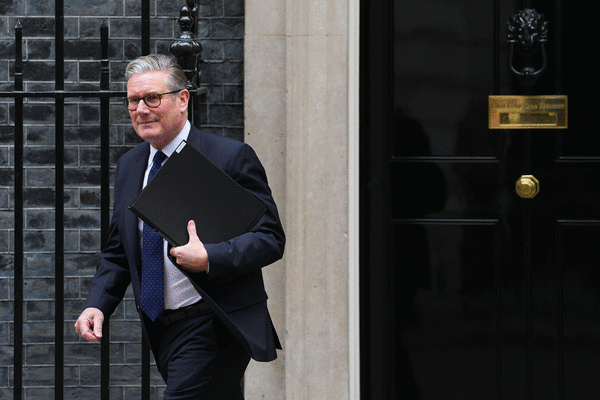
LONDON — Keir Starmer acknowledged the stakes if he and his Labour Party failed, in his first words as prime minister. Nodding to the political chaos that had gripped Britain in recent years, the former prosecutor pledged to end the “era of noisy performance” that was draining away people’s belief in a better future.
“One of the great strengths of this nation has always been our ability to navigate a way through to calmer waters,” Starmer told flag-waving activists outside No. 10 Downing St.’s glossy black door on July 5, 2024. “And yet this depends upon politicians, particularly those who stand for stability and moderation — as I do — recognizing when we must change course.”
Those words are now reverberating back on Starmer and the more than 400 Labour faithful he led to electoral victory in every corner of the country. Less than two years later, Starmer, weakened by personnel scandals, fiscal struggles and dismal election results, is facing calls from more than one-fifth of his party to go.
The biggest blow came three weeks ago. One of Starmer’s longest supporters in Westminster, the Energy Secretary Ed Miliband, called the prime minister, urging him to set a timetable to leave office. Starmer refused, arguing his departure would hand power to the populist architect of Brexit, Nigel Farage, according to people familiar with the conversation.
But the prime minister’s sense of betrayal, in learning that his earliest friend in Westminster was leading the effort to push him out, only compounded the crisis for the government. Britain is facing the prospect of a divisive and drawn out leadership battle to install what would be its seventh prime minister in a decade.
Far from reaffirming people’s faith in public service, Starmer’s historic collapse is raising questions about whether Britain has become ungovernable. The principal change promised by Labour — a turn away from the turmoil under the Conservatives that led to Brexit and the so-called mini-budget crisis — rings increasingly hollow.
Meanwhile, the investor confidence Starmer and his chancellor of the Exchequer, Rachel Reeves, have tried so hard to rebuild over the past 22 months has rapidly dissipated because of fears they could be swept aside by a more left-wing government that doesn’t accept how stretched the public finances are.
Starmer’s chief rival for the job, Greater Manchester Mayor Andy Burnham, has complained about the British government being “in hock” to the bond market, a remark he said was a critique of the political system rather than investors.
The uncertainty has prompted a steep selloff in the pound and U.K. government bonds, a third of which are held by overseas investors, as traders seek safer harbors. The yield on 30-year gilts, which is more sensitive to fiscal and political risks than shorter notes, rose above 5.8%, the highest level in almost three decades.
Some investors are now anticipating gilt yields above 6%, a level that could push Britain into recession and fiscal distress. Lurking in the background are the so-called bond vigilantes, who have repeatedly shown their willingness over the years to punish Britain for loose fiscal policy.
John Sidawi, senior portfolio manager at Federated Hermes, said that even from his base in Pittsburgh, Pennsylvania, the U.K.’s politics constantly command his attention. Sidawi pared back his investments in U.K. debt in February and said there’s little incentive to plunge back in.
“When political instability is tied to fiscal uncertainty, the value argument for the U.K. falls apart,” Sidawi said. “It opens the door to another bond vigilante run.”
This is the story of how Starmer led Labour from triumph to turmoil. It is based on interviews with dozens of ministers, lawmakers and political aides. They spoke to Bloomberg on condition of anonymity to discuss the details of internal government disputes.
The cheering crowds had hardly left Downing Street’s rain-soaked pavement in July 2024, when Starmer’s ministers — many in government for the first time — began to accept a gloomier narrative. In the row of 17th century houses that contain the center of British government, they discovered they hadn’t done enough in their long years in opposition to prepare for the task at hand and had far less money than they needed.
Reeves, a former Bank of England economist and junior chess prodigy, sat down with the Treasury only to be given the bombshell news that her Conservative predecessors had left the public finances in an even more parlous state than she had thought. She went public to warn of a £22 billion “black hole” in the budget. Starmer followed up a few weeks later with a similarly bleak message in the rose garden behind No. 10.
Their solution was to slash a popular subsidy on winter heating bills and signal tougher decisions were coming in Reeves’ first budget. Business confidence immediately plunged. Members of Parliament began to field complaints from pensioners furious that their heating expenses were soon to rise.
One former aide acknowledged that Reeves’ doom-laden rhetoric immediately wiped out any optimism that the public felt toward the new government. When the history of the Starmer administration is written, it is Reeves who will come off worst, a senior figure on the left of the party said, characterizing her as out of her depth.
Reeves has repeatedly defended the “tough decisions” she has made, blaming the fiscal situation she inherited. She told the BBC after the heating subsidy was abandoned last year that she did “understand the concerns that people have.”
Starmer, Reeves and other top ministers were buffeted early on by a wave of revelations that they had accepted clothing, concert tickets and other benefits from wealthy benefactors. While they apologized and agreed to curb the freebies, the episode reinforced impressions that Labour was no different from the scandal-plagued Tory government under Boris Johnson.
The atmosphere outside Westminster was even worse in the first weeks of the administration, as the killing of three girls in northwest England prompted a wave of unrest at hotels housing asylum-seekers. The sometimes-violent incidents were fanned online by hard-right agitators and billionaire Elon Musk predicted on his X social media platform that “Civil war is inevitable.”
Reeves’ first budget in October 2024 brought £40 billion of tax rises, focused on businesses, leading to widespread complaints that she was departing from her election pledge to prioritize economic growth. The tax increases have been blamed for helping push unemployment to a four-year high, with youth joblessness at almost 16%.
Behind the scenes, infighting had broken out between Starmer’s top lieutenants, including his chief of staff Sue Gray and top political adviser Morgan McSweeney. It had became clear that the plans needed to enact long-overdue overhauls of the courts, the prisons, the welfare system and the defense industrial complex and National Health Service were far from ready.
Gray, a veteran civil servant who had overseen inquiries into Downing Street parties during COVID-19 lockdowns, was the subject of a steady flow of critical stories citing anonymous Downing Street officials blaming her for the inaction. Just three months into the job, Starmer removed Gray and replaced her with McSweeney, whose efforts to limit the influence of Labour’s left-wing made him a subject of controversy in the party.
As Starmer’s domestic challenges piled up, events unfolded across the Atlantic that drew his attention abroad. Donald Trump’s election to a second term as U.S. president ensured havoc as he roiled the globe with tariffs, pulled back U.S. support for Ukraine in the war with Russia and threatened the collapse of the North Atlantic Treaty Organization.
The U.K., reliant on its so-called “special relationship” with America in particular for its defense and security, was especially exposed to the breakdown of the transatlantic alliance. Starmer adopted a strategy of flattery, shrugging off his past attacks on the president in an attempt to hold the billionaire Republican close and prevent a rupture in relations.
His approach at times appeared servile and was uncomfortable for many in Labour, still scarred from Tony Blair’s support for George W. Bush’s war in Iraq. While Starmer’s allies insist it helped prevent a worst-case scenario on Trump’s policy toward Russia, NATO and his designs on Greenland, it reached its limits when Starmer refused to support the president’s war with Iran, badly damaging their personal relationship.
A person close to Starmer blamed Trump as singularly responsible for the failure of his premiership. They said from the moment Trump was elected, the international crises that followed meant it was impossible for the prime minister to focus on the domestic priorities of voters.
No British leader had confronted a global security situation as dangerous as the one caused by Trump in decades, they said, arguing that if the Democrats had won the election the story of Starmer’s time in office would have been completely different.
Trump’s victory also led Starmer to make what he privately views to be his worst ever mistake. Rather than appointing a career diplomat as his ambassador to Washington, the premier appointed Peter Mandelson, a notorious figure from the Tony Blair era nicknamed the “Prince of Darkness” for his penchant for scandal and political machinations. The idea was that Mandelson’s skill-set would endear him to Trump-world.
Instead, a Bloomberg News investigation revealed the extent of his links to disgraced financier Jeffrey Epstein and set off a series of events that were integral to Starmer’s plight. The prime minister sacked Mandelson following the revelations, only for more details to emerge during the release of the Epstein Files which forced the resignation of McSweeney and sparked police and parliamentary inquiries, further destabilizing the government and imperiling Starmer’s position.
The Mandelson scandal deepened a factional divide that had already broken out between the right and left wings of the Labour Party, as it has so often in the party’s history.
In early 2025, confronted with a soaring welfare budget and productivity crisis, Reeves had sought to reform a key benefit payment given to disabled people with the aim of saving some £5.5 billion and curbing what she saw as an unsustainable rise in spending.
The chancellor did so with the bond market in mind. Despite the Bank of England cutting interest rates, the risk premium in gilts had risen since Labour entered office. That kept bond yields elevated, limiting Reeves’ fiscal room-for-maneuver and leaving her headroom against her budgetary rules vulnerable to the whims of investors.
Yet for left-wing Labour MPs who entered politics to protect the vulnerable, it went against everything they stood for. A rebellion grew as lawmakers warned they could not stomach measures they said would plunge thousands of people into poverty. For that wing of the party, the proposed cuts also spoke to their growing criticisms of Starmer as a leader: that he had no positive vision for the country and no policies bold enough to deliver the “change” Labour had promised.
By the summer, Starmer and Reeves were trapped, stuck between Labour rebels and the bond market. Politics prevailed and they were forced to climb down, canceling the cuts as well as a series of other unpopular revenue-raising policies, only adding to investors’ nerves. At the time, a person close to Starmer despaired that Labour had “a hundred Liz Trusses” on its backbenches, pushing the government into an ever-riskier fiscal space.
“Recent experience has shown investors that a big parliamentary majority no longer guarantees stability and, as a result, they are demanding a premium,” said Dan Hanson, chief U.K. economist with Bloomberg Economics. “With the electorate increasingly fragmented, the big risk is that future governments find that they lack the political capital needed to take the tough decisions that will have to be taken to keep the public finances on a sustainable path.”
One of the prime minister’s closest supporters said that capitulation on welfare was the beginning of the end of his premiership, arguing it sent a signal to Labour’s so-called soft-left faction that they had the numbers to push the premier in their direction and, if he refused, to force him out. Reeves’ subsequent appearance in the House of Commons in tears prompted investors to sell off, concerned she wasn’t long for the job.
Starmer and Reeves hung on. But from that moment, the prime minister was in office, but out of power, the supporter said.
Starmer nevertheless attempted a reshuffle in September, hoping for a reset. Some allies urged him then to fire Miliband, the energy secretary, and Health Secretary Wes Streeting, whom the prime minister already suspected of plotting against him. Starmer declined, fearing instability in the party, the person said.
By April of this year, fresh revelations about Starmer’s appointment of Mandelson had once again rocked faith in the PM’s judgment. The US-Israeli war in Iran has rekindled fears of inflation and dashed the government’s hopes of an economic rebound.
Local elections were looming that would see Labour lose some 1,500 council seats and surrender for the first time control of the Welsh parliament. The chief beneficiaries were Farage’s Reform, the left-wing Greens and pro-independence parties in Scotland and Wales. Some in the governing party decided it was time to lead the prime minister toward the exit.
Miliband took the lead. The former Labour leader, who had played an instrumental role in the prime minister’s decision to enter politics, urged him to set a timetable for an “orderly transition.” The call confirmed Miliband’s return as a power broker in Labour more than a decade after leading the party to defeat in the 2015 election.
A spokesperson for Miliband declined to comment.
In recent weeks, he emerged as a key advocate for allowing Burnham, the Greater Manchester mayor, back into Parliament and poised to seek Starmer’s job. An ally of the prime minister compared it with Miliband’s decision to stand against and defeat his own brother, David, for the Labour leadership in 2010.
Concerned that Labour’s left-wing was rallying behind Burnham, Streeting laid the ground for his own run for the leadership. He quit the cabinet on Thursday, saying it was “now clear” that Starmer wouldn’t lead Labour into the next election, due in 2029. He backed Burnham’s return to Parliament, but could yet challenge him for the leadership.
While allies of the prime minister complain of betrayal, Starmer has nonetheless inched toward accepting Miliband’s plan. On Friday, a key Labour panel cleared Burnham to run for the seat.
Allies of Miliband, Burnham and Streeting said their actions were motivated by a desire to give their party the best chance of defeating Farage. Still, one Starmer ally expressed disbelief that Labour politicians were riven by factionalism like the Tories after only a fraction of the time in power.
If Burnham succeeds in winning back local voters from Reform, he will be the clear front-runner to replace Starmer. Supporters of Burnham believe he will be named the new premier in time for Labour’s annual conference in September.
That prospect weighed on investors on Friday. The yield on 10-year gilts jumped 18 basis points to 5.17%, the highest since 2008, with global concerns about high energy costs and inflation also driving the move. Burnham’s announcement that he intends to run for Parliament put the pound on track for its worst week since 2024 against the dollar.
Burnham’s supporters hope a handover will be orderly. Recent experience of British politics suggests the chances of that are slim.
(Julian Harris, Alice Gledhill and Georgia Hall contributed to this report.)
©2026 Bloomberg L.P. Visit bloomberg.com. Distributed by Tribune Content Agency, LLC.






Comments