Minnesota Legislature had a 'productive' session in year it didn't have to
Published in News & Features
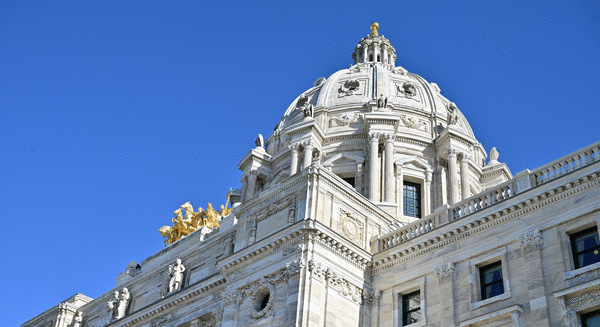
ST. PAUL, Minn. — Minnesota lawmakers worked until the midnight deadline Sunday and successfully passed a series of bills that made up a bipartisan end-of-session agreement.
Democratic-Farmer-Labor and Republican leaders were pleased with many of the measures that passed, including a bailout for Hennepin County Medical Center, $125 million in property tax relief and a $1.2 billion bonding bill. New measures to combat fraud in government programs also enjoyed bipartisan support.
Republicans were able to get many of their priorities passed in this year’s session — including a Senate GOP-backed $254 million cut to vehicle tab fees for next year. And they got school safety and mental health bills passed while blocking DFL gun control proposals in the House.
“Minnesota Senate Republicans used what little leverage that we had in the minority to achieve big things for the state,” Senate Minority Leader Mark Johnson said after adjournment early Monday morning. “We’re very proud of that, and we’re going to be moving forward into this November.”
Narrow margins in both chambers
For the last two sessions, the Senate has had a one-seat DFL majority and the House has been tied 67-67 between the parties. Technically, the Legislature didn’t have to pass any bills this year as members finalized a two-year budget in 2025.
Legislative leaders of both parties praised their productivity and the generally cooperative atmosphere.
It isn’t always like that, noted House DFL Leader Zack Stephenson, recalling the chaotic end to the 2024 session or when an end-of-session deal collapsed in 2022 — another time government was divided and a gubernatorial election was later in the year.
“We just had an incredibly productive session at a time when I think, walking in, most people were not optimistic about that,” he said after adjournment early Monday morning.
Still, Democrats said Minnesotans frustrated with no action on gun control or to address the impacts of the Trump administration’s winter immigration crackdown would want to see a return to one-party control next year.
“This power-sharing agreement prevented some really important work from being done,” Stephenson later said. “So, it’s my intention to ask Minnesota voters to give us a majority, so we can get that work done, because it’s just too important to continue to wait — most dramatically around guns and Operation Metro Surge.”
Guns, ICE
This year’s end-of-session deal held together despite many Democrats’ frustration with gun and immigration bills.
DFLers spent the last week of this year’s session pushing for gun control measures, which saw renewed interest in the wake of the deadly shooting at the Annunciation Catholic School church in Minneapolis last August.
That shooting came after the June assassination of former DFL House Speaker Melissa Hortman and her husband, Mark, at their home in Brooklyn Park, as well as the shootings of DFL state Sen. John Hoffman and his wife, Yvette, at their home in Champlin.
Lawmakers passed $52 million to fund new protections for elected officials this year and another $12.5 million for school safety and mental health services. But House Republicans stopped the DFL push for a ban on semi-automatic rifles with pistol grips and detachable magazines and limits on magazine capacities.
“I am deeply disappointed,” said Senate Majority Leader Erin Murphy, DFL-St. Paul. “We have seen the reckless shootings, an assassination, a church killing of children, a killing by federal agents … we need to do more on this front.”
Democrats tried to enact similar legislation when they controlled both chambers of the Legislature, but their own members in the state senate stood in the way. That changed this year with the last hold-out, Sen. Grant Hauschild, DFL-Hermantown, siding with the rest of his caucus in a ban on so-called assault weapons on May 4.
What followed was a “sit-in” in the House chamber late last week by DFL lawmakers advocating for new gun control after an unsuccessful push to suspend House rules to force a vote on the actual bill — something they had already tried earlier in the session.
DFL lawmakers also attempted to suspend rules and hold a vote on a bill to address the impacts of the Trump administration’s winter immigration crackdown in Minnesota.
The package, which passed the Senate on May 11, would create new restrictions on federal immigration agents, including a ban on face coverings and new options for residents to sue federal agents for violating their rights. DFLers also sought a $100 million business recovery loan program.
Republicans rejected the push minutes before the midnight deadline, drawing criticism from DFL colleagues in both chambers.
The deal
Minnesota Gov. Tim Walz, a DFLer, House Speaker Lisa Demuth, R-Cold Spring, Stephenson, and Senate Majority Leader Erin Murphy, DFL-St. Paul, reached a supplemental budget deal for the end of the session on Wednesday last week.
Here are some of the bigger pieces they enacted include:
• $205 million for Hennepin County Medical Center this year, plus $500 million in hospital relief through 2031 to prevent the top trauma hospital from closing.
• $125 million in property tax aid to boost the homestead property tax refund by 14.88%, a move that will affect 600,000 taxpayers, according to sponsors.
• $254 million cut for vehicle registration fees in 2027. An owner of a $50,000 vehicle would see a roughly $145 decrease in their tab fees, according to Senate Republicans.
• $39 million for fraud prevention efforts, including the soon-to-be-created Office of Inspector General.
• $1.2 billion for state infrastructure projects with a heavy emphasis on water treatment. About $420 million is for water projects. St. Paul’s Roy Wilkins Auditorium and Grand Casino Arena are expected to get $50 million.
• $90 million for government technology modernization.
• $52 million for safety measures for elected officials.
Of particular urgency for the Legislature this session was the bailout for HCMC, which expects to lose around $50 million this year and could face a $1.7 billion deficit in the next decade from Medicaid cuts passed by Republicans in Congress.
The Legislature is scheduled to reconvene next January following this year’s elections.
_________
©2026 MediaNews Group, Inc. Visit at twincities.com. Distributed by Tribune Content Agency, LLC.






Comments