Top Pakistan mediator in Iran amid hints of progress in peace talks
Published in News & Features
WASHINGTON — Pakistan’s army chief, the favored interlocutor between Washington and Tehran, arrived in the Iranian capital amid signals of progress in talks to end the war.
Field Marshal Asim Munir landed late Friday in Tehran, where he was welcomed by Iranian Interior Minister Eskandar Momeni, according to the military’s press wing. He’s there for discussions that will cover U.S.-Iran negotiations and peace in the region, a Pakistani security official familiar with the matter told reporters, asking not to be identified because the information isn’t public.
Pakistan has been shuttling between the two sides, seeking a compromise to advance the ceasefire agreed on April 8 and end the blockage in Gulf energy flows that’s threatening to upend the world economy. The war began when the United States and Israel attacked Iran at the end of February.
Iran’s Foreign Minister Abbas Araghchi held talks with Pakistan’s interior minister Mohsin Naqvi on Friday, the semi-official Iranian Students’ News Agency reported. Tehran is considering the latest proposal submitted by the U.S. through Pakistan, but has given no indication yet of when it will formally respond.
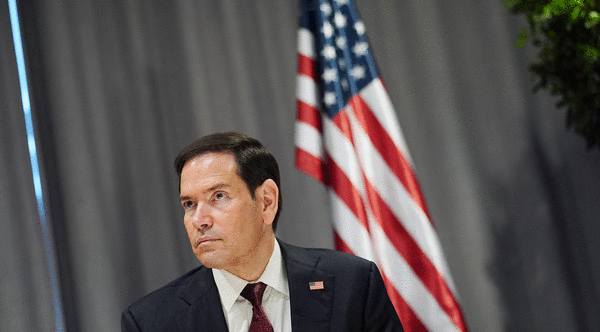
U.S. Secretary of State Marco Rubio said Friday there was “slight progress” in negotiations with Iran. “I don’t want to exaggerate it, but there’s been a little bit of movement, and that’s good,” he said at a meeting of NATO foreign ministers in Sweden.
President Donald Trump told reporters at the White House later Friday that Iran is “dying to make a deal.” The president has threatened further attacks on the Islamic Republic if it won’t agree terms acceptable to the U.S., though he’s also repeatedly pushed back his own deadlines for resuming the war.
Oil prices pared gains on expectations for an agreement that would normalize access to Persian Gulf exports. Brent crude traded slightly over $103 a barrel, up less than 1%. The S&P 500 is on track for an eighth consecutive week of gains.
Hopes of a breakthrough were also boosted Friday by the arrival of a Qatari negotiating team in Tehran. They’re working in coordination with the U.S. to pursue an agreement, according a person familiar with the matter.
Other Gulf Arab states, which fear retaliation from Iran if the U.S. and Israel attack again, are also backing a diplomatic resolution. The United Arab Emirates has made a more concerted push in recent days, joining Saudi Arabia and Qatar in urging Trump to give negotiations a chance, according to several people familiar with the matter.
The status of the Strait of Hormuz, a crucial conduit for global energy supplies, and Iran’s nuclear program have been major sticking points in the diplomacy.
Iran’s ambassador to France, Mohammad Amin-Nejad, told Bloomberg on Wednesday his country is discussing with Oman some form of permanent toll system in the strait, which the U.S. says is unacceptable.
Rubio said it would set a precedent for other areas of the world and that no country should accept the imposition of tolls in Hormuz.
Outside of Hormuz, the U.S. has repeatedly demanded Tehran hand over its enriched uranium and commit to ending enrichment for at least a decade. Iranian leaders have publicly rejected that, citing a right to enrich under international agreements.
Here’s more related to the Iran war:
—Japan, one of Asia’s largest importers of energy from the Middle East, flagged the impending arrival of its first oil shipment from the Persian Gulf since the war began.
—Iran claimed 35 ships crossed Hormuz in the past day after obtaining permission, ISNA reports citing an IRGC statement.
—Iran has destroyed more than two dozen MQ-9 Reaper drones operated by U.S. forces since the war began, according to a person with direct knowledge of the matter. That represents 20% of the Pentagon’s prewar inventory for the hard-to-replace unmanned system.
—House Republican leaders in the U.S. abruptly canceled a vote on the Iran war as GOP absences threatened an embarrassing defeat for Trump.
—Iraq formed a high-level committee to investigate drone attacks on the UAE and Saudi Arabia, including one that caused a fire outside the Barakah nuclear power plant, west of Abu Dhabi.
--------
(With assistance from Jeff Mason, Tooba Khan and Fiona MacDonald.)
©2026 Bloomberg L.P. Visit bloomberg.com. Distributed by Tribune Content Agency, LLC.





Comments