Warsh's Fed 'regime change' may require patience, consensus
Published in News & Features
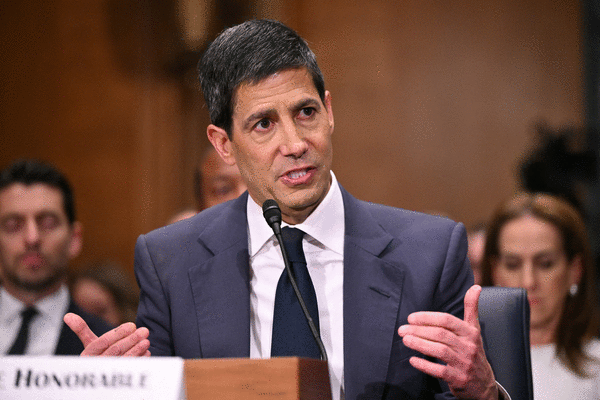
Kevin Warsh has vowed to usher in “regime change” as the new chair of the Federal Reserve, but Fed watchers say there are limits to how much he can revamp on his own — and that even in areas where he can make sweeping reform, it might be smarter for him to hold back.
On the most pivotal decisions, like ushering in changes to interest rates or the Fed’s $6.7 trillion balance sheet, Warsh would need the Federal Open Market Committee’s backing. And while the Fed chair does have full discretion over some issues, like the frequency of his press conferences, fellow officials typically provide input before big revisions are made to other key aspects of the central bank’s communications and policy making.
Should Warsh choose to buck that convention by pushing through major changes without broad support, he could find himself with few allies and diminished leverage when it really matters, former Fed staffers say.
“One of his primary things he’s going to be doing is presumably trying to build a consensus, when appropriate, to lower interest rates,” said Jon Faust, who previously worked as an adviser to former chairs Jerome Powell, Janet Yellen and Ben Bernanke.
“If that’s a top priority, then he won’t want to go out of his way to alienate the FOMC,” Faust added. “He’ll have an incentive to curry goodwill as much as possible.”
Interest rates
President Donald Trump has made it no secret that he expects Warsh to lower rates. Warsh has vowed to keep monetary policy independent from politics, but if he does want to push rate cuts, he’ll have to convince the majority of the 11 other voters on the FOMC.
Right now, that looks like a tall task.
With inflation accelerating amid the U.S.-Israeli war with Iran and the labor market showing signs of stabilization, policymakers are comfortable keeping rates on hold. Some are even pushing for the Fed to signal its next move is just as likely to be a rate hike as a reduction.
Balance sheet
Warsh has long been an advocate for shrinking the Fed’s asset portfolio. But any plan to trim its holdings would need to be implemented slowly to avoid market disruptions. And as with interest-rate decisions, changes to balance sheet policy require the FOMC’s approval.
The Fed stopped its latest round of balance-sheet reduction in December and has been purchasing Treasury bills to ensure there is enough liquidity to keep short-term funding markets functioning smoothly. To start reducing holdings again, the FOMC would need to direct Fed staff to research various strategies. Officials would then discuss their options and vote on an approach.
The Fed may also need to coordinate with other regulators to change some of the rules that affect how much banks hold in reserves with the Fed. Lowering banks’ demand for reserves would allow the Fed to shrink its balance sheet further.
Forward guidance
The incoming Fed chief told senators during his confirmation hearing that the central bank’s communications with the public and investors need “big changes.” He thinks officials shouldn’t be offering so-called forward guidance that signals where policy is heading and, in his view, locks them into a pre-set path.
It’s unclear whether Warsh, on his own, could eliminate or scale back the quarterly Summary of Economic Projections, a key Fed communications tool that shows policymakers’ forecasts for economic growth, unemployment and inflation. A Fed spokesperson didn’t immediately respond to a question on the topic.
When Chair Ben Bernanke introduced the SEPs in 2007, he sought consensus from other Fed officials, according to David Wilcox, a former head of the Fed’s Division of Research and Statistics who is now director of U.S. economic research at Bloomberg Economics.
“There was absolutely nobody on the committee who could say their views hadn’t been heard and carefully considered,” he said. The Fed added officials’ projections for the appropriate path of the federal funds rate, released in a chart informally known as the “dot plot,” to the document in 2012, also after extensive internal discussions.
And as the April Fed gathering showed, officials can vote against the post-meeting statement based on the guidance it contains if it doesn’t represent their views, leaving it to the Fed chair to forge consensus when possible.
“There's an opportunity to be the voice of calm, and I don’t think tearing up the Fed and having five dissents on wording is the way he’s going to want to do that,” said David Wessel, director of the Hutchins Center on Fiscal and Monetary Policy at the Brookings Institution in Washington.
Press conferences
As Fed chair, Warsh can choose how frequently he holds press conferences, how often he speaks publicly and what he says. But he would have no control over how often others on the Fed board or the regional Fed presidents speak. Reducing the frequency of press conferences could also confuse investors about the Fed’s plans and ignite volatility in financial markets, analysts have said.
Plus, there are reasons why Warsh might want to retain the advantage of being the first official to speak after each policy meeting. Giving that up could mean ceding control of the narrative to others, said Faust.
Inflation metrics
Warsh said during his confirmation hearing last month the data being used to measure inflation is “imperfect.”
The Fed’s 2% inflation target, formally adopted in 2012, is based on the personal consumption expenditures price index. That measure rose 3.5% in the 12 months ending in March.
Warsh has said he prefers to look at “trimmed averages,” measures that remove outliers in price figures to give a better sense of where the trend is headed. One such measure from the Dallas Fed showed inflation was 2.4% in the year through March.
The FOMC would need to vote on any tweaks to the formal inflation target. As chair, Warsh could request that Fed economists put more emphasis on trimmed-mean figures when analyzing inflation. But former Fed staffers say policymakers already look at the measures, and it would be challenging for Warsh to cherry-pick the wide array of data that economists and officials review.
Plus, individual inflation metrics can be misleading at times, said Faust. Powell pointed to trimmed mean inflation during his Jackson Hole speech in August 2021 that explained why he thought the rise in inflation would be “transitory.”
_____
©2026 Bloomberg L.P. Visit bloomberg.com. Distributed by Tribune Content Agency, LLC.



Comments