Bolivia's Paz says protests test democracy ahead of talks
Published in News & Features
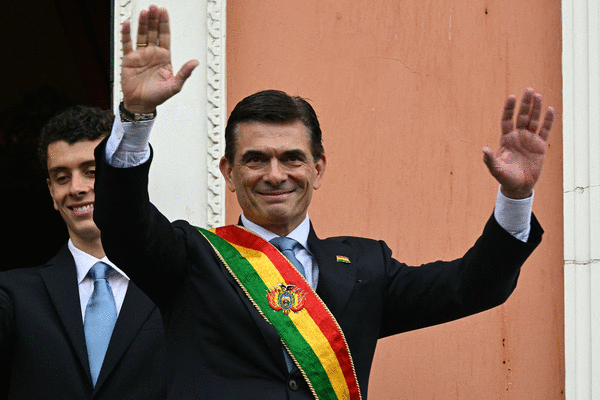
Anti-government protests and persistent roadblocks in Bolivia are testing the country’s transition to a democracy that’s open to the world economy, beleaguered President Rodrigo Paz said in an interview Saturday with Bloomberg Television’s Wall Street Week.
Now in their fourth week, the roadblocks have choked off food, fuel and medical supplies to the administrative capital of La Paz and neighboring El Alto in western Bolivia. Paz is pressing for dialogue with protesters while deploying security forces, sometimes using tear gas, to lift the blockades.
“There are many internal and external interests in making this democracy fail and generating regional disorder,” Paz said from the presidential palace in La Paz.
“This is a problem over whether democracy in Bolivia is viable or not,” said Paz, who took office in November following two decades of socialist rule.
The government has invited the La Paz farmers federation for talks on Sunday morning. Separately, a socioeconomic council encompassing different sectors is scheduled to meet Wednesday for a monthly meeting to discuss economic legislation involving key sectors, including oil and gas, mining, lithium and investment.
Paz said he hopes these meetings will produce results, although he noted that the constitution allows the use of force if necessary.
The farmers, union leaders and supporters of former President Evo Morales are demanding Paz’s resignation, arguing that after six months in office he has failed to fulfill his pledge to solve Bolivia’s acute economic crisis.
Paz, a Trump administration ally who rose to power by captivating working-class Bolivians and many supporters of the long-ruling Movimiento al Socialismo party, pledged “capitalism for everyone” during his campaign. Since taking office, he has implemented measures aimed at stabilizing the economy, including easing fuel subsidies, applying a foreign-exchange reference value and cooling inflation, while seeking to attract foreign investment and elevating the private sector.
The Paz administration has faced resistance from the start, including widespread complaints over poor gasoline quality, an unpopular law changing land management rules and union demands for wage hikes. The protests have coalesced into a single goal: Paz’s resignation.
Morales, who is believed to be hiding inside a radio station compound in the central coca-growing Chapare region of Cochabamba, his traditional stronghold, is calling for early elections.
Paz said there are sectors unwilling to allow Bolivia to take the next step in its transformation. “The past doesn’t want to give way to the present and the future, and that’s part of the conflict we’re living through,” he said.
Despite the turmoil, the president said he envisions a different country by the end of his term, with a controlled fiscal deficit, an open economy, legal certainty and a society where racial and cultural differences no longer generate the tensions Bolivia is currently undergoing.
“Our government represents the closing of a cycle of management of the last 20 years,” Paz said. “This transition won’t be easy, but clearly it’s the right path to free up Bolivia’s productive forces.”
(Simon Hampton contributed to this story.)
©2026 Bloomberg L.P. Visit bloomberg.com. Distributed by Tribune Content Agency, LLC.





Comments