EPA announces $295 million to remove Illinois lead pipes even as Trump moves to roll back clean water protections
Published in News & Features
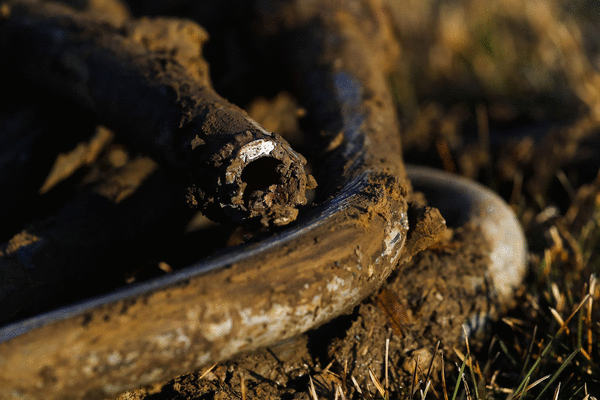
Illinois will receive $295 million to address lead in drinking water as part of a $921 million regional investment, the federal government has announced.
The move is one of many actions under the Federal Lead Action Plan, launched in President Donald Trump’s first term and aligned with his administration’s newer campaign to “Make America Healthy Again.”
Illinois has 677,000 known lead service lines and another 820,000 suspected lines currently connected to the state’s water systems. That’s more than any other state.
Chicago alone has more than 400,000 of the toxic pipes, by far the most of any U.S. city, as clout-heavy unions ensured the plumbing code required lead service lines until Congress banned the practice in 1986.
The funding announcement made on Wednesday — and another one on Thursday for $232 million to monitor bacteria levels at Illinois beaches — comes even as the Trump administration rolls back other clean water protections, including a move last week to reduce limits for PFAS levels in drinking water. Also known as forever chemicals, these can cause reproductive, endocrine and neurodevelopmental diseases in humans, as well as cancer, studies show.
Lead from pipes corrodes and leaches into drinking water. And when it’s consumed, the human body mistakes that lead for calcium, accumulating it in bones and organs. According to public health officials, there is no safe level of lead in human blood, meaning minor exposures can have long-term consequences. It can permanently damage the developing brains of children and contribute to heart disease, kidney failure and other health problems later in life. One study estimated more than 400,000 deaths a year in the U.S. are linked to lead exposure.
“Every lead pipe we remove is a victory for public health in Illinois,” said Anne Vogel, administrator of the U.S. EPA Region 5 office, which covers the Midwest. “This $295 million through the Drinking Water State Revolving Fund will support the nuts-and-bolts work — building complete service line inventories and replacing lead lines from curb to tap.”
The investments will go through the Drinking Water State Revolving Funds, state-run financial assistance programs that help communities comply with the Safe Drinking Water Act of 1974. Just a month ago, the Trump administration proposed a steep 90% budget cut for these programs — “returning the primary responsibility of infrastructure funding to the states” — and by more than half for the EPA as a whole.
The majority-Republican House Committee on Appropriations proposed on Wednesday less extreme but still substantial cuts, slashing 20% from the agency and reducing funding to the state clean water programs by almost 25%.
“These programs are really popular programs, so Congress is not listening to the administration,” said Nancy Stoner, senior attorney at the Chicago-based Environmental Law and Policy Center, “because they know people want clean water and clean air.”
In a news release Wednesday, U.S. Sens. Dick Durbin and Tammy Duckworth claimed the funding for lead pipe replacement — and an additional $21 million in federal money for grants to address PFAS in small and disadvantaged communities — was a Democratic victory, specifically through the 2021 Bipartisan Infrastructure Law signed by former President Joe Biden.
“I’m pleased to see this funding still coming to Illinois as EPA is recklessly reversing key restrictions against PFAS in our water supply and continually cutting EPA funding. This is not how you ‘Make America Healthy Again’ — it’s how you make America much, much sicker,” Duckworth said. “Every American — no matter their race, income or zip code — deserves to have confidence that their drinking water is safe, clean and reliable, and I won’t stop working to ensure that for all Illinoisans and Americans.”
Despite federal pushes to replace lead pipes in the state and the city over the last decade, including a mandate from the Biden administration to replace 20,000 pipes in Chicago every year, progress has been slow.
The Chicago Department of Water Management has so far replaced only 14,600 of the city’s lead service lines, spokesperson Megan Vidis said Wednesday, noting the number “changes daily.” Back then, the department said there wasn’t enough money, equipment or trained workers to meet Biden’s requirement. A report released earlier this year, however, found that lead pipe replacement could create 90,000 jobs statewide.
“We stand by the statement that there is still more money and trained workers required to be compliant with this enormous multi-year effort,” Vidis wrote, “which will create many jobs for a skilled workforce over the years.”
Three years ago, Mayor Brandon Johnson secured a $336 million federal loan to replace 30,000 pipes. City officials have projected it will take several decades to replace all of Chicago’s lead service lines. At the same time, the city has promised to begin replacing at least 10,000 every year starting in 2027.
Regarding a possible new influx of money, Vidis said, “As with every potential source of funding for (lead service line replacement), the Department of Water Management will work hard to secure our fair share for Chicago.”
The federal government will also distribute funds for lead pipe replacement to the other five states in the region: $202 million to Ohio, $144 million to Michigan, $129 million to Indiana, $94 million to Wisconsin and $57 million to Minnesota.
_____
(Chicago Tribune’s Michael Hawthorne contributed.)
_____
©2026 Chicago Tribune. Visit chicagotribune.com. Distributed by Tribune Content Agency, LLC.






Comments