US inches toward Iran deal as negotiators focus on Hormuz
Published in News & Features
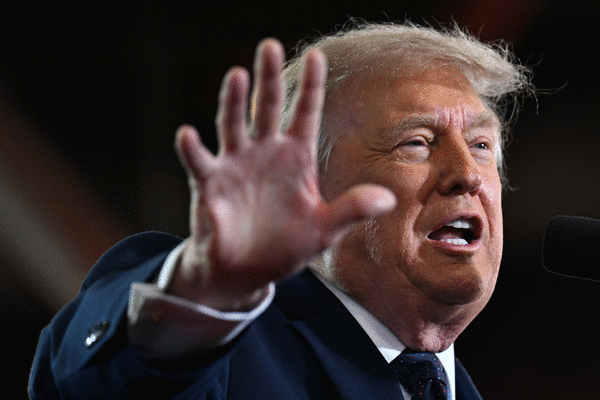
The U.S. and Iran are closing in on a deal that would reopen the Strait of Hormuz, senior U.S. officials said Sunday, even as President Donald Trump said he won’t “rush” into an agreement.
The U.S. officials told reporters that nothing is ready to be signed Sunday as the two sides negotiate on the precise language on key issues and that it may take several days for both sides to get final approval.
Iran’s semi-official Tasnim news agency said Sunday that the draft deal could still collapse because the U.S. is obstructing some key clauses, including Tehran’s demand that its assets be unfrozen.
Urged on by several Arab leaders, the U.S. and Iran have been discussing a possible extension of a fragile ceasefire, but both sides have offered differing descriptions of what an interim deal would include. The two sides have proposed several deals in the past few weeks that they have failed to clinch.
“Our relationship with Iran is becoming a much more professional and productive one,” Trump wrote Sunday in a social media post. “They must understand, however, that they cannot develop or procure a Nuclear Weapon or Bomb.” He added that the U.S. blockade of the strait would remain in place until an agreement is completed and that both sides must take their time to “get it right.”
Earlier, U.S. Secretary of State Marco Rubio said there may be “some good news” regarding Hormuz in the coming hours, as Iran and Washington press ahead with peace negotiations.
Still, the broad agreement described by U.S. officials does not address Iran’s missile stockpile nor does it contain an explicit ban on uranium enrichment — two of Trump’s most important goals. That could enrage Republican national security hawks that have already railed against the negotiations.
Iranian media and officials have also been more circumspect. Washington and Tehran are still at odds over “one or two provisions,” the semi-official Tasnim news agency reported, citing an “informed source.” The Fars agency, meanwhile, dismissed Trump’s claims on Saturday that a deal has been “largely negotiated” as “far from reality,” without citing anyone.
Iran’s nuclear program is a central sticking point, including its insistence that it isn’t seeking a nuclear weapon.
“We are ready to assure the world during any talks that we are not seeking nuclear weapons,” the Student News Network on Sunday cited Iranian President Masoud Pezeshkian as saying. He added that Iran is “not seeking unrest in the region.”
The U.S. plans to lift its blockade as part of the agreement and Iran has also agreed in principle to dispose of its highly enriched uranium, a Trump administration official told reporters, adding the U.S. does not plan to unfreeze any Iranian assets as part of the current agreement being negotiated. They also reiterated the Trump administration’s position that any toll system imposed by the Iranians for Hormuz transit is unacceptable.
Any sanctions relief will depend on how Tehran complies with various provisions of the deal, the officials said, adding that the timeline on Iran’s disposal of highly enriched uranium and a moratorium on enrichment will be negotiated later.
The U.S. officials said they expect a substantial Iranian commitment to forgo enrichment as part of any final deal. They said the U.S. believes it can ultimately negotiate an enforceable mechanism that guarantees Iran won’t have a nuclear weapon and leads to a more productive bilateral relationship. In previous talks, the U.S. has sought a 20-year moratorium on enrichment.
Iran hasn’t confirmed any of these details and has made clear it intends to preserve its uranium stockpile.
Israeli Prime Minister Benjamin Netanyahu said in a post on X he spoke with Trump about the U.S.-Iran negotiations and reiterated that the threat of Iranian nuclear weapons must be eliminated as part of any final agreement.
“President Trump also reaffirmed Israel’s right to defend itself against threats on every front, including Lebanon,” he said.
On Saturday, Trump had said a deal to start bringing an end to the U.S.-Israeli war on Iran was nearing completion and that the Strait of Hormuz could be reopened. But he was also receiving significant pushback from his political allies, who wanted him to restart the military campaign.
Senate Armed Services Committee Chairman Roger Wicker, R-Miss., wrote on social media before Trump’s Saturday post that a new ceasefire “would be a disaster. Everything accomplished by Operation Epic Fury would be for naught!”
Axios reported the pact would involve a 60-day extension of the existing ceasefire, during which the strait would be reopened and Iran allowed to sell its oil.
The draft was also said to stipulate that the parallel war between Israel and Iranian-backed Hezbollah in Lebanon would end — a step Israel may be reluctant to endorse.
Several Republicans compared the reported deal unfavorably to the 2015 Iran deal that President Barack Obama made with Iran. Trump on Sunday rejected that idea.
“It was a direct path to Iran developing a Nuclear Weapon,” he wrote about the 2015 deal. “Not so with the transaction currently being negotiated with Iran by the Trump Administration - THE EXACT OPPOSITE, in fact!”
_____
(With assistance from Eric Martin, Arsalan Shahla, Dan Williams, Se Young Lee and Eltaf Najafizada.)
_____
©2026 Bloomberg L.P. Visit bloomberg.com. Distributed by Tribune Content Agency, LLC.






Comments