5 years later: Mayor Brandon Scott's promises vs. progress in Baltimore
Published in News & Features
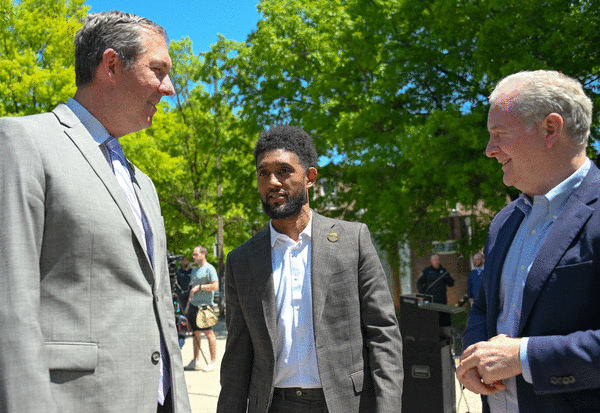
BALTIMORE — Five years after unveiling an ambitious blueprint for Baltimore’s future, Mayor Brandon Scott is highlighting sharp declines in homicides and shootings as evidence his public safety strategy is working.
But his second-term action plan also underscores a more complicated reality. Gains in crime reduction are unfolding alongside persistent gaps in mental health response, neighborhood investment and long-term development — raising questions about how evenly the city’s progress is being felt, and whether it will last.
In 2021, Scott organized the goals of his first term into five categories: building public safety, prioritizing youth, clean and healthy communities, equitable neighborhood development, and responsible stewardship of city resources.
“Five years later, we see the impact,” Scott said in a letter attached to his new plan. “We’ve invested in the heart of our city — Downtown — including upgrades to CFG Bank Arena, and launched redevelopment projects at Harborplace and Redwood Street.”
But an outside expert says the results are more complex than the mayor’s framing suggests.
“In broad strokes, he’s really done a good job at targeting what his action plan was and getting those things done,” said Dillon Mahmoudi, associate professor and urban scholar with the University of Maryland Baltimore County. “But there’s still some pretty big gaps where folks I know were hoping for a little more oomph.”
Public safety: Sharp declines, uneven implementation
Public safety was the centerpiece of Scott’s first-term agenda — and the clearest area of measurable change.
Baltimore reports that homicides have fallen 59% since 2021, while non-fatal shootings are down 57%. In 2025, the city recorded 133 homicides, its lowest total in nearly five decades.
Officials attribute much of that decline to the expansion of the Group Violence Reduction Strategy (GVRS), which has expanded district by district since 2022 and now operates in six of Baltimore’s nine police districts.
“We are following the data and doing it responsibly,” Scott said in April, noting the city’s phased rollout across districts.
The Baltimore Police Department has also made incremental progress under its federal consent decree, with five of 17 sections now considered resolved. That includes categories like officer health and transportation of people in custody, meaning the department maintained compliance for at least a year for each.
At a recent hearing, U.S. District Judge James K. Bredar said the department has “largely successfully transitioned” but still faces “nettlesome remaining deficiencies.”
Efforts to reduce gun trafficking within Baltimore have also picked up since 2021, with the city winning a lawsuit against a ghost gun dealer Hanover Armory. A bill banning Glocks from sale, transfer and manufacture in Maryland passed during the last legislative session, is set to go into effect in 2027.
When it comes to mental health provisions related to public safety, Scott promised to divert 911 calls to mental health services.
Since then, The Baltimore Sun found that the number of Baltimore’s behavioral health calls directed to mental health services dropped by 50% from 2023 to May 2025. Multiple police shootings involving reported mental health crises happened within this time as well.
Data from the end of 2025 shows the city improved that issue, increasing the amount of 911 calls diverted to mental health services by nearly 50%.
Baltimore dedicated $9.7 million in the fiscal 2027 budget to replace the Computer Aided Dispatch system for EMS and police services, meant to improve response times and quality of dispatch services, but those services were not improved since 2021.
Mahmoudi said other areas of public safety could have more care put into them, like the privately owned Johns Hopkins University Police Department, which residents have protested for years.
“It’s this kind of quasi-public private force with no local oversight,” Mahmoudi said. “Neighbors within, in and around Hopkins, both campuses, have complained about it. They want local control over the police force, and I think that’s a totally reasonable ask.”
Communities, neighborhoods and city resources
As for cleaner communities and improvement to neighborhoods, there is one glaring issue — the BRESCO trash incinerator located in Westport. Scott originally campaigned on solving the issue of the incinerator, which affects a Black neighborhood, but the issue remains.
“At the last minute, in the campaign, [he] ended up supporting the contract renewal for BRESCO,” Mahmoudi said. “It’s an incinerator that burns trash, Baltimore’s trash, but also Baltimore County’s trash, some of Baltimore County’s trash. So it’s taking, literally, trash from majority white Baltimore County and burning it in majority black Baltimore City.”
Development has also been rocky over the last several years, with Baltimore’s commercial properties losing $1 billion since 2020. Harborplace, a massive rehaul of a portion of downtown, has taken years to materialize as empty office buildings plummet the city’s value.
Although the city is focusing on bringing in more tourists and visitors, Mahmoudi said the Scott administration’s approach to development focuses more on attractions than residents living in and around downtown rather than visitors.
Mahmoudi said the mayor’s newest plan emphasizes reducing disinvestment in the city’s neighborhoods, but that the city’s propensity for commercialization of areas like Canton Crossing and the Harbor ignore meaningful development to be had in West and East Baltimore areas.
“The [2026] action plan, as is, touts investment, but it risks running the same or producing the same geography of inequality that has existed within Baltimore for decades,” Mahmoudi said. “It acts as if disinvestment is something that happens on its own, and it’s something that happens when investment happens. When investment happens in these kind of the White L or golden neighborhoods, that produces disinvestment in other places. And that’s because Baltimore is not growing.”
The Sun reached out to the mayor’s office, asking to discuss his prior action plan, but did not receive a response.
_____
©2026 The Baltimore Sun. Visit at baltimoresun.com. Distributed by Tribune Content Agency, LLC.



Comments