Cuba says US risks 'bloodshed' if it abandons dialogue for war
Published in News & Features
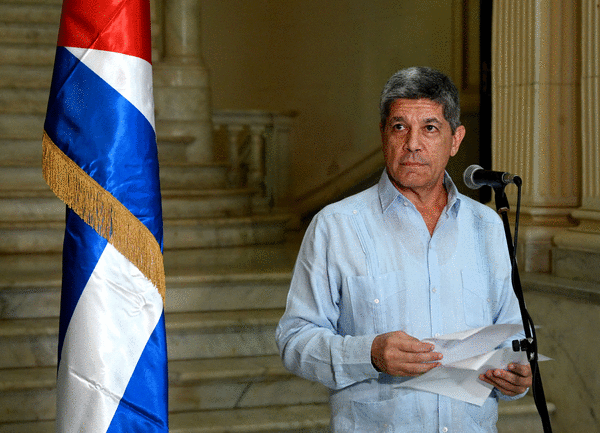
President Donald Trump has made no secret of his desire for regime change in Cuba.
His administration has declared Cuba a national security threat and has threatened military action against the Communist-run island, stationing naval warships off Cuba’s shores.
For months, the U.S. has blocked oil from reaching Cuba, triggering crippling blackouts. Last week, as the White House expanded sanctions on Havana’s leaders, federal prosecutors charged 94-year-old former Cuban President Raúl Castro with murder.
On Wednesday, Secretary of State Marco Rubio further raised the specter of war, saying “having a failed state 90 miles from our shores is a threat to the national security of the United States."
The Los Angeles Times interviewed Cuban Deputy Foreign Minister Carlos Fernández de Cossío, who, in sometimes defiant terms, said the Trump administration has triggered a humanitarian crisis and that the U.S. should solve its own problems before imposing its will on the hemisphere.
The conversation has been lightly edited for clarity.
Q: Secretary of State Marco Rubio said last week that the chances of a negotiated agreement with Cuba are “not high.” Do you agree with that?
A: We have in place a channel of communication to try to find a solution for bilateral issues. At the same time, parallel to this channel, the U.S. has pushed rhetoric about “ taking Cuba,” about putting an end to our government and has generated a humanitarian crisis.
So when Rubio says that he doesn’t have high hopes, perhaps he means that the U.S. isn’t taking that channel of communication seriously. On our side, we do look at it seriously, because we believe that with the United States, and any government, the only avenue to try to solve bilateral issues is dialogue. And we prefer dialogue to conflict.
Q: What concessions is Cuba willing to make?
A: How can a country under aggression be the one that needs to take steps or make concessions?
Q: Given the repeated threats of military action from the U.S., can you talk specifically about how the Cuban armed forces are preparing?
A: My generation grew up preparing for U.S. military aggression, because the threat has always been there. We are prepared to pay the maximum price if we have to defend our country.
There are politicians in the United States pushing the drumbeat of war against Cuba, trying to fabricate excuses, trying to portray Cuba as a threat, and trying to push the U.S. president to take military action, even with the understanding that military action would lead to a bloodshed, mostly of Cubans, but also of Americans.
The question is: How does a government convince American citizens that it is in their interest to cause death, cause destruction and suffering to a neighboring nation simply to satisfy the ambitions of a small cabal of wealthy influential people who enjoy the ear of politicians and powerful people in Washington?
Q: You and other Cuban leaders have said that the US “has no right to determine the Cuban political system,” and that changes to Cuba’s political structure and economy are not up for discussion.
But many Cuban citizens have also demanded political and economic change. Is Cuba willing to dialogue with Cuban dissidents and grant amnesty to political prison prisoners?
A: You have many U.S. citizens that disagree with the current state of politics in the United States, and disagree with the U.S. spending money on wars abroad.
Over 40 million of its citizens have no healthcare, and the U.S. ratio of incarceration is higher than any country in the world. Does the U.S. have a dialogue with its prison communities?
In a few weeks you will be celebrating 250 years of your Declaration of Independence, of not having another superpower interfere in the issues of the United States.
The right that Americans claimed for themselves is the same right that we claim for ourselves. We need to solve our own issues without the interference of the U.S. government.
Q: On my recent trip to Havana, I was surprised by the number of people who told me that they see U.S. intervention as the only way to move toward a political and economic transition, because Cuba hasn’t allowed change from within. What do you say to them?
A: Well, I can assure you that I’ve met hundreds, if not thousands, of Americans that believe that the U.S. government should be torn down completely. That exists in every country, and it also exists in Cuba today.
The fact that those people spoke to you tells you that in Cuba, there’s no punishment because of the way you think or because of what you say.
Q: Most people did not feel comfortable speaking to me on the record because they feared consequences for voicing political opinions.
A: Well you must be aware of some U.S. journalists and activists who are now under threat from the U.S. government for speaking about what they saw in Cuba. (He was referring to members of a humanitarian aid flotilla to Havana now under scrutiny by the Treasury Department’s Office of Foreign Assets Control).
Q: The U.S. under Trump has embraced a hegemonic policy in Latin America. How do you think U.S. actions in Cuba relate to its broader strategy to exert control in the region?
A: One of the main problems is the failure of U.S. politicians and members of government to accept that Cuba is a sovereign nation. The same goes for other countries in the region.
To portray the Western Hemisphere as a landscape that belongs to the U.S. and is under U.S. authority is an insult to international law.
The U.S., which was born out of a rebellion against a foreign power, wants to claim sovereignty over the whole hemisphere. I reject that. This doesn’t mean that we cannot work on friendly terms with the United States, that we cannot build a very good relationship.
Q: What are the biggest obstacles for the relationship between Havana and Washington right now?
A: Some are linked to the nature of U.S. politics, in which a small group of powerful and influential individuals have a disproportionate influence on the president, and their view prevails over the opinions of a majority of Americans.
I saw statistics recently that only 15% of US citizens support military action against Cuba.
Q: Rubio has argued that Cuba is run by a disproportionately small group of people, namely the Castro family and leaders of GAESA, the military conglomerate that runs many businesses.
A: Marco Rubio has never set foot in Cuba, so you cannot listen to him as an informed person on Cuban issues. He needs to argue that to justify a policy aimed at inducing a humanitarian crisis in Cuba.
It’s overblown. The Castro family does not govern Cuba. GAESA is a big conglomerate, which exist in many countries, and it is much smaller and less monopolistic than many of the conglomerates in the United States. But even if all that were true, these are Cuban issues.
Q: Can you update us on the humanitarian crisis? When I was in Cuba a few months ago, people were desperate. They were without power for many hours each day. Now by all accounts, it’s gotten worse.
A: There are now many more hours without power. Less public transportation. Many more difficulties for hospitals. More problems for the availability of running water because the system relies on fuel. There are problems with the transportation of goods.
They are punishing the whole population. I’m talking about infants, about children, about pregnant women.
Q: U.S. attempts to economically isolate Cuba are not new. It’s been six decades. Some people say, “Shouldn’t Cuba have been more prepared for something like this?”
A: During this economic war, with all the restrictions, Cuba managed to attain health indicators that were better than the United States and better sports, arts, culture and scientific indicators than any country in the Western Hemisphere, with the exception of Canada. That is a tribute to the creativity and strength of the Cuban system.
Ask yourself: What other country could have sustained such an onslaught from the U.S. government?
_____
©2026 Los Angeles Times. Visit at latimes.com. Distributed by Tribune Content Agency, LLC.






Comments