Lawsuit against city in slaying of 13-year-old Adam Toledo refiled in federal court
Published in News & Features
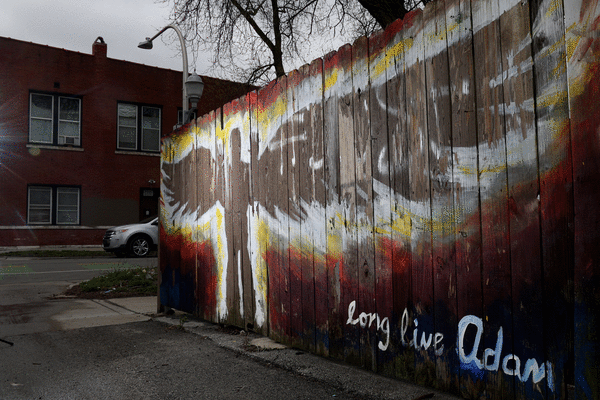
CHICAGO — More than a month after the parents of Adam Toledo strategically dismissed a lawsuit over the killing of their 13-year-old son, the family has refiled a new complaint against the city and the police officer who shot him, alleging wrongdoing in the boy’s death.
The complaint, filed this time in federal court rather than in Cook County, will start new proceedings after the prior lawsuit was abruptly dropped last month just before a jury was set to be selected for a sweeping, weekslong trial.
The trial, which was scheduled to begin shortly after the five-year anniversary of the boy’s death, had gotten off to a rocky start for the plaintiffs during pretrial motions. Cook County Judge Thomas Lyons, presiding judge of the Law Division, granted a motion from the city of Chicago to split the trial in two, severing the claims of negligent hiring by the city from the allegations around the shooting by Officer Eric Stillman.
That meant that the allegations against Stillman would proceed first, the judge ruled, and only if the Toledo family won their case would the other claims proceed — a win for the city and a blow for the family.
Now, the family seeks a fresh start with a new complaint, this time to be heard before a federal judge, rather than Lyons or any other Cook County jurists.
“For more than five years, Adam’s family has carried the unbearable weight of losing a thirteen-year-old child whose life ended in a dark alley at the hands of a Chicago police officer,” the family’s attorney, Adeena Weiss Ortiz, said in a statement. “This filing represents the family’s continued fight for the truth, for accountability, and for justice. This shooting was preventable.”
The family has alleged that Stillman wrongly killed the boy, while also accusing the city of Chicago of negligence in its hiring and training of Stillman, who had preexisting health problems, the complaint alleges.
The city declined to comment to the Tribune, and an attorney for Stillman did not immediately respond to a request for comment.
The procedural twists and turns have been closely watched by city residents and Little Village community members who protested and mourned in the wake of Toledo’s shooting.
On March 29, 2021, just after 2:30 a.m., Stillman shot Toledo after a pursuit in an alley behind Farragut Career Academy High School in Little Village. At the time, the boy was the youngest person to be fatally shot by a Chicago police officer in years, with the shooting roiling the city, leading to protests, calls for reform and eventually policy changes around when and how police can chase people.
Just before he was shot, Toledo “stopped running, turned toward the officer, and raised his hands in response to Stillman’s commands,” the lawsuit alleges.
It further alleges that the city had a “pre-employment medical questionnaire and application disclosing (post traumatic) stress disorder” and other issues that should have disqualified Stillman from employment.
According to body camera footage of the shooting, Stillman shouts, “show me your (expletive) hands!” followed by “drop it!” with a flickering flashlight on Toledo.
A pistol-shaped object appears to be visible in Toledo’s right hand behind his back as he pauses near an opening in a fence and turns his head toward the officer, though his hands appeared to be empty at the moment he was shot.
About a year later, former Cook County State’s Attorney Kim Foxx announced Stillman wouldn’t face criminal charges. Though she raised concerns about police foot pursuits, Foxx said prosecutors determined Stillman reasonably believed he was in danger, noting that the sequence of events in the video happened “almost simultaneously.”
The lawsuit, though, claims that Stillman “chose tactics that accelerated and compressed the encounter rather than slowed or stabilized it.”
Before the first complaint was dropped, attorneys for the city, Stillman and the Toledo family had been immersed in arguing more than 200 motions, battling over which evidence and witnesses would be presented to the jury and what arguments the parties could make.
Among the most impactful rulings was Lyons’ order to sever the cases, after the city argued that the “claims involve different legal standards, different evidence, and entirely different considerations for a jury.”
Weiss Ortiz countered that the city sought to “sanitize” the events surrounding the boy’s death, arguing that the attorneys “don’t want the jury to hear the issues that arose when Eric Stillman was hired.”
____
©2026 Chicago Tribune. Visit at chicagotribune.com. Distributed by Tribune Content Agency, LLC.



Comments