'We're playing defense, not offense': Nevada legislator weighs in on extreme heat crisis
Published in News & Features
The start of summer was always a point of contention for Sara Evans.
During shifts as a case worker for the child welfare system in Nevada, extreme heat meant it was that much harder to provide accurate assessments in the field, Evans said.
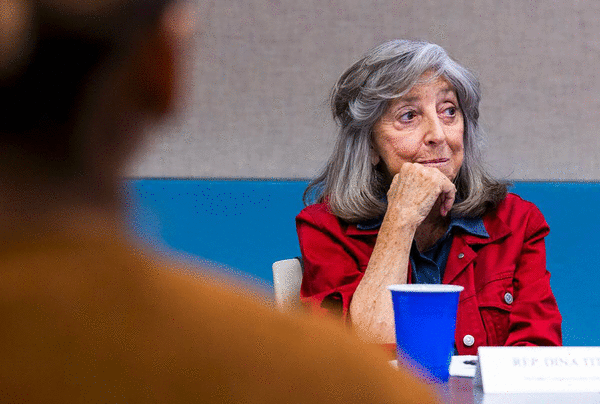
Evans, a union leader with Service Employees International Union Local 1107, told her story at a roundtable hosted by Rep. Dina Titus, D-Nev., on Thursday at Whitney Library. Panelists discussed what changes lawmakers should make to better prevent heat-related deaths.
Heat contributed to the deaths of more than 1,000 people in 2024 and 2025 combined. Last month, the Regional Transportation Commission hosted an extreme heat summit in Las Vegas to explore gaps in local response.
“I think we can make progress; but unfortunately, right now we’re playing defense, not offense,” Titus said. “It will be so nice when that turns back around.”
Evans is the chair of SEIU Local 1107’s Climate Justice Caucus, the first in the nation, advocating for policies that allow workers to better deal with extreme heat. Part of her job is undoing the machismo associated with working outdoors.
“Trade unions are some of the toughest individuals in the world,” Evans said. “They are incredible, and we love them, but baked into their culture is this toughness. It is very much, ‘I can withstand this,’ and people look up to that. They’re like, ‘Oh, wow, he stood outside in 110 degree heat all day.’”
The conversation ran the gamut of the many intersecting and moving parts of extreme heat, from cooling centers and tree canopy to worker protections, increasing strains on the energy grid and more.
Titus reaffirmed her commitment to pursuing her Extreme Weather and Heat Response Modernization Act, a bill that would allow the Federal Emergency Management Agency to use natural disaster funding for extreme heat.
That would mean that local governments could leverage federal funding for planting trees, bolstering shade at bus stops or staffing cooling centers like the Whitney Library.
“It’s not like one storm that you can see the results of,” Titus said. “It takes place over time; it’s spread out. You don’t know when it starts or when it stops.”
Another legislative focus for Assemblymembers Cinthia Moore, D-North Las Vegas, and Howard Watts III, D-Las Vegas, is passing state laws that ensure utility bills don’t continue to rise, they said.
Both lawmakers say they hear from constituents often who must make difficult choices between paying their energy bill or monthly rent.
Moore said she will reintroduce a bill that prevents NV Energy, Southwest Gas and other utilities from shutting off service in the summer months. Last session, a bill she worked on successfully required utilities to report to regulators quarterly how often they shut off customers due to nonpayment.
“It’s not a luxury; it’s a necessity,” Moore said of air conditioning.
Largely, the only immediate, official and community-level response to extreme heat has been cooling centers.
Air-conditioned buildings can be a life saver in deadly summers, though researchers have shown through surveys that cooling centers aren’t being utilized by many people.
Vanessa Garcia, of the Clark County Department of Family Services, said the National Weather Service’s extreme heat warnings were what used to dictate when the cooling centers would open their doors.
Now, Garcia said, the county’s new protocol will reflect that an official warning doesn’t need to be the only indicator for a really hot day. Above 105 degrees, cooling centers will be activated, she said.
Garcia said that cooling centers are stocked with water, and that she works with community organizations to collect donations. In the past, Garcia’s department collected sandals to prevent pavement burns in the homeless community.
The limiting factors of opening more cooling centers in Southern Nevada are both funding and the stigma surrounding the people who will use them, she said.
“All I can say is, ‘We’ll give you water,’” Garcia said. “But I can’t say we’re going to offer any kind of funding, so I don’t think that that really helps the situation.”
Dr. Joanne Leovy, a Las Vegas physician and founder of Nevada Clinicians for Climate Action, said the human health impacts of extreme heat aren’t getting better, largely because of a lack of societal education.
“When people come in, usually with heat exhaustion, it’s pretty easily treatable,” Leovy said. “But they are uniformly surprised that they got themselves into trouble in the heat. Most people still do not understand.”
___
©2026 Las Vegas Review-Journal. Visit reviewjournal.com.. Distributed by Tribune Content Agency, LLC.






Comments