How AI could help save lives this hurricane season
Published in News & Features
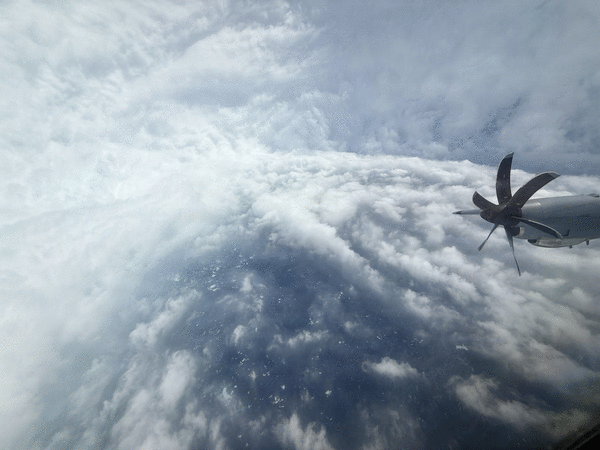
Artificial intelligence may have its flaws, but specific programs have proven themselves to be groundbreaking — if not lifesaving — tools in hurricane forecasts, and the National Hurricane Center will keep incorporating them into its forecast arsenal.
Last year, an AI model was actually more accurate than traditional methods at predicting the power and path of Melissa, the season’s most dangerous hurricane.
The Hurricane Center’s operation officer Wallace Hogsett said as forecasters gained experience last year, they “began integrating these new AI weather-prediction systems as guidance when preparing operational forecasts.”
In its review of the 2025 season, the Hurricane Center said official forecasts “generally outperformed most dynamical and consensus models, though the Google DeepMind ensemble mean (GDMI) showed slightly better short-range performance.”
This year’s hurricane season starts Monday and runs through Nov. 30. At this point, the Hurricane Center considers AI another tool in the toolbox, but one that could save lives.
Primary among them: Google’s DeepMind AI. Hogsett said the Hurricane Center “has partnered directly with Google DeepMind to develop a new AI hurricane forecast model that was used experimentally during the 2025 season.”
When DeepMind won out
Melissa, the strongest hurricane on record to make landfall in Jamaica, was the most destructive and deadly hurricane of 2025. It stunned meteorologists by quickly ramping up to have maximum sustained winds of 190 mph, tying 1980’s Hurricane Allen as the strongest Atlantic hurricane on record.
“Hurricane Melissa was a very difficult-to-forecast and impactful storm,” Hogsett said. “The AI models honed in very early on the likely track and intensity and provided very valuable guidance to complement our traditional (numerical weather prediction) guidance.”
“During Hurricane Melissa, you’ll see that the Google model was the one to insist that this was going to become a Category 5 and stay a Category 5,” said Bryan Norcross, hurricane specialist at Fox Weather, who was in South Florida to host the network’s Hurricane Week in the first week in June.
Other models suggested Melissa would grow very strong “but they fluctuated on their predictions, where the Google model insisted that this was going to take a track to the west and then turn north and be a spectacularly intense storm,” Norcross said.
Norcross said that by integrating the DeepMind forecast, the Hurricane Center was able to make a “very aggressive and sensitive forecast that was very accurate and benefited the people in Jamaica.”
Another win for Deepmind was Hurricane Imelda in September last year.
Meteorologist Jeff Berardelli of WFLA-TV Tampa Bay pointed out on social media site X that when most models were showing a landfall in the Carolinas, DeepMind consistently predicted a hard right turn out to sea, which eventually happened.
“To be sure, other models like the Canadian, German Icon and Euro AI also generally showed this out-to-sea track as well,” wrote Berardelli, “So the Google AI was not alone. But factoring in its performance this season, it appears it’s taking another victory lap.”
How it all fits together
The methodology of traditional forecasting and AI forecasting is quite different.
Google DeepMind and other AI hurricane models sift through vast amounts of historical data to find patterns, and use those patterns to predict what storms will do. Traditional forecasting uses current data to solve complex atmospheric physics equations.
Hogsett said that most of the current AI models are trained on huge global datasets that incorporate all global observations, and span many decades. Once they learn the relationships between variables such as pressure, wind, and temperature, they get a snapshot of current global conditions, and estimate the future state of the atmosphere.
The first step in both AI and traditional models is to collect a snapshot of the planet’s weather over a few hour period and assimilate it into a massive data set, Norcross said.
The AI systems use an incredible amount of data from the National Hurricane Center, the National Oceanic and Atmospheric Administration and from weather services all over the world.
Some of the data comes from hurricane hunter aircraft that drop instruments called dropsonde both in the storm and around them. There are also satellites sending data, and the National Weather Service releases balloons two times a day from each of their offices.
That data is then assimilated by different groups, and different assimilation programs produce different results. “The gold standard of that starting point estimate is done by the European Center, the ones that do what we call the Euro model,” Norcross said.
“Google DeepMind and most of the other AI models around the world use the European data assimilation,” said Norcross.
The next frontier in AI for hurricane forecasts, he said, is to develop AI for the assimilation step of the process and test it against current methods.
“More AI-based tools and models are coming, and we’re evaluating them all thoroughly for potential integration into forecast operations,” Hogsett said. “At NHC, we are just beginning to scratch the surface of how these new models may be used.”
_____
©2026 South Florida Sun Sentinel. Visit at sun-sentinel.com. Distributed by Tribune Content Agency, LLC.






Comments