Hegseth chides Europe, hails ties with China and Asia allies
Published in News & Features
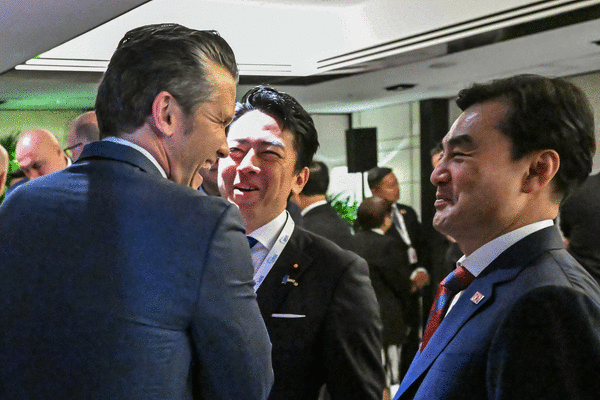
WASHINGTON— U.S. Defense Secretary Pete Hegseth praised defense allies in Asia and hailed newly stable ties with China, while taking swipes at longstanding security partners in Europe.
The comments, made Saturday at an Asia security forum in Singapore, are the latest sign of the Trump administration shifting attention toward the Indo-Pacific while expressing antagonism toward Europe and the NATO alliance.
Hegseth singled out allies such as South Korea, Japan and the Philippines for “stepping up” on defense while lambasting European nations that “threw open their borders and hollowed out their militaries.”
He also highlighted the importance of the “interpersonal diplomacy” between President Donald Trump and Chinese leader Xi Jinping after their meeting earlier this month in Beijing. Notably he made no mention in his prepared remarks of Taiwan, the key flashpoint between the two superpowers.
“The default Asian lens on America has been clearer and far more pragmatic than in other regions,” he said at the Shangri-La Dialogue. ”Our partners in Asia have long understood that the bedrock of a durable partnership is not based on idealistic values, but on the concrete alignment of national interest.”
Taiwan is top among several friction points between the U.S. and China, with American arms sales and diplomatic support for the island generating angry responses from Beijing. Xi warned Trump during the Beijing meeting that mishandling the issue could lead to clashes, and the U.S. leader has delayed approving a $14 billion weapons package to Taiwan, which is heavy on air defenses.
Hegseth’s failure to mention Taiwan in his address marked the first such omission by a Pentagon chief at the Singapore forum in at least a decade. The self-ruled island, which the Chinese Communist Party claims as its own despite never having ruled it, remains the primary red line in the U.S.-China relationship.
Last year, Hegseth mentioned Taiwan at least five times during his address to the forum. His predecessor Lloyd J. Austin III name-checked the global chip hub once the year before, and five times in 2023, according to the official transcripts.
The U.S. defense chief later told reporters the U.S. position on Taiwan was unchanged, adding that the only possible shift was “how we talk about” the issue. Hegseth described that updated approach to the self-ruled island as “strong, quiet but clear.”
Hegseth’s framing of the U.S.-China relationship — using the term “constructive strategic stability” that emerged from the Xi-Trump summit — also raised eyebrows.
“As defense minster he needed to show his willingness to counter China and reassure allies and partners, but he used a term that implies he wants to stick to a G2,” Daisuke Kawai, a professor at Tokyo University, said after the defense chief’s speech. “That will worry some countries here and it shows his stance has softened on China.”
Hegseth also had kind words for his Chinese counterpart, Defense Minister Dong Jun, who skipped the event for the second year. Last year, the U.S. defense chief quipped: “We are here this morning — somebody else isn’t.”
“I wish my counterpart was here at this conference,” Hegseth said on Saturday. “But I look forward to other options when we can cross paths and communicate.”
At one point, a Chinese delegate asked Hegseth to respond to a recent podcast comment by U.S. Forces Korea commander Xavier Brunson that South Korea is a “dagger in the heart of Asia,” a line Beijing slammed as hostile and aggressive.
Brunson, sitting in the audience, responded directly and cordially, saying he was riffing on a line from another era that referred to Korea as a dagger pointed at Japan, and that the full context of the comment was about changing perspectives in the region. He encouraged the Chinese delegate — Wang Dong of Peking University — to listen to his full remarks on the topic.
Trump has deployed the U.S. military into high-profile operations this year in the Middle East, against Iran, and in the Caribbean. While the actions against Venezuela were broadly seen as successful, the conflict in the Middle East has disrupted global energy supplies through the closure of the Strait of Hormuz while also depleting critical munitions.
In response to another question earlier in the day, Hegseth said that a delayed $14 billion Taiwan arms package should be decoupled from the issue of munitions.
“Any decision about future Taiwan arms sales, as the president said, will rest with him,” Hegseth said.
“Our stockpiles are more than suited for that, both there and around the globe, because of how we balance exquisite and more plentiful munitions,” Hegseth said. “We’re in a very good place.”
Hegseth provided no updates on talks with Iran, or a missile strike that injured several Americans, saying only that the U.S. is ready to step up the fight if there’s not a “great deal” that ensures Tehran’s leaders don’t get a nuclear weapon. He confirmed the U.S. blockade of the Strait of Hormuz was still in place.
While Hegseth also didn’t mention Iran in his prepared remarks, Trump has been frustrated by countries such as Italy for withholding access to their bases for U.S. operations. That’s left NATO allies bracing for Washington to withdraw more support from the continent, after the Republican leader announced he would pull 5,000 troops out of Germany.
Spain, which has drawn particular ire from Trump, is the only country to be granted an exemption from NATO’s new 5% defense spending target, leading to speculation the U.S. could reduce its presence at its Rota or Moron bases. The U.S. has about 85,000 military personnel currently stationed on the European continent.
Adm. Giuseppe Cavo Dragone, NATO’s military chief, later sought to downplay tensions later in a Bloomberg Television interview.
“We don’t have any drama going on” with the U.S., he said, adding that the alliance had already responded to American demands to boost military spending. “I think we are in a good shape.”
(Josh Xiao, Philip J. Heijmans and Ramsey Al-Rikabi contributed to this report.)
©2026 Bloomberg L.P. Visit bloomberg.com. Distributed by Tribune Content Agency, LLC.
Comments