Obama Foundation offers first glance of Jackson Park campus: Here is what to know
Published in News & Features
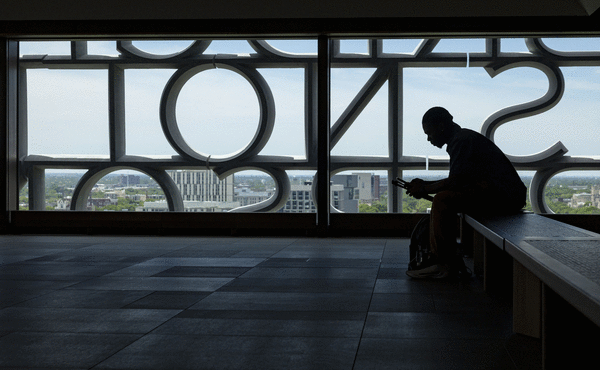
CHICAGO — While crews were still putting on the finishing touches — including paving part of the parking garage entrance — Chicago and national media were given a preview of the Obama Presidential Center in Jackson Park Wednesday ahead of it welcoming the public later this month.
The grand opening is set for June 19, following a star-studded dedication event the day before. The Obama Foundation has not yet announced the names of guests performers at the ceremony, but it will be streamed at a neighborhood watch party at the Midway Plaisance and online.
Here’s what to expect, some basics about the opening, and items of interest to look out for when you manage to get in.
Inside the museum
The museum spans four floors, culminating in the “Sky Room” with sweeping views on all sides.
The first floor focuses on the progressive movements that preceded Barack Obama: labor, voting rights, the New Deal and the cultural transformations of the 1960s through the 1980s. The exhibit pulls few punches, referring bluntly to pushback against racial progress, widening gaps between rich and poor and drivers of the conservative movement from presidents Richard Nixon to Ronald Reagan.
Chicago touchpoints are found throughout the museum, though the bulk are on the first floor, which has nods to Jane Addams, Harold Washington and Barack and Michelle Obama’s early careers in law and community organizing. Local political junkies may be disappointed: Obama’s time in the Illinois legislature, his unsuccessful congressional run in 2000 and the twists and turns of his U.S. Senate run only get brief mentions.
Obama narrates videos scattered across the exhibit, which also features a full wall of 2008 campaign buttons, original copies of essays from Obama’s school and community organizing days and a timeline of his first presidential campaign.
A small panel highlights the racist backlash the couple faced, mentioning the false claims that Obama was born in Kenya and “crude caricatures of Michelle Obama” (sans mention of then-businessman Donald Trump’s efforts to spread those rumors), and a marked-up draft of Obama’s 2008 speech on race relations in the wake of the controversy surrounding his former pastor, Rev. Jeremiah Wright.
The second floor covers the entirety of Obama’s two terms in office, with walls dedicated to the auto bailout and financial crisis, the battle for the Affordable Care Act, and the wars in Iraq and Afghanistan.
Roughly five-minute video installations for each are found throughout, featuring interviews with administration officials like Elizabeth Warren and Austan Goolsbee spliced with news clips, alongside letters and “lucky charms” the president received from constituents during the crises.
Small text boxes mounted within the exhibit highlight “The Work that Remained.” In the economy section, those include “proposals to make it easier for employees to form units … guaranteed paid sick and family leave, and … a higher minimum wage.”
The second floor also features a kid-friendly and interactive section on the basics of American democracy — the separation of powers, freedom of speech (including book bans), and voting rights.
Other family-friendly installations on the “palate cleanser” 3rd floor include the replica Oval Office, the first lady’s dresses, sports memorabilia and gifts from foreign heads of state, and another Chicago homage: miniatures of several White House events in an updated style of the Thorne Miniature rooms at the Art Institute.
The 4th floor explores other administration and foundation efforts on tribal, disability and LGBTQ rights; gender equity; criminal justice and policing reform; and science, innovation and climate change. It also features a story booth and station where visitors can design their own digital button.
What else to look out for
• The site will be reconnected to the pathways through Jackson Park for the first time in years. Cornell Drive, long a major thoroughfare for cars, is now bike- and pedestrian-friendly, closer to the carriage path it used to be. The pathways will also connect the center to the Museum of Science and Industry.
• Nearly half of the campus is technically below grade. The parking garage is fully underground, and courtyard levels are sunken, but exposed to light, an attempt to maximize park space above. Users of the parking garage will emerge outside before entering the museum — an attempt by the foundation to ensure tourists mix and mingle before and after their visit to the tower.
• Most of the museum’s spaces are named for major donors, famed organizers, politicians or artists, but two are memorials of sorts: the atrium in the middle forum building is named after Hadiya Pendleton, a Chicago teenager shot and killed a week after performing at Obama’s inauguration parade. The center’s restaurant is named for Tafari Campbell, the Obama family’s personal chef who died in an accidental drowning in a Martha’s Vineyard lake in 2023.
• Among the most controversial aspects of the foundation’s plans — and part of what inspired a lawsuit — were taking down old-growth trees on the site in Jackson Park. Visitors can see the remnants in the pathways for the playground spaces. The historic trees were also used for seeding, acting as nurse logs or buried under new soil to foster a similar microbiome to the rest of the park, foundation officials said. New plants are either native or climate resilient, able withstand rain, drought or major temperature swings.
• The granite exterior on the outside of the building has drawn plenty of attention and architectural criticism. Besides selecting the stone, the president proposed other tweaks to the building’s exterior, officials said: a series of bas-relief rows that cast lined shadows depending on the time of day, and angled 45-degree cuts known as chamfers, which break up the edges of the building along the southeast and southwest sides. A polished version of the same granite forms many of the internal walls.
• Chicagoans who inspired or made up Obama’s Cabinet are scattered throughout exhibits. Former Mayor Harold Washington appears extensively — including a candid photo of Washington shaking hands with constituents while a young Obama lingers in the background. Aside from current foundation CEO Valerie Jarrett, Mayor Rahm Emanuel, Bill Daley, David Axelrod and Goolsbee pop up in videos or photo panels.
The basics
After the June 19 opening, free “open house” events will continue throughout the grand opening weekend, from live entertainment to face painting and photo booths, story time and sports and play stations. The center has previewed other public programming throughout June and July to mark the 250th anniversary of the country’s founding.
Museum tickets are sold out until late August. For non-Illinoisans, entry will be $30 for adults and $23 for kids. For Illinoisans with proof of residency, tickets cost $26 for adults and $15 for kids. Tickets are free for Illinoisans on Tuesdays, but the next open spots are not until late fall.
Though museum tickets are hard to come by, people will be able to walk around the rest of the campus from 6 a.m. to 9 p.m. once the center opens. That includes all surrounding parkland — picnic, playground, and public art spaces — as well as the athletic center and the Chicago Public Library branch.
While there are about 400 paid spots under the center itself, the foundation notes parking is limited.
The Metra Electric Line exits at 59th and 60th are a three-minute walk to the museum, and 63rd Street station is an eight-minute walk to Home Court, the athletic center. Neither of those have an elevator, though: the closest Metra stop with one is 55th-56th-57th Street , 12 minutes from the museum.
The CTA’s No. 6 Jackson Park Express, No. 10 OPC and Museum of Science and Industry Express, No. 15 Jeffrey Local, and No. 28 Stony Island buses have stops directly in front of the campus. The CTA’s Red and Green lines connect to the bus line from the Garfield Boulevard or Cottage Grove stops on the Green Line, or 63rd on the Red.
There are also Divvy stations along Stony Island Avenue at 56th and 64th Streets.
The closest hotels are the Sophy Hyde Park, Hyatt Place Chicago-South/University Medical Center, and The Study at the University of Chicago.
____
©2026 Chicago Tribune. Visit at chicagotribune.com. Distributed by Tribune Content Agency, LLC.




Comments