U.S. denies sanctions caused Cuba's crisis as UN warns of worsening shortages
Published in News & Features
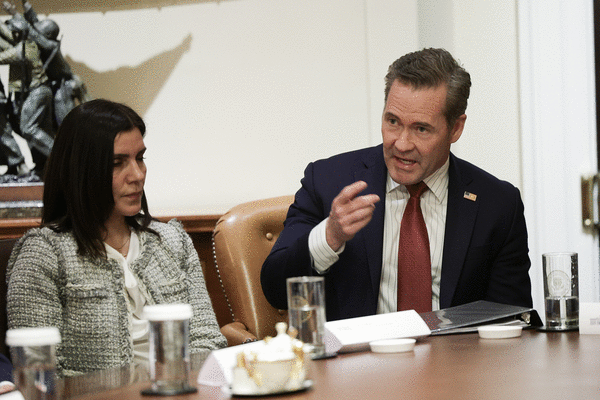
The U.S. ambassador to the United Nations on Thursday rejected claims the U.S. policies are responsible for Cuba’s worsening humanitarian crisis, telling U.N. member states that the U.S. government is offering a new $100 million humanitarian aid package while accusing the Cuban government of causing the island’s shortages through corruption and failed economic policies.
The sharp exchange came during a briefing on Cuba, hours after Stéphane Dujarric, spokesperson for U.N. Secretary-General António Guterres, told journalists on all of Cuba’s “basic services, from clean water and sanitation to food production and the health sector, have been impacted by the lack of fuel and electricity.”
Edem Wosornu, director of the Crisis Response Division at the U.N. Office for the Coordination of Humanitarian Affairs, chaired the briefing. Wosornu recently traveled to Cuba with officials from the World Health Organization and the Pan American Health Organization. He said the visit was “strictly humanitarian” and focused on the impact of overlapping crises, including repeated hurricanes, economic constraints linked to sanctions and persistent energy shortages.
“What we’re seeing here today is beyond the impact of one single event,” Wosornu said.
She said Cuba’s energy crisis is affecting nearly every aspect of daily life, including access to water, food systems, sanitation, education and health services. Humanitarian groups are also struggling to deliver aid because of fuel shortages, transportation problems, higher logistics costs and complications tied to U.S. sanctions.
In one pediatric hospital she visited, Wosornu said, “only the emergency room and the intensive care unit remained open out of seven wards due to lack of electricity.”
Francisco Pichón, the U.N. resident coordinator in Cuba, said the island energy crisis has become “a growing humanitarian emergency that is affecting millions of people every single day.” Since the beginning of the year, he said, no new oil shipments have reached the country for regular distribution and use in the national power system, except for one Russian shipment in April that covered roughly two weeks of demand.
As a result, Pichón said, daily blackouts in Havana now exceed 20 to 22 hours, while outages in other parts of the country can last more than a day.
“Night has become days,” Pichón said, describing how Cuban families cook, store water and reorganize their lives around the few hours electricity is available.
Pichón said about 2.7 million people are affected by water shortages, the national water system is functioning at 37% with the available fuel and only about 30% of essential medicines are available. He also said about 100,000 patients are waiting for surgeries, including 12,000 children.
The U.N. humanitarian action plan for Cuba seeks $94.1 million and targets 2.2 million people, Pichón said. About 33% of the funding, or approximately $31 million, has been secured, leaving a funding gap of about $60 million. He said the biggest obstacle remains access to humanitarian fuel.
“The challenge extends beyond fuel,” Pichón said, adding that banks, shipping companies, logistics providers and private sector actors are increasingly avoiding transactions connected to Cuba because of sanctions concerns and overcompliance.
He said 2,900 metric tons of food are currently delayed in reaching Cuba.
Ernesto Soberón Guzmán, Cuba’s permanent representative to the United Nations, blamed the crisis on U.S. policy, calling it a “policy of collective punishment” and saying recent U.S. executive orders have intensified the economic pressure on the island.
“The complex humanitarian situation Cuba faces today has a direct cause: the inhumane policy of collective punishment imposed by the United States against my country,” Soberón Guzmán said.
But U.S Ambassador Mike Waltz pushed back sharply, saying the United States “stands with the people of Cuba,” but not with the Cuban government, which he accused of failing, jailing and stealing from its people.
Waltz said the U.S. has provided $9 million in humanitarian assistance since Hurricane Melissa struck in October 2025 and is now offering an additional $100 million package that includes food, hygiene products and water treatment supplies. The aid, he said, would be distributed directly to the Cuban people through the Catholic Church and other reliable institutions, not through the Cuban government.
Waltz also denied that there is an “oil blockade,” saying Washington has permitted fuel deliveries from Russia and fuel shipments from the United States to private entities not affiliated with the Cuban government.
“It’s not because of the embargo, or because of an ‘oil blockade,’ which is untrue and fake,” Waltz said. “Cuba is suffering because the regime chose failed communist economics.”
He said the Cuban government must open the economy, free political prisoners and stop blaming the United States for the island’s suffering.
Soberón Guzmán accused the United States of lying about the causes of the crisis and said the embargo has caused billions of dollars in annual damage to Cuba.
“The best assistance that the U.S. government could provide to the noble Cuban people at this time or any time is to de-escalate the energy, economic, commercial and financial blockade measures,” Soberón Guzmán said.
Wosornu closed the briefing by urging member states to turn the discussion into help, including funding and access to fuel for humanitarian purposes.
“This is a pivotal moment,” Wosornu said. “I urge all of us to translate today’s discussion into concrete support.”
©2026 Miami Herald. Visit at miamiherald.com. Distributed by Tribune Content Agency, LLC.



Comments