San Diegans voted for far more police oversight. Little has materialized, a new report finds
Published in News & Features
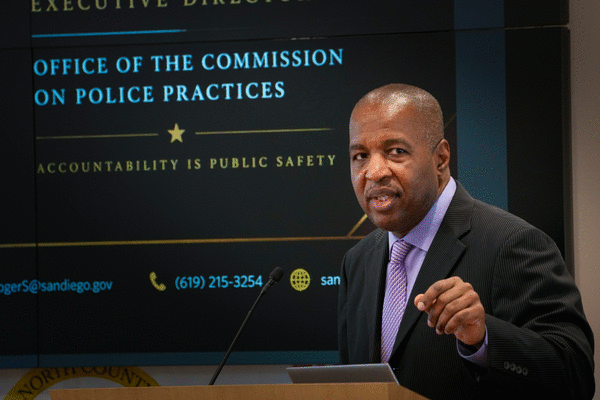
SAN DIEGO — More than five years after San Diego voters overwhelmingly approved the creation of a stronger, more independent system of police oversight, the city’s Commission on Police Practices still lacks many of the powers voters were promised.
Nearly 75% of San Diego voters approved Measure B in November 2020 amid nationwide calls for greater police accountability following the murder of George Floyd.
The measure sought to replace the city’s previous Community Review Board on Police Practices with a new commission that would have subpoena power and the authority to conduct its own investigations into allegations of police misconduct.
But the commission continues to operate largely as its predecessor did — reviewing San Diego Police Department internal affairs investigations and issuing policy recommendations.
In a report released earlier this month, the San Diego County Civil Grand Jury raised concerns about the commission’s slow rollout and cited stalled labor negotiations, staffing challenges, limited access to police records and delays in obtaining information from the Police Department as major obstacles.
Councilmember Henry Foster III, who serves on the City Council’s public safety committee, called the timeline unacceptable.
Implementing Measure B “does need to be prioritized, and the commission needs to be given the attention and the resources to get this done,” he said.
Foster blamed much of the delay on turnover at the commission, including the resignations of Executive Director Paul Parker and General Counsel Duane Bennett in late 2024.
Parker, who previously led the county’s Citizens Law Enforcement Review Board, resigned after only six months on the job and warned in an exit memo that it could take years before the commission began functioning as voters intended.
Their departures came as the commission was trying to finalize the operating procedures needed to carry out many of Measure B’s provisions.
Foster said he’s optimistic about the commission’s direction under Roger Smith, who was hired as executive director earlier this year.
“I think we got the right person in the right place,” Foster said.
Before being hired to lead the Commission on Police Practices, Smith spent more than 16 years in civilian police oversight, including leadership positions in New York City, Cleveland, Phoenix and Oakland. He previously worked as a prosecutor in Manhattan and as an attorney for New York City’s Department of Correction.
While Smith said he was familiar with San Diego’s challenges before accepting the job, he said seeing them from the inside has been a different experience.
He’s become increasingly vocal about what he sees as systemic obstacles slowing the commission’s development.
“The commission is a baby, but unlike real babies, this one can be kept a baby if you keep it from growing,” he told the audience at a recent forum on police accountability.
At the center of those obstacles is a state-mandated labor negotiation process known as “meet and confer,” a form of labor negotiations required before the commission can implement permanent operating procedures.
The process has taken significantly longer than anticipated.
A year ago, commission leaders expressed optimism that negotiations would begin soon. Instead, the commission is still operating under interim procedures approved in 2021.
Smith argues that delays have extended beyond the labor negotiations themselves.
He pointed to disputes over proposed operating procedures and prolonged administrative reviews that he believes slowed progress toward negotiations with the police union.
The result, he said, is that San Diego remains years behind where voters expected the commission to be.
The grand jury raised similar concerns, urging city leaders to move the negotiations forward.
The commission has also struggled to get the information it says it needs. While it doesn’t have investigative authority, CPP investigators can review Police Department internal affairs investigations. Lacking direct access to the databases that hold that information, investigators rely on the department to provide records.
Grand jurors found the arrangement can create delays and makes it difficult for the commission to know whether it’s received everything it needs.
Smith said his investigators often must make additional requests when materials appear incomplete.
“Access is a problem,” he said, “in the sense that where we don’t have immediate access to data and we don’t receive everything in the first submissions that we get from the department, we often have to make follow-up requests to get information that we need — that does affect the timeliness of reviews.”
The issue extends beyond individual investigations.
Smith has also raised concerns about those complaints the commission never sees because internal affairs categorizes them as informal or frivolous.
Without those records, he said, the commission has no way of independently evaluating whether these complaints were categorized appropriately.
That issue also surfaced in the recent grand jury report, which found the commission lacks access to complete complaint data.
The question of how complaints are classified is already under scrutiny. The city auditor recently launched a review of the Police Department’s Internal Affairs unit, looking at how complaints are categorized, investigated and resolved.
Foster said transparency from the Police Department must improve.
Referencing concerns raised in the grand jury report, he said he specifically discussed information-sharing with Police Chief Scott Wahl during the chief’s confirmation process.
“I will also be holding them accountable to make sure that they are meeting their obligations to provide the commission with the information that they need to do the work that they are there to do,” Foster said.
Even without independent investigative authority, the commission has spent the past few years reviewing a backlog of internal affairs cases, commissioning an outside audit of police misconduct investigations and weighing in on department policies.
One of the biggest disputes has centered on vehicle pursuits.
After several chases killed people, the commission recommended tighter restrictions on pursuits in 2024. But the Police Department declined to adopt the recommendations.
While the CPP can make recommendations, it cannot compel the Police Department to adopt them.
The commission also continues to face resource challenges.
Smith said one of his top priorities is obtaining funding for a complaint information management system that would allow the commission to better track investigations, manage records and analyze trends.
The request has been included in multiple budget cycles but has not yet been funded, he said.
Foster said he supports the request and hopes the council approves funding for the system in the coming weeks.
©2026 The San Diego Union-Tribune. Visit sandiegouniontribune.com. Distributed by Tribune Content Agency, LLC.





Comments