The pope appears to Spain's Pedro Sánchez in his moment of need
Published in News & Features
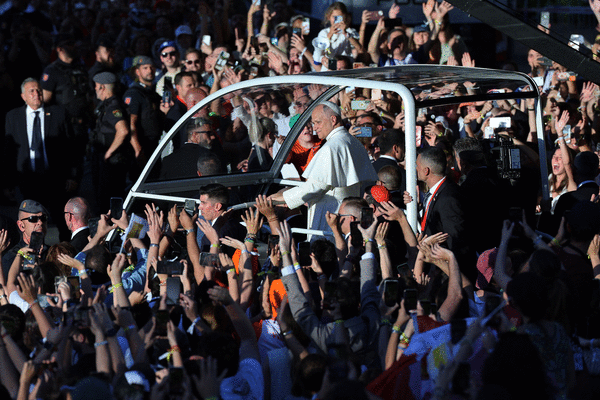
Pedro Sánchez is having a come-to-Jesus moment.
After eight years in office, Sánchez attended his first Roman Catholic mass as prime minister on Wednesday when Pope Leo XIV blessed the Sagrada Familia cathedral in Barcelona. Sánchez’s Socialists have traditionally had a difficult relationship with the church — but this week, with this pope, the 54-year-old premier has found that religion can work for him.
Sánchez has been having a terrible time lately with his brother on trial, his mentor hit by graft allegations and a probe into alleged dirty tricks against judges investigating his party all turning voters against his government. The pope provided a welcome distraction.
It wasn’t just that he brought a million people onto the streets of Madrid and dominated the news agenda with his weeklong trip. Leo also put the conservative opposition on the spot with barely veiled support for two of Sánchez’s most controversial positions: opposition to the U.S. war on Iran and offering a welcome to migrants, a stance which has provoked a ferocious response from the right-wing opposition.
“Today, here, by the sea, every life that arrives asks us what remains of our humanity,” the pope said Thursday in Port of Arguineguín in the Canary Islands, the destination for tens of thousands of migrants each year who attempt the treacherous sea crossing from southern Morocco.
“Sooner or later, it will be known whether we knew how to safeguard it or whether we allowed indifference to speak for us,” the pope warned.
Sánchez’s aides had been optimistic about the pope’s visit ahead of time. Afterward they were delighted, in spite of a brief disruption to his return journey that resulted in King Felipe VI volunteering use of his private jet. A technical issue had thwarted the pope's original flight back to Rome.
`Life takes strange turns’
His address to the Spanish Parliament also hit on his two key themes — the dangerous forces pulling the world into wars and the need provide compassion for migrants. The speech won the pope acclaim from across the political spectrum, and a seven-minute standing ovation, despite the fact that it contained clear criticism of the positions advanced by the conservative People’s Party and the far-right Vox.
“He is putting his finger on the right’s sore spot,” said Pablo Simón, a political scientist at Carlos III University in Madrid.
Churchgoers in Spain have traditionally tended to vote for those parties even though, as politics in Spain and around the world have become more polarized, both the PP and Vox find themselves on the opposite side of the debate from the pope on both migration and the war in Iran.
“Life takes strange turns,” said Socialist Justice Minister Félix Bolaños, taunting the opposition. “In the end, we’ll be the ones going to heaven, and you’ll be burning in hell.”
That response probably wasn’t the sort of exchange the pope was hoping to elicit. He was instead at pains to try to take the heat of the political situation. “Today, the temptation to gain popularity by fanning the flames of polarization seems to have grown rather than diminished, and human dignity continues to be violated,” he said during comments at the Royal Palace in Madrid.
Whether the papal visit can offer a more long-term boost to the struggling prime minister is harder to say. "It probably will not move many votes tomorrow,” says Anna López Ortega, a political scientist at Valencia International University. “But it may influence how certain Catholic voters interpret issues such as immigration, solidarity or the role of the Church in politics over the coming months.”
Sánchez is facing public pushback from inside his own party as clings to power in the face of mounting opposition and governmental paralysis. His Socialist opponents say he’s putting his own political career ahead of his party’s interests.
A recent 40dB poll for El País gave the PP a lead of almost 5 percentage points over the Socialists who are down by a similar margin from their result in the 2023 election result. Since December, the prime minister’s party has lost all four regional elections held in Spain. In Andalusia, once a Socialist stronghold, it recorded its worst ever result.
Party tensions
“This is the moment of greatest risk for the Socialist Party in the entire democratic era,” Emiliano García-Page, Socialist president of the Castilla-La Mancha region south of Madrid, said recently. “We have to put Spain’s interests above the interests of the Socialist Party.”
García-Page, one of only four Socialist regional leaders in Spain, has spent more than a year calling for a general election. But for all the noise, there’s little that he or the right-wing opposition can do to force Sánchez’s hand before elections that are due next summer.
Under the Spanish system, a no-confidence vote requires the opposition to unite around an alternative premier, an unrealistic prospect in a divided parliament, and the premier has a tight grip on his own party machinery.
When the election does come, all the data suggest that the PP and Vox should be able to improve on the 2023 result that saw them fall four seats short of the majority they’d need to oust Sánchez’s governing alliance. But Sánchez’s many opponents have learned not to underestimate a politician who has built his career on a series of unlikely comebacks.
Even now, Sánchez argues that strong economic performance, advances in social rights and Spain’s prominent international profile will eventually win voters round. His condemnation of what he describes as “genocide” in Gaza and of the US war on Iran align with the views of many Spaniards, as does his confrontation with Donald Trump.
And for this week at least, he appears to have the vicar of Christ on his side too.
©2026 Bloomberg L.P. Visit bloomberg.com. Distributed by Tribune Content Agency, LLC.



Comments