US at odds with allies over how easy it is to reopen Strait of Hormuz
Published in News & Features
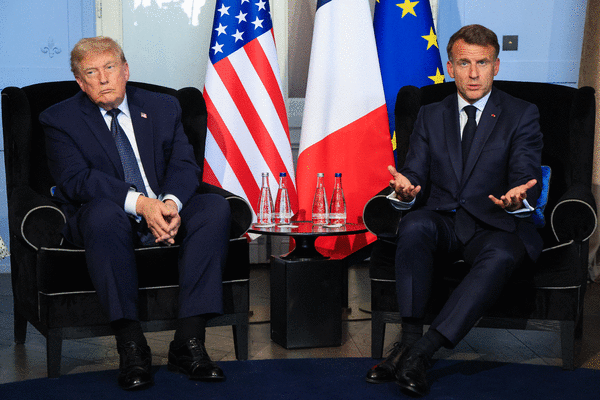
U.S. President Donald Trump keeps repeating that the Strait of Hormuz — through which one-fifth of the world’s oil and liquefied natural gas supplies normally flow — will reopen by Friday.
But on the sidelines of the Group of Seven summit, where Iran will dominate Monday’s dinner conversation, it’s clear that his European allies don’t share his optimism. They disagree that trade can resume by week’s end, like Trump promised, and have practical questions about what exactly was agreed before they can commit to de-mining missions and patrols.
According to one G7 official, speaking on condition of anonymity to discuss internal dynamics, there are serious difficulties in finding a common position among the group about how to deal with the situation in Iran. Few are expecting a joint communique, something that has proved elusive during the Trump era.
Even Italian Prime Minister Giorgia Meloni, who for the most part has artfully avoided provoking Trump, said her country’s contribution is conditional on a cessation of hostilities in Lebanon, where Israel’s military has carried out strikes in recent days. She isn’t alone in questioning Trump’s accelerated timeline.
It doesn’t help that even within Trump’s own administration, there are prominent figures who didn’t go as far in promising that navigation along the vital chokepoint can go back to normal at the snap of a finger.
One senior U.S. official said traffic in the waterway would ramp up over time, and it could take as many as two weeks for shipping to significantly increase — and even longer for it to return to the levels seen before the United States and Israel attacked Iran in February. There are mines in the strait that still need to be cleared and shippers have different risk tolerances about navigating Hormuz, the official said.
The official said the memorandum of understanding between the U.S. and Iran will make it explicit that the strait will be open toll-free for 60 days, and the U.S. will expect that provision makes it into a final agreement. The fact is that free navigation, once a given, is now the subject of negotiations that haven’t even started.
Oil industry leaders have told the White House and the broader Trump administration for months that it would be untenable for the U.S. to permit tolls being charged for safe passage through the Strait of Hormuz, according to a person familiar with those discussions, who asked not to be named because they were private. The White House knows where the industry stands, the person added.
While the U.S. and Iran both said they reached an interim agreement to reopen the strait, without an official document out in the open, they have offered different descriptions of what it says.
Officials are due to sign the accord in Switzerland on Friday. U.S. officials have offered differing timelines for when the full text will be released, with Trump saying by week’s end at the earliest and another senior U.S. official saying within the next two days. Vice President JD Vance is likely to represent the administration at the signing.
The G7 leaders will next decide on a framework to de-mine the waterway, including an agreement from Iran and other involved parties, Bloomberg reported earlier. European leaders are planning to seek Trump’s approval for the mission at the G7.
The problem they are facing is that Trump has played down their role and the difficulties that they would face in trying to help.
“Ships are starting to go out now, on Friday it’ll be completely opened,” Trump said Monday at the leaders summit in Evian. “They’re doing a little hunting for a couple of mines that they’ve already found, but it’s — essentially ships are starting to go out now.”
Furthermore, deployments won’t start before there’s a final agreement between the U.S. and Iran that restores full and unimpeded commercial navigation rights as well as a permissible environment for military assets in the strait, Bloomberg previously reported.
That could be a matter of weeks rather than days, German officials are warning, because any direct involvement would require an international mandate. And clearing the mines could prove complex and time-consuming.
It’s not clear how many mines are in the strait or even whether any were placed to begin with. Iran has, at various times, said it had mined the narrow waterway. As early as mid-March, the United Kingdom said it appeared clear Iran had done so, while the U.S. said that was not the case.
Ensuring the strait is clear will be a painstaking exercise, said Caitlin Talmadge of the Massachusetts Institute of Technology. The work will go faster if Iran provides whatever information it has about mine placement, she said.
European countries have a substantial amount of mine-clearing capabilities, she added. But those vessels will be in a bad position if hostilities resume.
“Mine clearance operations are intended to be conducted in a permissive environment,” she said. “The relevant vessels and operators could be vulnerable if Iranian attacks resume, particularly dedicated mine countermeasures ships which generally lack an ability to defend themselves.”
In spite of their reservations, Europeans are moving forward with their planning.
French President Emmanuel Macron and U.K. Prime Minister Keir Starmer have led an effort by U.S. allies to produce a plan to help reopen the strait in the event of a final peace deal. More than 15 countries have committed equipment and personnel to the mission.
As host — and this is his last G7 as leader — Macron is invested.
“It’s a very important matter for peace, for the whole world, and it will reopen Hormuz,” Macron said. “It will provide peace in Lebanon. And so we are ready to take our fair share of the burden and be part of the commitment of the international community.”
_____
(With assistance from Ania Nussbaum, Gerry Doyle, Catherine Lucey, Jennifer A. Dlouhy and Iain Marlow.)
©2026 Bloomberg L.P. Visit bloomberg.com. Distributed by Tribune Content Agency, LLC.





Comments