US hails deal that defers war goals and gives Iran relief
Published in News & Features
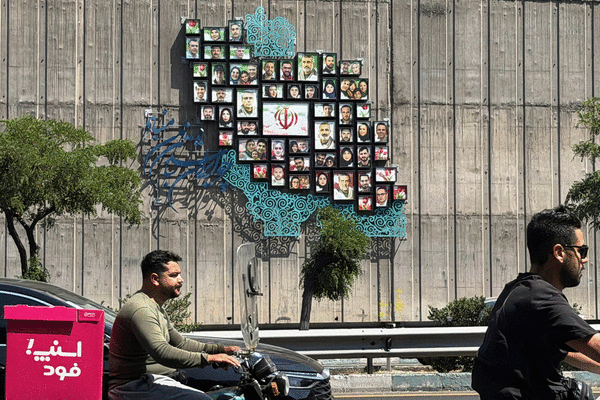
The Trump administration hailed its interim peace deal with Iran that’s meant to reopen the Strait of Hormuz, even as hawks in the U.S. pointed to the billions of dollars of economic gains set to come Tehran’s way.
Iran will be allowed to restart oil exports immediately under the so-called memorandum of understanding, with the U.S. granting sanctions waivers, according to a draft of their agreement seen by Bloomberg News. Tehran will also potentially gain access to a $300 billion development program following negotiations for a permanent peace and see funds held in various countries unfrozen, albeit only if it meets certain criteria.
The MOU does not in itself restrict Iran’s nuclear program or say Tehran commits to relinquishing or destroying its stockpiles of highly-enriched uranium. Those will only be discussed during an upcoming 60 days of possibly tense talks. The timeframe, which many analysts say is too short given the highly-technical nature of the topics, can be extended if the sides agree.
“It’s much bigger than a mistake,” Mike Pence, U.S. President Donald Trump’s vice president from his first term, said to CNN of the provisional deal. “These immediate concessions, particularly sanctions waivers right out of the gate, would essentially be a lifeline to the Iranian regime. I think it’s ill-advised. We’ve got to keep the pressure on.”
Trump batted aside criticism, saying the deal would stop Iran getting a nuclear bomb and dismissing the notion the U.S. would contribute any money to the rehabilitation fund, but said other countries would be free to invest in the Islamic Republic.
Washington would “not be putting up 10 cents,” he said at the Group of Seven summit in France on Wednesday. He pointed to a rise in stock prices and oil falling, saying, “there’s nothing so smart as the market, and the market loves it beyond anything that I’ve actually seen.”
The MOU is scheduled to be formally signed by U.S. Vice President JD Vance and Iranian Parliament Speaker Mohammad Bagher Ghalibaf in the Swiss town of Lucerne on Friday. Neither Washington nor Tehran has yet officially released the document.
Iran’s Tasnim news agency cited an unnamed official on Wednesday as saying parts of the text published by Bloomberg are inaccurate. The report did not specify what was different. Bloomberg previously reported there could be differences in the wording between the English and Persian versions of the MOU.
Trump and Israeli Prime Minister Benjamin Netanyahu — who began the war by bombing Iran on Feb. 28, saying it was necessary to stop the Islamic Republic building a nuclear weapon and alluding to regime change — have fallen far short of their initial aims.
Their forces battered Iran’s military and economy, causing hundreds of billions of dollar of damage. But the Islamic Republic, an arch enemy to the U.S. and Israel since being ushered in by Iran’s 1979 revolution, is still standing, despite Trump saying Iranians would soon be able to “take over” their government.
The 15-week war has taken longer than Trump expected, and he’s been increasingly frustrated by Iran’s refusal to cave in to his demands. Tehran has shown it can still menace the region. It fired drones and missiles at American allies such as Kuwait, Bahrain and the United Arab Emirates in recent weeks as a ceasefire that started in April came close to collapsing.
Iran’s ability to effectively close the Strait of Hormuz weakened the White House’s position, sending oil prices soaring and hurting the global economy. The rise in prices in the U.S. hit the standing of Trump and his Republican Party ahead of November’s midterm elections.
At its core, the interim deal “trades the reopening of the Strait Hormuz for economic relief,” said Bloomberg Economics analysts including Dina Esfandiary and Ziad Daoud. “But the exchange is uneven: Tehran’s gains will be plenty and new. Washington will just recover some benefits that existed before the war began in February.”
Oil has fallen sharply since Trump announced late last week a deal was imminent. It steadied on Wednesday, with Brent rising slightly to just below $80 a barrel.
While its down from a high of $125 in late April, it’s still up more than 30% this year, with energy traders saying it will take weeks — maybe months — for oil and liquefied natural gas flows through the Hormuz strait to return to normal.
The MOU says Iran will immediately start allowing maritime traffic through the chokepoint again, though it’s unclear if it will try to charge ships fees of some kind. Iranian media has reported that Tehran will introduce navigation fees after about 60 days, while the U.S. has insisted that there is free passage for vessels.
The document, similarly, is vague on the release of Iran’s tens of billions of dollars of frozen assets, held in countries such as Qatar. It says the U.S. undertakes that those funds “will be released and made fully available” without setting a timeline.
Asked for comment, a U.S. official declined to discuss the specifics of the draft but said Iran can only benefit if it meets commitments. Those include never acquiring a nuclear weapon, neutralizing its enriched material and allowing free navigation in the strait.
Iran will demand “full assurance regarding effective access” to frozen funds following the official signing of the interim deal, the semi-official Tasnim news agency cited Central Bank Governor Abdolnaser Hemmati as saying on Tuesday.
A key challenge in the talks ahead will be the war between Israel and Iran-backed militant group Hezbollah. The draft version said the U.S.-Iran conflict will be ended “on all fronts, including in Lebanon.” That will require consent from Netanyahu, who has so far refused to stop fighting Hezbollah or move Israeli troops out of southern Lebanon. He says Hezbollah continues to threaten communities in northern Israel with missiles and drones.
“It’s crucial that Israel stays in southern Lebanon for the time being, cleaning after the Hezbollah infrastructure,” Mark Regev, former Israeli Ambassador to the U.K., told Bloomberg on Wednesday.
Ghalibaf, Iran’s lead negotiator with the U.S., said Israel “must withdraw from occupied territories” in Lebanon, according to the semi-official Mehr news agency.
The deal presents political risks for Trump, who had claimed for years that a 2015 accord between President Barack Obama’s administration and Iran over its nuclear program amounted to a massive financial giveaway to Tehran. Trump scrapped that agreement in 2018 and promised something far better.
©2026 Bloomberg L.P. Visit bloomberg.com. Distributed by Tribune Content Agency, LLC.



Comments