Conspiracy indictment against Minnesota anti-ICE demonstrators comes as federal prosecutors struggle to hold up similar charges
Published in News & Features
MINNEAPOLIS — The 94-page indictment unsealed by federal prosecutors Tuesday that accuses 15 Twin Cities residents of conspiring to impede immigration enforcement efforts or injure federal officers is relentlessly detailed, with thorough descriptions of alleged ties to the leftist “antifa” movement, and reams of direct messages and social media postings on apparent plans to interfere with federal agents.
“We’re not talking about peaceful protests anymore,” defendant Kyle Wagner said on social media.
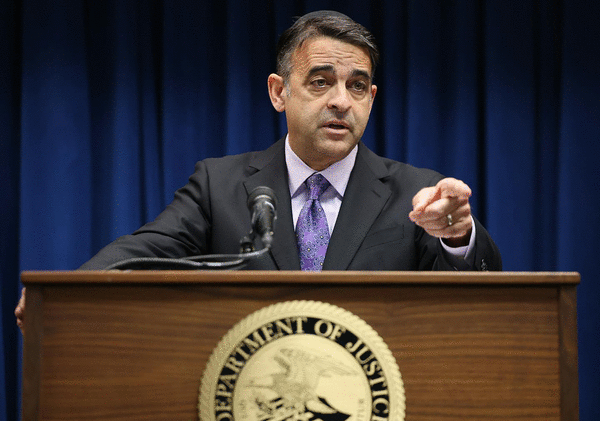
What the indictment doesn’t include is any direct assertion that federal agents were injured as a result of the online coordination. Pressed on that question Tuesday, U.S. Attorney Daniel Rosen responded that “whether or not they actually at the end of the day caused bodily harm is not the measure of whether or not they committed a federal crime.”
“I would dare say, we just cannot have in this country people getting together, engaging in all of these violent acts, and then simply saying ‘Well, you know, nobody got hurt, so how bad could it have been?’” Rosen said.
The indictment quickly drew opposition from critics, including some lawyers who called it a “propaganda show” and said the 15 are being prosecuted despite their First Amendment right to protest — while the government alleges they went far beyond that. It also comes as the U.S. Attorney’s Office is struggling to make many of its accusations against Minnesota-based protesters stick in the courtroom. About a third of the cases have been dismissed as prosecutors downgrade or drop charges. As recently as Wednesday, prosecutors quietly moved to dismiss the case against Davis Redmond, who stood accused of assaulting and impeding officers.
Many question whether a similar outcome awaits Tuesday’s indictment.
“I know (judges) haven’t been happy with the grounding in the cases,” said University of Richmond law professor Carl Tobias. “I’m not sure whether DOJ is going to have a very good reception in the federal courts there.”
A Minnesota U.S. Attorney’s spokesperson referred to Rosen’s prior remarks when asked for comment.
The new charges come months after a wave of criticism and, at times, civil contempt findings, by Minnesota’s federal bench over the U.S. Attorney’s Office’s handling of immigration and some criminal cases. The crush of immigration filings, known as wrongful detention petitions, strained the federal prosecutor’s office, which saw an exodus of veteran talent at the start of the year over Justice Department directives.
Tobias said similar, critical responses from Minnesota’s federal bench could come in response to the new charges.
“The federal judges in Minneapolis have been dubious about most of what’s going on in the U.S. Attorney’s Office,” Tobias said.
The majority of Tuesday’s indictment details messages between defendants through the Signal app or social media about coordinating actions or protests. There are a few mentions of the members wearing clothing or gear with labels saying “antifa.” The indictment focuses on the group Direct Action Minnesota, which prosecutors referred to as an organization “dedicated and committed to direct action against federal law and immigration enforcement. Direct action refers to disruptive and obstructive tactics to forcibly challenge, block, or stop immigration raids, detentions, and deportations.”
Antifa has been a target of Trump dating back to 2020 during the unrest following George Floyd’s murder. In September 2025, Trump issued an executive order designating the movement a domestic terrorist organization. The White House repeated similar claims in a news release on Wednesday, referring to the defendants as “terrorists.”
In announcing the charges, Rosen cited the National Security Presidential Memorandum 7, a directive ordering the Justice Department to prioritize politically motivated violence.
Tobias said Trump’s hard-line stance was probably a major factor in bringing these charges at a time when other cases have faltered.
“This is just him blowing off steam, as far as I can tell,” Tobias said about Trump.
Jessica West, assistant professor of law at Mitchell Hamline School of Law, said she was struck by the length of the criminal case, which she said shows the U.S. government has done significant investigative legwork. In a court filing asking that the case be designated complex, prosecutors said their evidence includes more than 20 terabytes of information that covers 44,000 pages of written reports, surveillance and body cameras and 15 terabytes of message exchanges through the Signal app.
At the same time, West said she sees differences between the defendants in terms of the severity of their alleged actions. She pointed to the allegations against William Morgan, whom the indictment accuses of taking part in an “Anarchist Speaking Tour” to discuss tactics against immigration enforcement officers, and the following of an ICE agent from Whipple to Hudson, Wis., near where an officer lived. West said the latter act falls under protected First Amendment rights.
“One of the things the government sometimes does, and I would venture a guess is certainly doing here, is lumping all these people in together so that the case against (a defendant) doesn’t seem as weak,” West said.
She added that it’s “very hard to know, even from a 276-paragraph indictment,” how the facts will play out among the defendants but that it will likely be different for each person.
During Tuesday’s news conference, Rosen highlighted the case against Wagner, the leader of Direct Action Minnesota, who in a video posted online lamented, “This is exactly what I said was going to (expletive) come when we didn’t (expletive) go march on (expletive) Whipple with guns.” He remains in custody after his arrest in February on threat charges.
Four of the defendants face additional charges beyond conspiracy, including interstate stalking, solicitation to commit a crime of violence, destruction of government property and assault on a federal officer.
The indictment drew swift reaction.
Hundreds of people demonstrated outside the Minneapolis and St. Paul federal courthouses following the charges, at one point leading to clashes in St. Paul, where law enforcement unleashed chemical irritants and flash-bangs while protesters tried to keep the courthouse doors open.
Many of the protesters characterized the charges as another form of retaliation against activists who criticized ICE during Operation Metro Surge. They expected the indictment will have the same weaknesses as prior such cases.
Outside the Warren E. Burger Federal Building, one of the defendants, Cameron Kennedy, called the allegations against him and the 14 others “ a new wave of political reprisal.”
“It’s basically just alleging that we were conspiring to protest,” he said. “Essentially, if we’re guilty of (the charges), so is the entire city of Minneapolis.”
_____
(Elliot Hughes and Louis Krauss of the Minnesota Star Tribune contributed to this report.)
_____
©2026 The Minnesota Star Tribune. Visit startribune.com. Distributed by Tribune Content Agency, LLC






Comments