Trump-backed conservative leads in Colombia presidential runoff
Published in News & Features
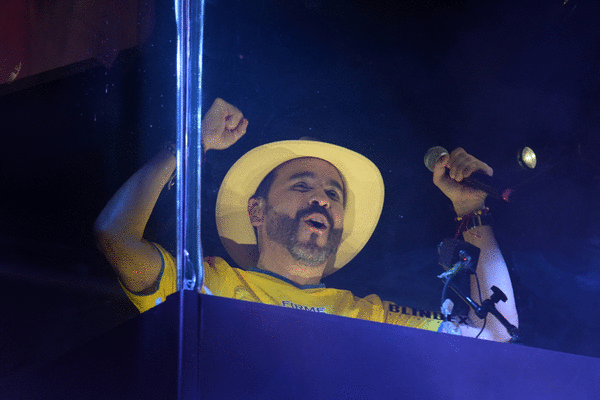
Conservative attorney Abelardo de la Espriella led Colombia’s presidential runoff as early results came in Sunday, putting him in a strong position to sweep aside Gustavo Petro’s leftist movement and align Bogota with the Trump administration.
De la Espriella received 50.6% of the vote with 65% of polling stations reporting, according to the electoral authority. Leftist senator Iván Cepeda, a Petro ally, had 47.8%, in one of the most polarized elections in the nation’s history.
More complete results are expected later Sunday. The winner will take office on Aug. 7. Petro was constitutionally limited to one four-year term.
If he can maintain his lead, the conservative lawyer’s victory would make Colombia the latest Latin American country to align with President Donald Trump.
De la Espriella, who is also a U.S. citizen, won Trump’s endorsement after campaigning to build El Salvador-style mega prisons, bomb the camps of cocaine-trafficking militias, and reopen the nation to new oil exploration including by allowing fracking.
He leaned heavily on patriotic imagery and messages centered on security, national identity and “patria.” Legal disputes over his use of symbols including the national football team’s jersey became a campaign issue in its own right.
The outcome is being closely watched by markets and business leaders concerned about the direction of policy in South America’s third-biggest economy. Colombia faces widening fiscal deficits, slowing growth and persistent inflationary pressures.
Many investors view De la Espriella as more likely to pursue fiscal discipline and preserve the independence of the central bank, which came under repeated pressure during Petro’s administration. Cepeda, the son of a slain communist leader who has spent more than four decades in politics, has sought to reassure moderate voters and investors that his government would avoid radical economic shifts while continuing Petro’s social agenda.
The election is also being closely watched in Washington, where Trump has pledged the U.S.’s “total support” for Colombia if De la Espriella prevails. By contrast, Trump has sparred publicly with Petro, and would likely to do so if Petro’s ally Cepeda assumes the presidency.
Cepeda, who has a strong base of support among low income Colombians and Black and Indigenous voters, said he would increase taxes on the rich, redistribute land to poor farmers and ban fracking. He was one of the architects of the “Total Peace” plan, which has brought drug-trafficking groups to the negotiating table though failed to produce large demobilizations of fighters or quell Colombia’s tide of violence.
The presidential vote follows congressional elections in March, when Petro and Cepeda’s Historic Pact coalition won 25 of 108 Senate seats, making it the chamber’s largest bloc.
A victory for De la Espriella, a political novice who has never held elected office, would raise questions about his ability to govern.
The campaign grew increasingly acrimonious after the first round. Cepeda sought criminal charges against De la Espriella, while the conservative candidate repeatedly questioned the integrity of the electoral process and enlisted support from international allies to monitor the vote.
Polling Stations
By mid-morning around Bogotá’s Virrey Park, an affluent neighborhood in the city’s north, entire families accompanied by children and dogs were streaming to polling stations. Many wore Colombia national football team jerseys, which De la Espriella controversially appropriated as a campaign symbol, while a few sported white caps reading “Make Colombia Great Again.”
Days earlier, a large mural depicting a tiger in Colombia’s national colors — another De la Espriella motif — had been painted nearby, while campaign posters and stickers for Cepeda covered poles and walls, something not seen during the first round. On election day, however, the mural had been partially covered with black plastic sheets, and most of the posters and stickers had been torn down.
Elsewhere in the neighborhood, some businesses had reinforced their storefront windows amid concerns that a De la Espriella victory could trigger protests, particularly if Petro refuses to recognize the result. Social media was flooded with posts urging voters to cast their ballots and return home, reflecting the tense atmosphere surrounding the vote.
Eighteen-year-old Jefferson Guarín headed to Corferias, Bogotá’s largest voting center, on Sunday afternoon.
“I’m really nervous that there could be protests,” he said a few meters from a car displaying advertising for leftist candidate Iván Cepeda. “The country is far too divided.”
Some voters at Corferias wore Colombia’s national football jersey. Among them was 70-year-old pensioner Danilo Sánchez.
“The idea is to remain optimistic that everything will unfold peacefully,” he said as he left the voting center.
Broad Appeal
Both candidates adjusted their strategies in an effort to broaden their appeal. Cepeda sought to reassure moderate voters by abandoning proposals to rewrite the constitution and campaigning in Bogotá districts where he had underperformed in the first round.
The candidates never met for a debate. Instead, both focused on rallies, media appearances and voter mobilization efforts in the final stretch of the race.
About 41 million Colombians were eligible to vote, including citizens living abroad, who began casting ballots earlier this week at Colombian consulates.
_____
©2026 Bloomberg L.P. Visit bloomberg.com. Distributed by Tribune Content Agency, LLC.






Comments