Did South Florida help decide Colombia's election? See what voters are saying
Published in News & Features
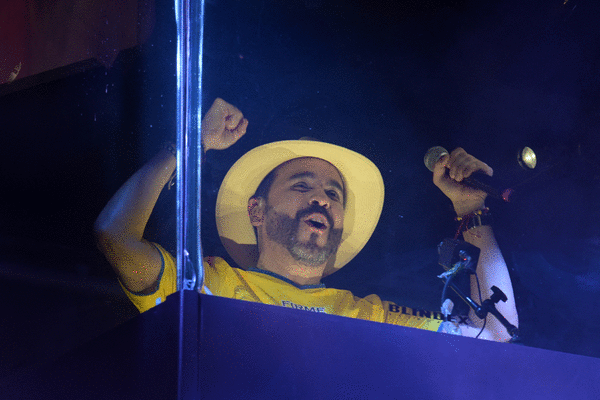
For many Colombians in South Florida, the outcome of Colombia’s presidential election felt deeply personal.
As preliminary results showed conservative candidate Abelardo de la Espriella narrowly defeating leftist rival Iván Cepeda, supporters across Miami-Dade, Broward and Palm Beach counties poured into the streets waving Colombian flags, honking horns in long car caravans and chanting in scenes that mirrored celebrations unfolding simultaneously in Bogotá, Medellín and Barranquilla.
In Doral, Weston, Kendall and parts of Palm Beach County, yellow, blue and red flags fluttered from car windows as supporters drove through neighborhoods, many describing the moment as one of relief after what they viewed as four difficult years under President Gustavo Petro.
For members of the Colombian diaspora, the celebrations reflected more than partisan victory. Many said they felt their votes, cast over seven days, may have directly influenced the outcome.
“There’s a real sense that Colombians abroad helped put a president in office,” said Camilo Florido, a Doral resident and spokesperson for the Centro Democrático party, speaking from Bogotá, where he traveled as an election observer after casting his ballot in Miami earlier in the week.
Florido said the atmosphere in Colombia the morning after the vote was charged with optimism.
“There is an air of hope,” he said. “The country has gone through four very difficult years, and now people are looking toward the future with expectation and optimism.”
The closeness of the national race has only strengthened the perception among overseas Colombians that their turnout may have tipped the balance.
With 99.65% of votes counted, de la Espriella had secured 12,931,544 votes, or 49.65%, compared with 12,684,994 votes, or 48.70%, for Cepeda, according to Colombia’s Registraduría Nacional. The margin separating the two candidates stood at just 245,738 votes, or 0.95 percentage points.
The razor-thin lead was far narrower than many polls had anticipated and less than half the margin de la Espriella held after the May 31 first round, when he led by more than 659,000 votes. While both candidates expanded their support in Sunday’s runoff, Cepeda gained ground at a faster pace, turning the contest into one of the closest presidential races in recent Colombian history.
More than 426,000 voters cast blank ballots, representing 1.63% of the total, while 220,507 ballots were declared invalid and another 29,455 were left unmarked, underscoring how even small shifts in voter behavior could prove consequential in such a tight race.
According to Florido, the nationwide margin between de la Espriella and Cepeda had initially stood at roughly 78,000 votes, but ballots cast by Colombians abroad widened that gap substantially.
“Colombians in the exterior — especially in the United States, Europe and Latin America — made the difference,” Florido said, noting that overseas votes added about 168,000 votes to the conservative candidate’s advantage, putting him ahead by more than 250,000 votes.
The numbers reinforced a growing belief among expatriates that the Colombian diaspora has evolved into a major political force.
Historically, Colombians living abroad have voted at relatively low rates. This year appeared dramatically different.
“We broke records,” Florido said. “In the ten years I’ve lived in the United States and after participating in more than three presidential elections, this is the first time I’ve seen so much willingness from Colombians to serve as election witnesses, jurors and voters.”
That sense of civic urgency had been visible even before election day.
At polling centers such as Cypress Bay High School in Weston and voting sites in Miami-Dade, turnout was strong from early morning, with long lines and unusually high enthusiasm. Many voters described the election as a pivotal chance to push Colombia toward what they called “change” on public safety, economic management and institutional stability.
That same sense of pride was echoed by Fabio Andrade, a Colombian activist and Weston city commissioner, who said turnout in South Florida reached historic levels.
“The vote in Florida was the highest in our history,” Andrade said. “The results were very positive, and Colombians abroad played a huge role.”
According to Andrade, 69,000 Colombians voted in the first round out of roughly 131,000 registered voters in Florida. In the runoff, turnout climbed even higher, with 72,144 votes cast in South Florida alone.
“That is remarkable,” Andrade said.
He estimated that nearly 90% of South Florida voters supported de la Espriella, according to preliminary data.
“If you look at the numbers, the overwhelming majority voted for change,” Andrade said.
Part of de la Espriella’s appeal in South Florida may also stem from his personal ties to the region. The president-elect has lived and worked in Miami as a lawyer, giving him name recognition and credibility among many Colombians who have built lives in South Florida while remaining deeply invested in their homeland.
The victory also drew praise from local officials with close ties to the Colombian community.
Miami-Dade Tax Collector Dariel Fernandez publicly congratulated de la Espriella and celebrated the Colombian diaspora’s political engagement.
“Congratulations to Abelardo De La Espriella on his victory,” Fernandez wrote in a public statement. “We celebrate the democratic participation of the Colombian people and wish the president-elect success.”
Fernandez also praised South Florida’s Colombian community, highlighting its contributions to the region and its commitment to values such as freedom, entrepreneurship and prosperity.
The election result also drew strong praise from prominent South Florida Republican lawmakers, many of whom had openly backed de la Espriella and framed the Colombian election as part of a broader ideological struggle across Latin America between democratic capitalism and leftist populism.
U.S. Rep. María Elvira Salazar, a Republican whose Miami-area district includes a large Colombian-American population, congratulated de la Espriella on what she called a historic victory. She said the result sent a clear message in favor of “freedom, security and opportunity,” while arguing that leftist political models have repeatedly failed across the hemisphere.
Salazar had urged Colombians, including those in South Florida, to vote for what she described as a path toward liberty and economic progress, and had been one of Petro’s most vocal critics in Washington.
Florida Republicans Rep. Carlos Giménez and Sen. Rick Scott also celebrated the result. Giménez said, “From the United States Congress, we congratulate the next president of the sister Republic of Colombia,” while Scott described the election as “a great day” for freedom-loving nations.
Scott praised the high voter turnout and peaceful participation, adding that he expects de la Espriella’s presidency to strengthen ties between Washington and Bogotá. Both lawmakers have consistently described Colombia as one of America’s most important democratic partners in the region.
For many Colombian immigrants, political participation was shaped not only by ideology but by personal experience.
Many left Colombia because of insecurity, extortion, violence or political instability. Community leaders said that lived experience helped fuel the extraordinary turnout.
“Colombians abroad represent a very important region of Colombia,” Andrade said. “Many left because of security concerns or persecution. That creates a very strong emotional connection to what happens back home.”
Community organizers spent months ensuring access to polling sites.
Andrade said he was directly involved in efforts to facilitate voting across Florida, including helping secure polling stations outside the Colombian consulate in Miami — a process he said required significant coordination with local and federal authorities.
He noted that one of the biggest logistical victories came in Weston, where the local voting center recorded 11,294 votes in the first round, making it the largest overseas voting center by participation.
“That tells you how engaged our community has become,” Andrade said.
Not all Colombians in South Florida backed de la Espriella. Some supported Cepeda, while others remained skeptical of both candidates. Still, public celebrations and early voting patterns suggested strong pro–de la Espriella sentiment across large segments of the diaspora.
The election remains politically sensitive. Neither de la Espriella nor Cepeda immediately declared victory or conceded, while Petro raised concerns about the integrity of the process, saying there were “many irregularities” and insisting that the final word will come from the official scrutiny conducted by more than 9,000 judges and notaries across Colombia.
Even so, many Colombians in South Florida believe something fundamental has changed.
For years, overseas voters were often viewed as politically peripheral. This election may have altered that perception.
“The voice of Colombians abroad is extremely important,” Florido said. “This election showed that clearly.”
_____
©2026 Miami Herald. Visit miamiherald.com. Distributed by Tribune Content Agency, LLC.






Comments