Ex U.S. ambassador says Mexico's former president feared Sinaloa boss would expose corrupt officials
Published in News & Features
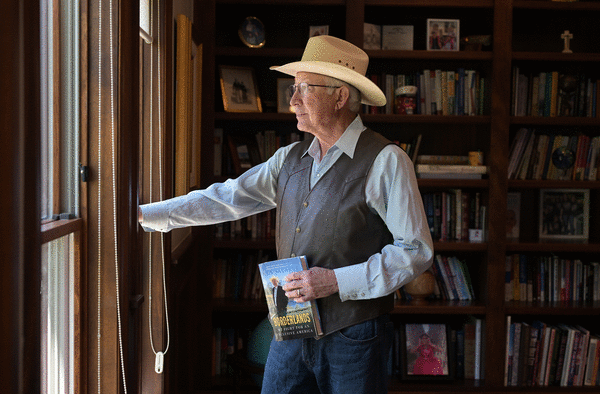
A new memoir by an ex-U.S. ambassador in Mexico — who wrote that former president Andrés Manuel López Obrador feared that a drug kingpin arrested by the FBI would "spill the beans" on corrupt Mexican officials — has ignited a media firestorm in Mexico.
In his book, Ken Salazar, the former U.S. envoy to Mexico City, said that the July 2024 arrest outside El Paso of Ismael "El Mayo" Zambada — co-founder of the notorious Sinaloa cartel — prompted López Obrador to worry that the mob boss would inform U.S. prosecutors about Mexican authorities in cahoots with organized crime.
"It was well known that Mexico's powerful transnational criminal cartels had compromised many government officials," the ex-ambassador wrote in "Borderlands: My Fight for an Inclusive America," scheduled for release next month by BenBella Books.
The account prompted pushback Monday from President Claudia Sheinbaum. At her regular morning news conference, Sheinbaum said that her predecessor and mentor was concerned about U.S. "meddling"in Mexico — not about any inside information on corruption that the jailed capo might provide to U.S. authorities.
"There was no worry about" what Zambada would tell U.S. prosecutors , Sheinbaum said.
There has been no direct response to the book from López Obrador, who is retired but long denied unconfirmed reports linking him to organized crime.
In a telephone interview, Salazar said he had never seen any evidence tying López Obrador, president from 2018 to 2024, to Mexico's cartels.
"I never saw any proof of it," Salazar said. "As far as I know, Andrés Manuel López Obrador was a president who strongly believed in Mexico and the sovereignty of Mexico."
In his book, Salazar acknowledged that the purported concern about Zambada turning snitch did not come directly from the president. Rather, the information came from an unidentified source who Salazar, using López Obrador's nickname, labeled "the AMLO whisperer, someone who was a friend and confidant to the Mexican president."
According to Salazar, "The Whisperer" told him that López Obrador "is very concerned about the information the United States will get from El Mayo."
Salazar, a Biden administration appointee who long enjoyed close access to López Obrador, was frozen out after the arrest of Zambada and never spoke to the president again, he wrote.
Salazar, a longtime Democrat and former U.S. senator and secretary of the Interior under President Obama, became a "persona non grata" in Mexico City following Zambada's arrest and resigned after the election of Donald Trump.
Salazar's account, initially reported by the Mexican daily Reforma, has caused a stir in the Mexican press and in social media. Many commentators have cited the timing — just as Mexican, U.S. and Canadian officials are negotiating a new free-trade-agreement, a pact that is crucial to the export-dependent Mexican economy.
In the interview, Salazar said the timing of the book's release had nothing to do with the free-trade negotiatons. "It takes time to write a book," he said.
Behind the controversy about the book are lingering questions about Zambada's 2024 abduction in Mexico and his arrival and subsequent arrest outside El Paso.
Mexican authorities have long voiced the suspicion that U.S. officials were behind the kidnapping of Zambada in Mexico and his transport to U.S. territory. U.S. authorities have denied any involvement.
According to the official U.S version, the septuagenarian capo was taken into custody after an insider betrayal: Joaquín Guzmán López — a son of the legendary Joaquín "El Chapo" Guzmán," Zambada's former partner leading the Sinaloa cartel — engineered Zambada's kidnapping and transport via private plane to the United States.
Guzmán López was also aboard the aircraft and surrendered to U.S. authorities when the plane landed near El Paso, according to U.S. authorities.
In December 2025, Guzmán López entered a guilty plea to federal drug charges and is awaiting sentencing. Guzmán López received no "cooperation credit" for "coordinating and committing the kidnapping" Zambada, the Justice Department said in a statement at the time of his guilty plea.
But Mexican authorities remain convinced that U.S. officials outsourced the kidnapping and rendition of Zambada, who has pleaded guilty to smuggling-related charges and awaits sentencing in the United States.
Whether Zambada has informed U.S. prosecutors about corrupt Mexican officials remains publicly unknown.
But the Trump administration — widely believed to be utilizing information from jailed Mexican narco-traffickers — has stepped up prosecutions of Mexican officials allegedly on cartel payrolls.
The most high-profile target to date is Rubén Rocha Moya, governor of Sinaloa state, who was indicted in U.S. District Court on in April.
Rocha Moya, who went on leave following his indictment to fight the charges, has denied any wrongdoing.
Washington is seeking his extradition to the United States, but Mexican authorities say they haven't seen enough evidence yet to merit extradition.
Also indicted in the same case were other high-raking officials in Sinaloa, the northwestern state that gave birth to Mexico's most notorious organized crime syndicate.
The kidnapping and arrest of Zambada occurred during the presidency of Joe Biden. But Mexican concerns about U.S. interference have only accelerated during the administration of Trump, who has repeatedly threatened to act unilaterally against Mexican cartels.
_____
(Special correspondent Cecilia Sánchez Vidal contributed to this report.)
_____
©2026 Los Angeles Times. Visit latimes.com. Distributed by Tribune Content Agency, LLC.




Comments