Minnesota faith leaders weigh AI's place in church life
Published in News & Features
The rise of artificial intelligence has Minnesota faith leaders wrestling with questions that feel both ancient and newly urgent: How should they respond to a force rapidly reshaping daily life?
And where is the line between using technology to, say, streamline church work and allowing it into relationships and spiritual practices long defined by what is human and what is divine?
Minnesota pastors are already using AI to summarize meetings, brainstorm sermon ideas and help draft church communications. Seminary professors are figuring out how to teach future church leaders in a world where students can instantly generate papers and theological reflections with the help of apps. And clergy are weighing what guidance, if any, they should offer congregants who are turning to chatbots for advice, companionship and even spiritual counsel.
Pope Leo’s recent — and first — encyclical has pushed the conversation onto a larger stage. In "Magnifica humanitas," the pope argues that artificial intelligence should serve human dignity and the common good, raising concerns about everything from jobs and economic inequality to misinformation and human connection.
Minnesota clergy and religious scholars say congregations, seminaries and denominational offices across the state are working toward drafting formalized guidance on AI use.
The Minneapolis Area Synod of the Evangelical Lutheran Church in America recently approved a resolution creating an AI task force, while Catholic dioceses in St. Cloud and Crookston are studying the encyclical and developing their own policies.
“The church is not always on the front edge of technological conversations,” said Nicholas Tangen, assistant to the bishop for faith and neighboring Practices for the Minneapolis Area Synod. “And this just feels like such a massive field.”
Grappling with the topic can mean answering questions that are both practical and deeply theological — everything from whether the Holy Spirit can be present in AI-generated religious content to whether the technology’s growing energy demands are compatible with calls to care for God’s creation.
“Maybe we’re good using AI for a flyer but not a sermon,” Tangen said. “Then what about things in between there? Like, what about a discussion guide for Bible studies? What’s innocuous and what’s not?”
Those questions are no longer hypothetical. According to a Lifeway Research study, 1 in 10 pastors say they are regular users of artificial intelligence, and nearly a third say they have experimented with it. And, according to the Christian research group Barna, roughly 4 in 10 practicing Christians say AI has helped them with prayer or Bible study.
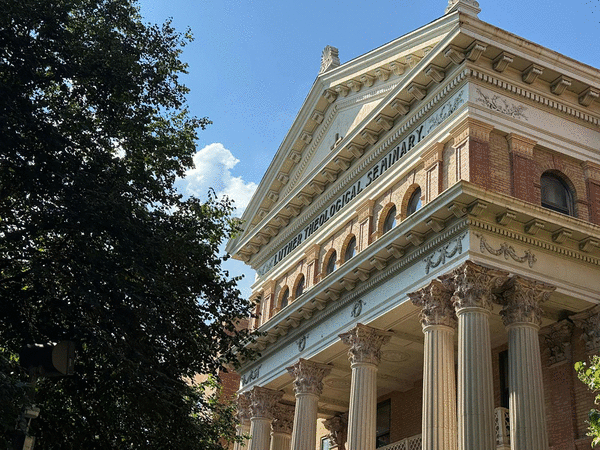
At Luther Seminary in St. Paul, conversations about AI first emerged through concerns about academic honesty since students now have access to tools capable of generating entire papers. But an all-out ban on the use of such tools isn’t practical or wise, seminary leaders say.
Clergy are using AI to organize notes for adult education classes, sharpen church fundraising materials and summarize lengthy meetings. Others see potential in analyzing neighborhood census data to better understand local demographics, identify food insecurity or guide outreach efforts.
Rolf Jacobson, dean of the faculty and a professor of the Old Testament at Luther Seminary, said clergy have long borrowed ideas from books, other preachers and prewritten sermons.
But even before ChatGPT, it wasn’t wise to stand at the lectern and pass off another person’s idea or personal story as your own, Jacobson said, because “that’s what compromises the pastoral relationship.”
Noreen Herzfeld, director of Benedictine spirituality and the environment at St. John’s School of Theology and Seminary in Collegeville, said relationships should be at the heart of any discussion about AI in faith communities.
In 2024, an AI priest known as “Father Justin” created by Catholic Answers, a Christian group in San Diego, was quickly modified after users began confessing to it and the chatbot appeared to offer absolution.
That’s an extreme example of what can happen when spiritual counsel is intentionally or unintentionally outsourced to technology, Herzfeld said.
“Wherever there is a relational component to something, AI doesn’t belong,” she said, adding that the Bible references the human component of sharing the word of God.
“The word became flesh,” she said. “Not the world became digital.”
Herzfeld said churches may ultimately have something increasingly rare to offer in an AI-driven world: a place for in-person community.
In recent years, reports suggest young people are gravitating toward faith traditions that emphasize ritual and in-person worship, she said.
“One of the ways churches may be able to meet their felt need is by being a technology-free zone,” Herzfeld said, “and giving them a place where they can come and form the kind of relationships they want, both with each other and with God.”
The questions become even more complicated when they shift from relationships to power. The biggest concerns surrounding artificial intelligence, Herzfeld said, can be traced back to a few basic questions: Who has the power? Who wields it? And for whose benefit?
The challenge for faith leaders, she said, is ensuring that AI serves the common good instead of becoming a source of division or uncurbed authority.
Within the ELCA, conversations around AI are beginning to move from discussion to formalized guidance. Earlier this year, the Minneapolis Area Synod adopted a resolution calling for the creation of an AI task force to help develop synod policies and educational resources for congregations.
The resolution cites concerns about the environmental impact of data centers, the spreading of misinformation and the risks of people forming one-sided relationships, especially for young people.
The Catholic Diocese of St. Cloud is also working on an AI policy. In a statement, Bishop Patrick Neary said any use of artificial intelligence should be measured against a simple standard, one that came through in the pope’s encyclical: Does it strengthen human dignity and the common good?
When used “ethically and thoughtfully,” he wrote, “AI can help us spread the Gospel message and offer us opportunities to communicate more clearly, reach more people and accompany one another with greater compassion.”
“Our task is to ensure that these innovations reflect our deepest values: the inherent dignity of others, care for all of creation and building the ’civilization of love’ that Pope Leo calls us to do.”
_____
©2026 The Minnesota Star Tribune. Visit startribune.com. Distributed by Tribune Content Agency, LLC





Comments