Chemours chemical company settles with Trump administration over PFAS pollution
Published in News & Features
RALEIGH, N.C. — The U.S. Justice Department has reached a $450 million settlement with Chemours over the company’s release of “forever chemicals” in three states that exposed residents to per- and polyfluoroalkyl substances, better known as PFAS.
The federal order announced Wednesday covers four Chemours facilities across West Virginia, New Jersey and North Carolina. It requires the company to pay a $22.5 million penalty and spend $90 million to reduce PFAS discharges. The deal seeks to resolve a U.S. Environmental Protection Agency complaint that North Carolina political and environmental leaders say they were not aware existed before this week.
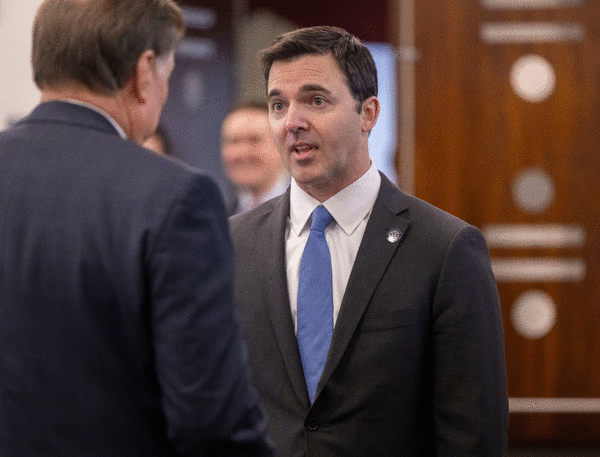
In a phone interview with The News & Observer on Wednesday, North Carolina Attorney General Jeff Jackson called the agreement “an insult to the people of Eastern North Carolina.”
“Our state is ground zero for GenX contamination, but under this deal, North Carolina would receive practically nothing,” he said. “And Chemours gets to decide how any little cleanup money we do receive is spent.”
Under the settlement, which still requires court approval, the company will dedicate an estimated $280 million to “supply clean drinking water for more than a decade” to communities near its facilities in West Virginia and New Jersey, the Department of Justice stated. The company also agreed to spend roughly $60 million to better control PFAS emissions at its West Virgina site.
In North Carolina, the Justice Department said Chemours will establish further PFAS pollution controls at its Fayetteville Works plant in Cumberland County for 15 years “based on recommendations from a third-party engineering firm.”
Chemours must also prevent the release of the chemical compound GenX at each of the four facilities at a 99% efficiency rate or higher. The company has previously acknowledged it first discharged GenX, a PFAS used to make the plastic fluoropolymer, at the Fayetteville Works plant in 1980.
In an email to The N&O, DOJ spokesperson Matthew Nies said that communities near the Fayetteville Works plant did not receive specific clean drinking water funding in this settlement because Chemours is already required to provide this through an existing agreement with the North Carolina Department of Environmental Quality.
“This first comprehensive federal settlement against a major PFAS manufacturer delivers on the Trump administration’s promise to make polluters pay and stop PFAS contamination at the source,” Jeffrey Hall, assistant administrator for the U.S. Environmental Protection Agency’s Office of Enforcement and Compliance Assurance, said in the DOJ statement.
Chemours stock rose 6% Wednesday after the DOJ released news of the settlement.
Impacts on future Chemour accountability
Gov. Josh Stein echoed Jackson in his criticisms of the settlement. “This deal does nothing meaningful for North Carolinians,” he wrote in a statement Wednesday. “This EPA, which has already weakened protections against chemicals like GenX, is now allowing polluters to pick and choose how and where they’ll fix their contamination — leaving North Carolina with no guarantees.”
In April, EPA Administrator Lee Zeldin selected two Chemours scientists to its 36-member Science Advisory Board. This marked the first time employees of the company served on the influential board.
“Tragically, this is exactly the kind of settlement we would expect from this EPA and Justice Department,” wrote Hope Taylor of Clean Water for North Carolina in an email to The N&O.
Chemours spun out of DuPont in 2015. The Delaware-based company manufactures Teflon and a range of other performance chemicals that make products non-stick or water- and weather-resistant.
As part of a 2019 consent order with North Carolina, the company had to take steps to prevent further PFAS environmental contamination. The state amended its order with new requirements the following year. In November 2021, the N.C. Department of Environmental Quality linked Chemours to the contamination of water supply wells in New Hanover County and possibility Pender, Columbus and Brunswick counties.
Wednesday’s announced settlement does not impact the state’s agreements with Chemours.
In a public statement Wednesday, the company called the settlement agreement “the latest progress delivered under the Strengthening the Long Term pillar of Chemours’ Pathway to Thrive strategy, which includes the Company’s sustained efforts to address legacy PFAS and other environmental claims.”
The National Institute of Environmental Health Sciences, which is based in Research Triangle Park, says that because PFAS don’t break down easily, if at all, they can accumulate in bodies exposed to them. One study published in 2015 on more than 1,600 people found that more than 97% had PFAS in their blood. According to the EPA, exposure to PFAS has been linked to decreased fertility, youth development delays and greater risks of certain cancers.
Kemp Burdette, the Cape Fear Riverkeeper, said he is concerned both with what the settlement says and what it means for future federal attempts to penalize Chemours.
“If this were to go forward as is, I think it will provide a shield to some, or any future attempts, to hold it accountable,” he said.
_____
©2026 Raleigh News & Observer. Visit newsobserver.com. Distributed by Tribune Content Agency, LLC.






Comments