Attorneys file wrongful death lawsuit in dehydration death of prison inmate
Published in News & Features
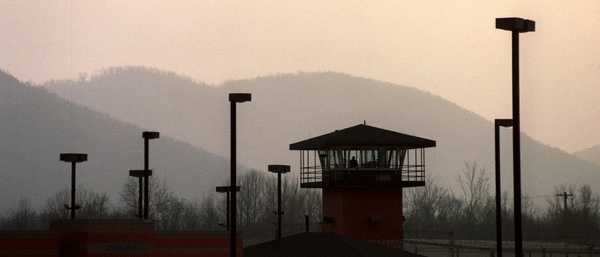
BALTIMORE — The family of an inmate at Western Correctional Institution who died of dehydration while at the facility filed a wrongful death lawsuit Thursday in Baltimore City Circuit Court. Officers, who allegedly cut off water to his cell more than a week before his death, also failed to take him to a scheduled medical appointment the day he died, the suit said.
“[Lamont] Mealy had a medical appointment on the day of his dehydration death [when officers had already observed him in need of medical help and IV hydration would have saved his life] and the officers failed to transport him to the medical appointment despite his obvious distress,” the 119-page lawsuit reads.
The family’s suit seeks economic and punitive damages in excess of $75,000.
Mealy, 52, died in his cell on July 5, 2023. The state medical examiner ruled that Mealy died of dehydration, and determined the manner of death an accident.
A fellow inmate, who was in a nearby cell, wrote a letter to Gov. Wes Moore and other officials alleging that correctional officers cut off water to Mealy’s cell eight days before he died, the complaint alleges. Correctional officers on duty during the days leading to Mealy’s death have denied turning off the water to his cell, per the suit.
In light of the officers’ denials, the lawsuit posits an alternative theory: “that a maintenance worker, who worked on the on the water system the day [Mealy] was placed in the cell, and again, the day after his death, inadvertently disconnected the water to [Mealy’s] cell.”
Such an error would be easy to make, given the age and disrepair of the system, the lawsuit states.
“Further, there is testimony to the effect that on the day the maintenance worker came out of the utility closet the day after [Mealy’s dehydration] death, he loudly announced to the tier that he had not turned the water off. This supports the strong inference that he may have inadvertently left it off nine days earlier.”
In either event, a correctional officer saw Mealy was in medical distress 13 hours before he died, “at a time when he could have been saved by at the WCI medical unit with a simple IV,” the lawsuit says. “The officer reported Mr. Mealy’s condition, and the fact that he needed medical care, up the chain of command, but nothing was done and he died.
“Indeed, after the report that Mr. Mealy needed medical attention, guards on the tier tried to ignore him – only doing about half of the required checks on him until his death.”
In the fall of 2025 – about three months after lawyers for Mealy’s family filed a public records lawsuit seeking emails, cellblock video and other records that could shed light on how Mealy died – Maryland Department of Public Safety and Correctional Services Secretary Carolyn J. Scruggs asked the Maryland Attorney General’s office to conduct an independent investigation into Mealy’s death.
“While the Office of the Chief Medical Examiner (OCME) ruled Mr. Mealy’s death to be an accidental death by dehydration, the internal administrative review conducted by DPSCS has uncovered deeply troubling, systemic failures and serious deviation from department policy,” Scruggs wrote in an email to Deputy Attorney General Carrie J. Williams.
Scruggs predicted that Mealy’s death “appears to be a failure that will likely result in significant costs to the state or a major lawsuit,” in an email to the DPSCS official in charge of the agency’s investigation.
In their public records lawsuit, attorneys for Mealy’s family are seeking the results of the OAG investigation.
------------
©2026 The Baltimore Sun. Visit at baltimoresun.com. Distributed by Tribune Content Agency, LLC.






Comments