'A true tragedy': Death toll rises to 188 after powerful quakes hit Venezuela
Published in News & Features
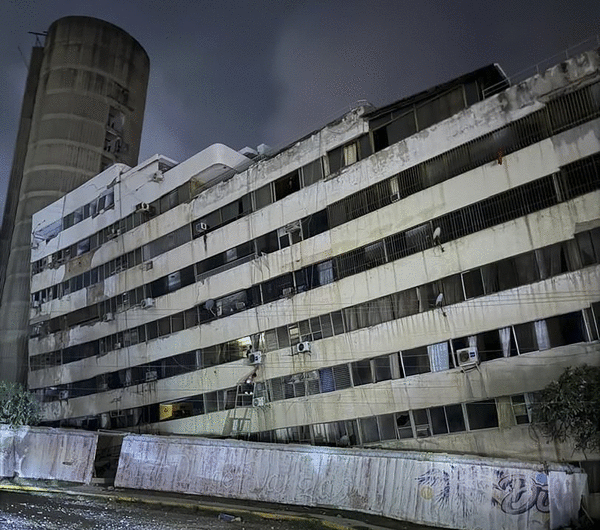
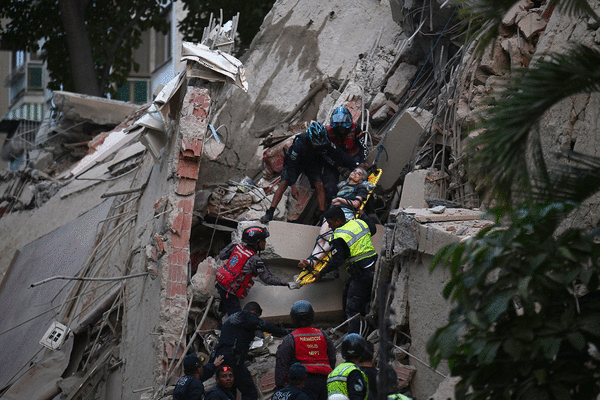
The death toll from the powerful double earthquake that struck Venezuela’s Caribbean coast Wednesday has climbed to at least 188 people, with more than 1,520 injured, as rescue crews continue searching through collapsed buildings amid growing fears that the final number of victims could rise significantly.
Authorities also reported 157 people missing and more than 200 trapped beneath collapsed structures, underscoring the scale of what is becoming one of the worst natural disasters in modern Venezuelan history.
Speaking Thursday on state-run television, interim President Delcy Rodríguez said the earlier casualty figures had not yet included victims from La Guaira, the coastal state that neighbors Caracas and that she described as the area hardest hit by the disaster.
“We can say that the situation in La Guaira state is a true tragedy; it has become a disaster zone,” Rodríguez said.
Emergency officials and rescue workers warned that the current death toll might represent only a fraction of the final number as dozens of collapsed buildings in La Guaira, Caracas and surrounding urban centers continue to be searched.
Using predictive fatality modeling based on earthquake magnitude, depth, population density and structural vulnerability, the U.S. Geological Survey estimated that the eventual death toll will most likely reach into the thousands, with a significant probability that fatalities could exceed 10,000 if worst-case scenarios materialize in the hardest-hit urban areas.
Adding to concerns, a website created by leaders of Venezuela’s opposition to help track missing persons listed more than 24,000 people as unaccounted for as of 10:40 a.m. local time Thursday, underscoring the enormous uncertainty regarding the human toll. The figure does not necessarily represent confirmed disappearances because it might include duplicated reports and people temporarily unreachable due to power and communications outages, but it highlights the scale of the chaos facing families searching for loved ones.
Wednesday's two powerful earthquakes — measuring 7.2 and 7.5 in magnitude — struck just 39 seconds apart, according to the U.S. National Tsunami Warning Center.
The agency described the event as a “seismic doublet,” a rare one-two punch in which a pair of major earthquakes occur within seconds of each other in the same region. The stronger second quake, a shallow 7.5 magnitude tremor, caused widespread destruction across Venezuela’s central and coastal states.
According to the U.S. Geological Survey, the second earthquake struck at 6:04 p.m. local time, with its epicenter about 186 miles east of Caracas, near Montalbán, in the country’s central region.
Because of its shallow depth, the quake was felt intensely across much of Venezuela, including Caracas, where residents described some of the strongest shaking in decades.
Massive destruction across central Venezuela
The scale of the destruction is emerging.
Jorge Rodríguez, president of Venezuela’s National Assembly, said preliminary government assessments show about 250 buildings have either collapsed or suffered catastrophic structural damage nationwide, with the heaviest destruction concentrated in La Guaira, particularly in Caraballeda and Playa Grande.
Rodríguez said the earthquakes also damaged eight hospitals, some of which had to be evacuated, forcing authorities to transfer patients to other medical centers while emergency crews worked to restore supplies, medicine and hydration services.
He added that 20 shopping centers and 68 public infrastructure projects were also damaged, bringing the total number of affected infrastructure sites to 346.
“As of this moment, we must sadly report 188 Venezuelans dead as a result of the earthquake,” Rodríguez said.
He said 1,520 injured people had already been admitted to hospitals.
Authorities are also racing to locate the missing.
Rodríguez said 157 people remain unaccounted for, while more than 200 people are believed trapped under rubble.
“We are in a determined race against time to rescue most of them alive,” he said.
The disaster has also displaced 2,927 families, many of whom lost their homes or were forced to evacuate unsafe buildings.
“The earthquake struck with immense force, especially in La Guaira,” Rodríguez said. “The areas suffering the most severe devastation, with what I would describe as a truly terrifying situation, are Caraballeda and Playa Grande in Catia La Mar.”
Panic in Caracas
In the capital, residents reported evacuations, structural damage and partial building collapses across multiple neighborhoods.
Adriana Meneses Ímber, who was in La Floresta in eastern Caracas, said she noticed the lights flickering before a slight movement suddenly turned violent.
“I had never experienced anything like it, and I lived through the 1967 earthquake as a child, but this was stronger,” Meneses told el Nuevo Herald. “We started hearing the sound of objects in the house falling, glass breaking. I got under the table. It felt like it lasted two or three minutes, with incredible intensity.”
Meneses left her home with neighbors and remained in the street fearing additional tremors. She said she felt at least two aftershocks and heard reports of broken windows in Los Palos Grandes and partial wall collapses in Altamira.
Many Caracas residents spent the night outside, unwilling to return to damaged buildings.
Elena González, a resident of eastern Caracas, was inside her apartment with her mother, who is in her 90s, when the shaking began and power started failing.
“I was in the bedroom with my mother, and the lights kept going off and coming back on. The moment I felt the earthquake, I hugged my mother and told her, ‘If we die, we die together,’ ” González told el Nuevo Herald.
Neighbors knocked on her door to help evacuate her mother. They remained outside with other residents while feeling at least three aftershocks.
In La Guaira, entire sections of Catia la Mar remained without electricity Thursday after many residents spent Wednesday night sleeping in streets, cars or near damaged buildings, terrified of further collapses.
Journalists on the ground observed deep cracks in residential towers, collapsed walls and entire structures reduced to rubble.
Rescue operations continued across Caracas, where crews searched through collapsed structures in neighborhoods that included El Paraíso, San Bernardino, Maripérez and Los Palos Grandes, one of the city’s most seismically vulnerable districts.
Heavy machinery began arriving after many initial rescue efforts relied largely on manual labor.
Damage across multiple states
The quakes were also felt across central and western Venezuela.
In Los Teques, in Miranda state, residents described chaos and damage to buildings and businesses.
Yraluz Galindo said she was outside when she heard a deafening roar seconds before the ground began shaking violently.
“It sounded horrific, as if a jet were flying directly over my head. Then it felt as if I were surfing a wave with the movement,” Galindo told el Nuevo Herald.
She said several buildings suffered major structural damage. At La Cascada shopping center, the roof of a store partially collapsed.
Carabobo, one of the regions closest to one of the epicenters, also appears to be hard-hit.
Juan Carlos Colina, director of Venprensa.com, told el Nuevo Herald that the shaking there was especially severe.
“In the area where I am, in the San José district of Valencia, many buildings — including the one where I live, which consists of two 21-story towers — sustained considerable damage,” Colina said.
He said two water tanks in the building ruptured and multiple buildings developed gas leaks, creating fears of secondary emergencies.
“People fled the buildings and gathered in the streets,” he said.
In Barquisimeto, Lara state, Katherine Guaramaco described the experience as unlike anything she had felt before.
“It was quite strong. I had never felt an earthquake so loud,” she said. “It wasn’t just that the shaking was very strong, but there was also a sound that echoed. Everything moved, and my house is stable.”
State of emergency and international response
Speaking in a nationwide television broadcast Wednesday night, Rodríguez declared a state of emergency and confirmed that at least 30 aftershocks had been recorded.
She said the areas hardest-hit include Caracas, Miranda, La Guaira, Aragua, Carabobo and Falcón.
Rodríguez said building collapses had been reported in several districts of Caracas, while significant damage to homes, buildings and public infrastructure was reported in multiple states.
Among the most serious impacts, she cited power outages in Caracas and La Guaira, as well as disruptions to water service in Miranda, parts of Caracas, Falcón, Yaracuy, Zulia and La Guaira.
As a preventive measure, the government suspended home gas service in several areas to reduce the risk of explosions.
“Immediately after these two earthquakes occurred, all of our authorities and the civil protection system mobilized for rescue operations,” Rodríguez said. “At this moment, the priority is to save lives.”
She said that once the emergency phase passes, efforts will shift toward restoring critical infrastructure and rebuilding damaged homes and property.
As part of the emergency response, the government suspended operations of the Caracas Metro and the national railway system, canceled classes for the remainder of the week and halted non-essential activities.
Rodríguez also said the country’s public and private healthcare network had been fully activated to treat the injured, urging doctors, nurses and other medical personnel to report immediately to work.
She also announced the closure of Maiquetía International Airport, the main gateway serving Caracas, after severe structural damage was reported.
The disaster has triggered an international response.
U.S. Secretary of State Marco Rubio said Washington would immediately deploy rescue and humanitarian assistance teams to Venezuela.
“The United States stands with the Venezuelan people during these difficult times and, acting on President Donald Trump’s instructions, the State Department is immediately deploying search and rescue teams, medical resources, and humanitarian assistance to Venezuela,” Rubio wrote on X.
Rodríguez said rescue teams from the United States, Mexico, El Salvador, Qatar and the Dominican Republic are expected to arrive soon.
Venezuela lies in a zone of high seismic activity due to the interaction between the Caribbean and South American tectonic plates. The country has experienced devastating earthquakes before, including the 1967 Caracas earthquake, which killed hundreds and caused widespread destruction in the capital.
©2026 Miami Herald. Visit at miamiherald.com. Distributed by Tribune Content Agency, LLC.






Comments