Ukraine's Crimea attacks expose limits of Putin's protection
Published in News & Features
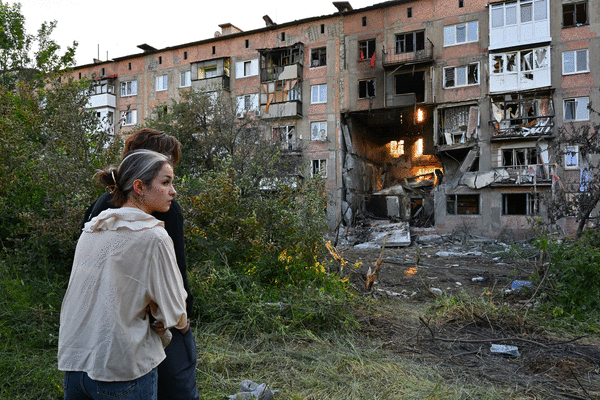
Vladimir Putin’s war in Ukraine is rebounding on Russia in Crimea, amid escalating attacks on the Black Sea peninsula that he annexed in 2014.
Ukrainian drone and missile strikes are disrupting Russian logistics and supply routes to Crimea, plunging the region into crisis as officials resort to emergency measures. Electricity blackouts leave thousands of residents without running water while many Russians complain they’re unable even to flee because of a ban on fuel sales at filling stations.
Even the port city of Sevastopol, home to Russia’s Black Sea Fleet before the war, is not immune from the difficulties following attacks on its power grid this week, which also disabled water pumping stations. The local utility company deployed mobile tankers to supply residents.
The deteriorating situation for Russians in Crimea underscores the recent improvement in Ukraine’s position in the war that Putin started. His approval rating among Russians soared after Russia seized Crimea from Ukraine in 2014 then stoked violence in the eastern Ukrainian regions of Donetsk and Luhansk, sparking the conflict that led to the 2022 full-scale invasion.
“The crisis with fuel, military logistics, and governance in Crimea is deepening on a virtually daily basis,” Ukrainian President Volodymyr Zelenskyy said Thursday on social media. “The Russian occupation administration quite clearly and unequivocally acknowledges its inability to resolve the problems created by our mid-range sanctions.”
While Russian forces incur huge casualties on the battlefield, Ukraine is waging an increasingly effective campaign of drone and missile strikes inside Russia, damaging oil refineries and other key infrastructure including in Moscow. That’s leading to spreading fuel shortages and adding to the economic strains of funding a war that’s well into its fifth year with no end in sight.
“The seizure of Crimea consolidated Putin’s support,” said Ella Paneyakh, a research fellow at the London-based New Eurasian Strategies Centre think tank. “The attacks on Crimea are hitting two crucial elements of the Kremlin’s domestic narrative — that ‘Crimea is ours’ and ‘Putin means stability’.”
Putin has said little so far about the difficulties facing Crimea or the waves of attacks inside Russia. On Thursday, he held a meeting of the Russian Security Council to discuss “internal security and stability.”
As well as hitting at military targets inside Crimea, Kyiv’s forces have struck a series of bridges on routes used by Russia from occupied southern Ukraine to try to cut off logistics supplies into the peninsula. Recent attacks have also focused on ferries and storage depots near the Kerch Bridge as well as trains and trucks to disrupt deliveries from Russia.
That increasingly leaves the bridge as the only viable link between Crimea and Russia. So far, it appears Ukraine hasn’t attempted to knock out the bridge, leading to speculation it wants to make conditions so difficult on the peninsula that Russians take the opportunity to flee across it.
“Russia has few effective ways to counter Ukrainian actions to isolate Crimea,” said Ruslan Pukhov, a Moscow-based defense expert. “Ukraine has greatly weakened the air defense system of the Russian Armed Forces in Crimea, after which it began systematic attacks on the vulnerable points — logistics, fuel, energy.”
There’s been a nearly 10-fold increase in strikes by Ukraine’s mid-range drones targeting Russian logistics, supply depots, command posts and equipment over the past six months, Ukrainian Defense Minister Mykhailo Fedorov said Thursday on X. “This has enabled the launch of a campaign to isolate Crimea and reinforced Ukraine’s advantage on the battlefield.”
Zelenskyy said late on Thursday that he approved a 40-day “influence operation” against Russia “aimed at compelling it to end the war.”
Crimea’s Kremlin-appointed leader, Sergey Aksyonov, this week ordered the closure of all children’s summer camps on the peninsula. Last year, more than 78,000 children from all over Russia attended residential camps in Crimea, and around 36,000 took part in day camps, according to Aksyonov.
Fuel shortages “remain acute,” and damage to energy infrastructure means “temporary power outages will be carried out throughout the territory of Crimea,” Aksyonov said Thursday on Telegram. “Food security in the republic is ensured in full, and necessary medicines are available.”
Local authorities also suspended all sports events in Crimea until September. Aksyonov on Friday announced regional emergencies had been declared for Crimea and Sevastopol.
With fuel for the peninsula’s two million residents officially rationed to essential government services, a black market has emerged where unlicensed dealers offer to sell gasoline through digital chat services at about 150 rubles ($2) per liter — nearly double the average Russian retail price.
In a bid to support tourism, the authorities are allowing visitors to transport as much as 200 liters (53 gallons) of fuel in canisters across the Kerch Bridge. But the shortages being experienced in Russia leave drivers facing huge lines at fuel stations on the approach to Crimea in an attempt to fill up before crossing.
Public transport is also being curtailed. Officials announced on Thursday a sharp reduction in daily train services between Russia and Crimea, with routes now terminating after the bridge across the Kerch Strait at the entrance to the peninsula and other seasonal services canceled.
That’s hitting Crimea’s economy at the height of its tourist season, with Russians who’ve been prepared to travel to the peninsula’s resorts despite the war now facing logistical obstacles. More than 3.77 million people visited Crimea during the three summer months last year, more than 60% arriving by car across the Kerch Bridge, Aksyonov said on Telegram.
With the Kremlin preparing for elections to Russia’s lower house of parliament in September, the Ukrainian assault on Crimea and the growing unpopularity of the war among Russians risk undermining the central premise of Putin’s covenant with the electorate: stability in exchange for political support.
Even so, analysts warn that won’t necessarily translate into a political backlash and may even consolidate public support for Putin.
“The general background is more anxious now,” said Denis Volkov, director of the independent Levada Center in Moscow. “But so far it has led to greater bitterness and growing support for more decisive, aggressive strikes on Ukraine.”
Still, trust in Putin fell to its lowest level in more than a year, according to a June 19–21 survey by the Kremlin-affiliated Public Opinion Foundation. He retains broad public support with 69% of respondents saying they trust him, but the share saying they distrust the Russian leader rose to 18%, its highest level in at least a year.
Few in Crimea are willing to criticize Putin for bringing the war to their door, even as they acknowledge growing hardship and discontent with local officials.
“In recent weeks, I have felt mentally and physically exhausted, completely powerless,” said Natalia, a 44-year-old economist from Sevastopol, who asked not to disclose her surname for safety reasons. “It feels like we are all living on a lost island now.”
In Yalta, a tourist hub now devoid of its usual summer crowds, 48-year-old Svetlana said she and her husband sent their children to friends in Russia, and remained behind to care for elderly parents.
“The food is there, but with gasoline, it’s a total disaster,” she said. “My husband leaves at dawn just to try and hunt down fuel, and most of the time he returns empty-handed.”
“The atmosphere is bleak, it’s true,” said Irina, 38, a housewife from Sevastopol. “Many people I know have left or sent their families to safer places.”
Still, she says she supports Russian rule and doesn’t want Crimea to return to Ukrainian control.
“The Ukrainians would put everyone in jail, that’s obvious,” she said.
©2026 Bloomberg L.P. Visit bloomberg.com. Distributed by Tribune Content Agency, LLC.





Comments