San Diego immigration court braces for 'mega' hearings as Trump administration works to clear backlog
Published in News & Features
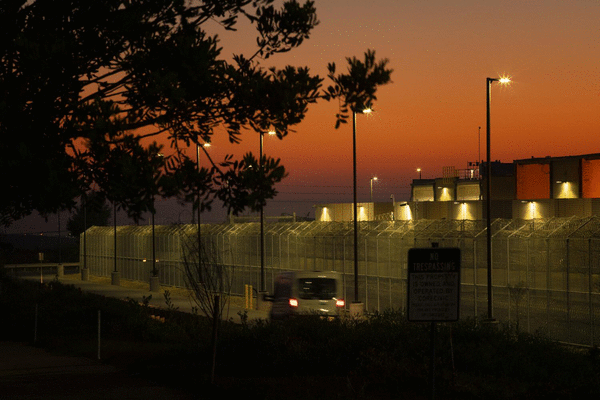
In what some claim is the Trump administration’s latest tactic to fast-track removal orders, the San Diego immigration court on a recent Friday scheduled a higher-than-usual number of hearings on a single day.
The move appeared to be the first local “mega” master calendar hearing, in which a large group of individuals in removal proceedings go before a judge at once, in some cases earlier than their previously set court dates. Such accelerated hearings have been reported in immigration courts across the country since May.
The Trump administration indicated the move is intended to reduce the backlog in immigration courts, though some San Diego immigration attorneys and court observers fear the en masse hearings could result in due process violations.
During master calendar hearings, the judge explains to individuals who have received a Notice to Appear their rights, alleged immigration law violations and options for representation. Such hearings are generally scheduled in groups.
Court observers and immigration attorneys in San Diego were bracing for those master calendar groups to get a lot bigger on June 12. Sure enough, the list of names set to appear that day on the monitors in the court waiting rooms was unusually long.
More than 80 people were scheduled to appear before a single immigration judge that day, court observers said.
At least two men who appeared in court and requested more time to get an attorney said that their hearings had recently been moved to that day. One man from Mexico, with an asylum case, said that his initial appointment had been originally scheduled for August, but he received notification of the new date “some days ago.”
During the morning session, about 20 people were present in one of the courtrooms, including a family with small children. Most of them spoke Spanish and followed the hearing with the help of an interpreter.
None of them had legal representation, so they requested time to hire an attorney and were given another court date next month. Some initially said they wanted to represent themselves but changed their minds when the judge explained their options.
Many others on the calendar didn’t show up.
Paulina Reyes, directing attorney with the Immigrant Defenders Law Center, raised concerns that some individuals might not be aware their hearings had been rescheduled, which could result in an order of removal for failing to appear. According to Daylight San Diego, 50 people were ordered deported in absentia on June 12.
“It’s just another way for the Trump administration to move the process quickly for folks, confuse individuals, order them removed, and in a way do a new iteration of mass deportation,” Reyes said.
A spokesperson with the Department of Justice’s Executive Office for Immigration Review did not address the move to “mega” master hearings in San Diego directly but said that the agency “makes scheduling adjustments as needed to ensure cases do not languish.”
“Unnecessary delay hurts both aliens with meritorious claims and the American public who wish to see aliens with non-meritorious claims removed as quickly as possible,” the spokesperson said. “As it continues to add new immigration judges, EOIR will continue to make scheduling adjustments to ensure all cases are handled in a timely and lawful manner.”
DOJ officials said that an in-absentia removal order can only be issued if the immigration judge finds that “proper notice was given and the Department of Homeland Security has established removability.”
The agency did not respond when asked how much advance notice individuals are receiving about their new court hearing dates.
“(We) want to ensure that people do have a right to a full and fair hearing, as is their right in this country and under immigration law,” said Reyes, who encouraged individuals to check their case status online for updates on hearings. She also urged immigrants to notify the court of any change of address.
Former San Diego immigration judge Meghan Heesch noted the unusual nature of the June 12 mass hearing. During her three years on the bench, she said, the most hearings she had in a day were slightly over 30.
“I’m still confused why this is happening here in San Diego when we have effectively managed immigration dockets,” said Heesch, now a partner at the Sanford Heisler Sharp McKnight firm.
According to data obtained via public records request by the Transactional Records Access Clearinghouse at Syracuse University, the San Diego immigration court had about 5,700 pending cases as of April, which is lower compared to other California immigration courts. For example, the San Francisco court had nearly 116,000 pending cases, while the Santa Ana court had about 23,000.
Heesch said she is worried for her former colleagues, whom she described as “very reasonable” and “well-prepared.”
She also voiced concerns about what this could mean for other cases, such as those involving individuals who are ready for their final hearings, and whether their cases might be pushed back to make room for cases that are earlier in the process.
“It’s very clear from coverage in the media that this administration is focusing on the number of removal orders, that’s very important to them, so it’s easier to get more removal orders if you have more people, as opposed to just one who’s finally waiting for their asylum hearing after a year,” she said.
Immigration attorney Saman Nasseri, who handles cases in both San Diego and Los Angeles, said he has already had cases that are farther along in the process rescheduled for later months.
“With these mega masters, it’s a little difficult to get things done,” he said. “The judges are very overwhelmed. It’s just crowding the calendar.”
He also expressed surprise that this appears to have begun at the San Diego Immigration Court.
“I just think it’s a ripple effect on the rest of the country,” he said. “I think because they’re applying it everywhere else, they have to apply it here too, but the judges, everybody here is confused by it, it makes no sense.”
Packed dockets have resulted in long lines in courthouses across the country, including in Virginia and Chicago, as reported by The New York Times earlier this month. In New Orleans, the news outlet reported that there were days earlier this month with over 200 cases in one courtroom alone.
It’s still unclear how the “mega” master calendar will pan out in the coming weeks in San Diego.
In the days following June 12, court observers said the docket appeared to have the expected number of cases, including Friday, when the waiting room monitors showed about 30 hearings for the day.
Kimberly Morales, a volunteer with the Faithful Accompaniment in Trust and Hope, or FAITH program, which regularly provides accompaniment for immigrants at court hearings, said this week that they are keeping an eye out for a pattern.
_____
©2026 The San Diego Union-Tribune. Visit sandiegouniontribune.com. Distributed by Tribune Content Agency, LLC.






Comments