As Venezuela mourns quake victims, Machado says 'time has come' to return
Published in News & Features
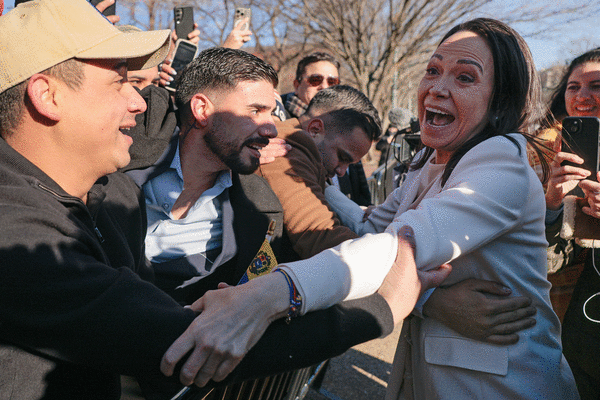
Even as rescue crews dig through rubble in Venezuela and thousands search for missing loved ones, another question is beginning to loom over the country’s uncertain future: whether opposition leader María Corina Machado is finally coming home.
Machado said over the weekend that she plans to return to Venezuela in the coming days, describing the country’s earthquake catastrophe as a moment that demands unity, solidarity and presence.
Speaking to Fox News, the exiled opposition leader said “the time has come” for her return to the South American nation, where twin earthquakes on Wednesday killed at least 1,450 people, injured thousands and left many more trapped beneath collapsed buildings.
“It is my duty to accompany my people. We need to be together, to embrace, to grieve and mourn together,” Machado said.
The opposition leader and Nobel Peace Prize laureate said she intends to be in Venezuela “very soon.”
Her announcement comes as Venezuela struggles to cope with one of the worst natural disasters in its modern history.
The back-to-back earthquakes — measuring 7.2 and 7.5 in magnitude and striking just 39 seconds apart — devastated large parts of Caracas, La Guaira and surrounding central states, triggering a massive international rescue and relief effort.
Authorities say hundreds of aftershocks have continued to shake the country, complicating rescue operations and fueling fears among survivors who remain unwilling to return to damaged homes.
Thousands are still believed to be trapped beneath the rubble, while tens of thousands remain displaced.
Machado’s proposed return, however, appears to be generating growing unease in Washington, where U.S. officials remain focused on stabilizing Venezuela’s fragile political transition while managing the worsening humanitarian emergency.
A White House official, speaking to Reuters on condition of anonymity, said Machado’s renewed efforts to secure U.S. assistance for her return have frustrated senior administration officials.
According to the official, Machado has contacted several U.S. government figures in recent days, including officials at the White House, the State Department and several members of Congress, requesting help to facilitate her return to Venezuela.
“We support her returning to Venezuela, but does it have to be 24 hours after a massive humanitarian catastrophe where the death toll continues to climb?” the official told Reuters.
The comments underscore Washington’s increasingly delicate balancing act in Venezuela following the dramatic January U.S. military operation that captured Nicolás Maduro in Caracas.
Maduro’s removal initially raised expectations among many opposition supporters that Machado — widely viewed as the most influential opposition figure in the country — would assume a leading role in Venezuela’s political transition.
Instead, President Donald Trump backed Delcy Rodríguez, Maduro’s former vice president, to head an interim administration, arguing Machado lacked sufficient institutional support to govern effectively in the immediate aftermath of Maduro’s capture.
Since then, Rodríguez has governed as acting president while attempting to stabilize a deeply fractured country grappling with economic collapse, weakened institutions and persistent security threats.
Machado, 58, has repeatedly called for free and fair elections and has insisted she intends to return to Venezuela before the end of the year.
For months, she has publicly suggested her return was imminent.
Those declarations, however, have repeatedly failed to materialize, fueling skepticism among some analysts over whether the conditions exist for her safe return.
Machado left Venezuela in December to travel to Oslo to receive the Nobel Peace Prize, defying a decade-long travel ban imposed under Maduro’s government.
Before leaving, she had spent more than a year largely in hiding following the disputed 2024 presidential election, which the opposition insists it won but which Maduro claimed amid widespread allegations of fraud.
Since departing, Machado has spent most of her time in the United States.
The earthquake disaster now adds a powerful emotional dimension to Venezuela’s political crisis.
Machado portrayed her planned return not as a political maneuver but as a moral obligation to share in the suffering of Venezuelans.
That message may resonate strongly with many citizens as families across the country continue desperately searching for missing relatives.
Social media and online registries remain flooded with photographs and pleas for information from people trying to locate loved ones who disappeared during the earthquakes or in the chaotic hours that followed.
At the same time, Washington remains deeply engaged in the relief operation.
The State Department said the United States has deployed search-and-rescue teams, coordinated deliveries of medical supplies and unlocked $150 million in emergency humanitarian assistance.
That aid includes support for international relief agencies, emergency medical operations, logistics and urban rescue missions.
American rescue teams — including specialized units from Miami-Dade County and the City of Miami — continue operating in the hardest-hit areas, particularly in La Guaira, where entire residential blocks collapsed.
The United States has also deployed military logistics assets, including heavy-lift aircraft and naval support, to sustain relief operations.
U.S. officials appear concerned that Machado’s return during the height of the rescue phase could introduce political complications, strain security arrangements or divert attention from humanitarian operations.
_____
©2026 Miami Herald. Visit miamiherald.com. Distributed by Tribune Content Agency, LLC.






Comments