The troubling new trend that's making California's forest fires more dangerous
Published in News & Features
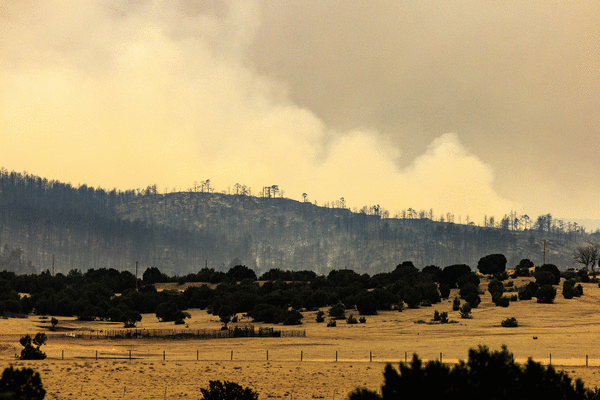
SAN JOSE, Calif. — With July Fourth weekend, California and other Western states are heading into the beginning of peak fire season — when rain is scarce and temperatures are high.
But an ominous new trend is reshaping forest fire behavior. Not only have the number and size of fires grown in recent decades, but fires are burning hotter and more intensely now, and causing more lasting damage to forests.
From 1985 to 2024, the number of acres that burned in California’s forests has increased by roughly tenfold, according to a new study by scientists at the University of California, Los Angeles. But the acres burned by high-severity fires — when flames explode out of control with extreme temperatures, incinerating trees rather than simply clearing out dead vegetation — have increased thirtyfold. These destructive fires have now become the most common type of forest fire.
Simply put, severe fires are killing trees instead of giving them a chance to recover. As they become the norm, they are changing California’s landscape.
“We’ve known for a while that forest fires in California are getting bigger,” said Park Williams, a professor of geography at UCLA and co-author of the study. “But while that was happening, the fires have also been getting more severe.”
Williams, who studies long-term drought and fire trends, said that in generations past, high-intensity forest fires did occur but were rare. But now in some parts of the state, particularly the Sierra Nevada, they are the majority.
Fires like the Camp Fire that destroyed the town of Paradise in 2018; the CZU Lightning Complex Fire, which raged through the Santa Cruz Mountains in 2020, burning 1,490 structures and decimating Big Basin Redwoods State Park; and the Caldor Fire, which burned 221,835 acres in 2021, devastating the community of Grizzly Flats along Highway 50 and nearly spreading into the city of South Lake Tahoe, are examples, he said.
While most wildfires in the past burned slowly across the forest floor, providing benefits to the forest, high-severity fires roar into the tops of the trees, burning 1,000 degrees or hotter, with flames that can reach 200 feet tall.
“These are fires that are essentially impossible to put out,” Williams said. “They move quickly and are uncontainable.”
The tipping point when high-intensity, severe forest fires became the most common type in California forests occurred around 2012, the researchers found. There are two culprits, they said: Decades of fire suppression that have made many of the state’s forests unnaturally thick and left huge amounts of dead trees and brush to fuel big fires, and climate change, which has increased temperatures.
Other researchers who were not involved in the study have found similar effects of heat and dry vegetation on forest fires.
“With a slight increase in temperature of 1 degree, that doesn’t really matter when a fire starts,” said Scott Strenfel, PG&E’s chief meteorologist. “But over the several months leading up to it, it matters. Ultimately, what happens is that the fuels when fires start are drier than they would have been without climate change. Drier fuels mean more fires.”
“Just a very small change can yield big impacts,” he added.
Add to that a century of fire agencies putting out fires, breaking the natural cycle.
“We all remember Smokey Bear — ‘Only you can prevent forest fires,'” said Mitchell Hung, a doctoral student now at Stanford University who co-authored the study, which was published June 22 in the scientific journal PNAS. “Preventing a fire often just prevents it in the short term, but kicks the can to a later point when there’s even more fuel to burn.”
One answer, Williams and Hung said, is that California and the federal government need to continue to expand the number of controlled burns and thinning operations to restore forests to their natural conditions. Historically, modest fires every seven to 20 years kept forests from being overgrown and choked with highly flammable dead wood and brush, Williams said.
The pair studied satellite data from 4,391 forest fires larger than 10 acres in California over the past 40 years to determine how severely they burned.
Low-intensity fires regularly occurred in California before the 1850s Gold Rush, sparked by lightning strikes or burning by Native American tribes. Trees like the ponderosa pine and sugar pine evolved with fire.
Today’s severe fires can change a landscape for centuries by killing most or all of the trees, baking the soil, incinerating the seeds and leaving large open areas that cannot easily recover, Williams said. Sometimes planting thousands of small seedlings can help, but that doesn’t always work, he added, noting that often these areas are converted from forest land to grass and shrubs, including invasive plants.
The cost of lost forests reaches well beyond the burn scars. Forests clear the air and filter water, provide tourism and timber, and habitat for birds and other wildlife, the researchers noted. Enormous fires destroy homes, kill people and emit huge amounts of soot into the air.
“We are going to get more fire no matter what,” Williams said. “But if we can choose when the fires occur, we can reduce the severity and the damage to people and the environment.”
So far, 2026 has been a mild fire year in California. There have been no major fires in the Bay Area, Northern California or the Sierra Nevada, with zero fatalities so far and 36 structures burned statewide.
Of the 82,663 acres that have burned in California this year, 22% came in just one fire. That blaze started May 15 on Santa Rosa Island, part of Channel Islands National Park off the Santa Barbara coast, after an amateur sailor crashed his boat on the shore and the boat caught fire. That 18,379-acre fire burned for two weeks, largely charring grass over about a third of the island. Most of the rest of the larger wildfires so far in California have occurred in rural parts of Kern and Riverside counties.
California’s mild start is largely because the state saw relatively normal precipitation this winter and cooler weather recently, particularly along the coast, said Daniel Swain, a climate scientist with the University of California Division of Agriculture and Natural Resources.
But more than a dozen major wildfires are burning now in Colorado, Utah, Nevada, New Mexico, Arizona and other Western states.
A record warm and dry winter, combined with windy conditions, low humidity, drought and hot temperatures now, has led to very dangerous conditions so early in the fire season in those states, officials say.
Last month, three firefighters were killed as they fought the Knowles and Gore fires along the Colorado-Utah border. They were part of a helicopter crew working with the U.S. Forest Service and other agencies. They were overcome by flames after deploying emergency shelters to shield themselves, officials said.
Little relief is expected anytime soon. On June 29, officials at the National Interagency Fire Center in Boise increased the national “preparedness level” for wildfires to a 4, on a scale of 1 to 5. They warned of a high potential for new, large fires across the Rocky Mountains, Great Basin and the Southwest due to extremely dry vegetation and hot temperatures.
“The air is bone dry,” Swain said. “The soil is bone dry. And the vegetation is bone dry. It’s a pretty serious situation.”
Swain noted that scientific studies have shown the day of the year when the most wildfires start is July Fourth. He urged people in all states, including California, despite its relatively lower fire risk right now, to avoid shooting off fireworks.
“It’s actually quite unusual for organized displays set off by counties or towns or cities to spark wildfires,” he said. “The vast majority are people setting off fireworks in their backyards or parks and open spaces … Don’t do it. It just isn’t worth it this year. There’s a really high likelihood of igniting fires.”
©2026 MediaNews Group, Inc. Visit at mercurynews.com. Distributed by Tribune Content Agency, LLC.






Comments