Death toll from Venezuela's twin earthquakes rises to 3,342
Published in News & Features
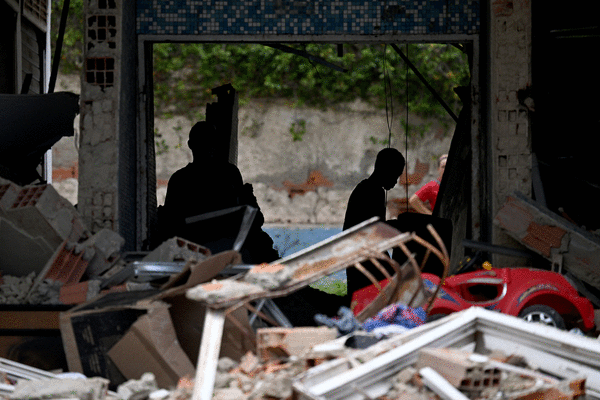
Venezuela’s earthquake death toll climbed above 3,300 on Sunday as authorities increasingly turned their attention from rescue operations to rebuilding, nearly two weeks after the devastating twin earthquakes struck the country.
The Ministry of Communication reported that the official death toll has risen to 3,342, with 16,740 people injured, making the twin 7.2- and 7.5-magnitude earthquakes that struck north-central Venezuela on June 24 one of the country’s deadliest natural disasters in modern history.
Officials said 6,462 people have been rescued alive, while the number of people left homeless has climbed to 17,345, an increase of more than 2,000 since previous government reports, underscoring the growing scale of the humanitarian crisis.
Authorities also reported 995 aftershocks since the main earthquakes, nearly reaching the 1,000 mark, while 190 buildings have been confirmed destroyed and another 856 damaged across the affected region.
Although isolated search operations continue in parts of La Guaira, emergency officials have increasingly shifted personnel and equipment toward debris removal, structural inspections and restoring critical infrastructure as hopes of finding additional survivors continue to fade.
The uncertainty surrounding thousands of people whose whereabouts remain unknown remains one of the most painful aspects of the disaster.
While the government has not released updated figures on the number of people still unaccounted for, humanitarian organizations continue warning that thousands of families are still searching for relatives amid widespread communications disruptions and the destruction of entire residential neighborhoods.
The United Nations’ International Organization for Migration has previously estimated that roughly 50,000 people remain unaccounted for, many of whom could still be trapped beneath collapsed buildings or separated from relatives because of the chaos caused by the earthquakes. Volunteer-run online registries continue compiling tens of thousands of reports from families seeking information about missing loved ones.
Government efforts are increasingly centered on caring for those displaced by the disaster.
Officials said the number of temporary camps has increased from 59 to 79, reflecting the growing demand for emergency shelter as structural engineers continue evaluating damaged apartment buildings and homes.
Nearly 86,800 families have now received some form of government assistance, while authorities said more than 9,585 metric tons of food and 669,000 liters of water have been distributed throughout the disaster zone.
Hospitals and emergency clinics have treated 23,820 patients, according to the latest official figures.
International support also continued to expand over the weekend, with senior U.S. officials traveling to Venezuela to review the disaster response firsthand.
The U.S. Embassy in Caracas said Executive Secretary of State Lisa Kenna and Caleb Orr, the State Department’s deputy assistant secretary for economic, energy and business affairs, visited the country alongside members of the U.S. Disaster Assistance Response Team to assess relief operations and identify additional humanitarian needs.
During the visit, the delegation conducted an aerial survey of some of the hardest-hit areas aboard a military aircraft provided with support from the U.S. Department of Defense, allowing officials to evaluate damage and determine where additional U.S. assistance could be directed.
The visit underscored the unusually close cooperation between Washington and Caracas following the June 24 earthquakes. The United States has become one of the largest contributors to the international response, deploying hundreds of search-and-rescue specialists — including teams from the city of Miami and Miami-Dade County — as well as humanitarian experts and disaster-response personnel working alongside Venezuelan authorities and international organizations.
The interim government reported that 4,088 foreign rescue specialists are now participating in the response alongside 29,567 Venezuelan military, police and emergency personnel and 27,482 registered volunteers, illustrating one of the largest humanitarian mobilizations in the country’s recent history.
Despite the broad international response, humanitarian organizations continue warning that emergency needs remain acute.
Aid agencies say access to temporary housing, clean drinking water, sanitation, medical care and psychological support continues to lag behind demand as thousands of displaced families remain reluctant to return to homes that may have suffered structural damage.
The enormous cost of rebuilding is also becoming clearer.
A preliminary assessment prepared for the U.N. Office for Disaster Risk Reduction estimates the earthquakes caused approximately $37 billion in direct physical damage to buildings and infrastructure, though researchers caution that figure excludes indirect economic losses, business interruptions and reconstruction costs, meaning the disaster’s total financial impact is likely to be substantially higher.
The assessment concluded Venezuela experienced an unusual “earthquake doublet,” in which the initial 7.2-magnitude earthquake triggered a neighboring fault, unleashing the larger 7.5-magnitude quake just 39 seconds later.
The report estimates approximately $24 billion in direct losses to buildings and another $13 billion in damage to infrastructure, with telecommunications and energy systems among the sectors hardest hit.
Meanwhile, engineers continue inspecting damaged buildings as authorities attempt to determine which structures can be repaired and which must be demolished.
The Venezuelan Guild of Engineers has launched emergency training programs to expand the number of specialists available to conduct post-earthquake structural evaluations, while government officials continue discussions with international organizations over financing the massive reconstruction effort.
Interim President Delcy Rodríguez has said her administration is seeking international financial resources to support rebuilding and has announced an initial $200 million reconstruction fund, though experts say recovery will ultimately require many times that amount.
_____
©2026 Miami Herald. Visit miamiherald.com. Distributed by Tribune Content Agency, LLC.






Comments