US handshakes with Interior Minister Diosdado Cabello sparks outrage across Venezuelan social media
Published in News & Features
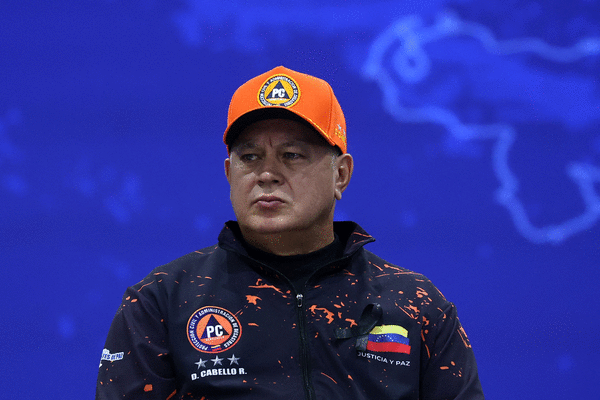
Public handshakes between senior U.S. officials and Venezuelan Interior Minister Diosdado Cabello have sparked a wave of anger, disbelief and soul-searching across Venezuelan social media, where many opposition supporters are accusing Washington of embracing one of the very figures it once vowed to bring to justice.
Photographs from separate meetings showing Gen. Francis Donovan, commander of U.S. Southern Command, and U.S. Chargé d’Affaires John Barrett with Cabello as part of post-earthquake coordination efforts spread rapidly across X and other social media platforms this week, generating thousands of reactions that highlighted deep divisions over the Trump administration’s evolving Venezuela policy.
Among opposition activists and members of the Venezuelan diaspora, the dominant reaction was outrage.
Many users pointed to what they described as a glaring contradiction: U.S. officials sitting across the table from a man indicted by the Justice Department on narcotics-related charges and for whom Washington continues to offer a $25 million reward.
“Post the photo of Donovan with the thief Cabello; that’s the one you need to post first, so the world sees that they are doing business with the narco-terrorist most wanted by the United States,” wrote X user @ciudadano5050 in one of the most widely shared posts.
Another user, @luisparragonza4, wrote that seeing Donovan shake Cabello’s hand “seems like a lack of respect for all Venezuelans.”
Others described the images as an insult to victims of political persecution under the socialist government.
“It is grotesque to see Diosdado Cabello at the same table as U.S. government delegates; that is an insult to the population,” wrote @Doncactus22.
The criticism reflects broader unease among Venezuelans who for years supported U.S. sanctions and criminal investigations targeting senior members of the Maduro government.
For much of the past decade, Washington portrayed Cabello as one of the principal leaders of the so-called Cartel de los Soles, a criminal organization U.S. authorities say is embedded within Venezuela’s political and military elite.
U.S. Secretary of State Marco Rubio — whose security was beefed up in 2017 following intelligence that Cabello may have sought his assassination — was among the strongest advocates of that approach during his years representing Florida in the U.S. Senate.
“The United States is offering $25 million for Maduro and Diosdado Cabello,” Rubio wrote on social media before joining the Trump administration. “You can help us make Maduro and Cabello new residents of the U.S. federal prison system.”
Rubio had previously urged the Justice Department to seek an Interpol Red Notice for Nicolás Maduro, arguing that Venezuela’s leadership was not merely an authoritarian government but a criminal enterprise involved in drug trafficking, money laundering, illegal gold mining and large-scale corruption.
Those earlier statements resurfaced online this week as critics questioned how the administration — which seized Maduro in a military raid early this year and is prosecuting him in New York — could justify direct engagement with Cabello while the reward for his capture remains in effect.
“Now what I’m seeing is Mr. Barrett and the U.S. actively working with Delcy Rodríguez and Diosdado Cabello, which means the U.S. is working with criminals. Hypocritical,” wrote @ProudlyVenekian.
The backlash extended beyond ordinary social media users to prominent Venezuelan-American voices. Political adviser Esteban Gerbasi warned that the administration’s engagement with Cabello could erode support among Latino voters who have backed Republican candidates largely because of their hard-line stance against the Venezuelan government.
“See you at the polls on Tuesday, Nov. 3, and you will witness the embrace of the Latino vote in the U.S.,” Gerbasi wrote on X. “Grand speeches rejecting socialism, communism, drug trafficking and terrorism in the U.S. — yet they embrace and praise the biggest kingpins and representatives from the Americas. Shameful.”
Even users who acknowledged the practical need for cooperation after Venezuela’s devastating June 24 earthquakes expressed unease.
One widely shared post by @Vzladespiert4 argued that Donovan’s meeting with Cabello reflected Washington’s effort to preserve the stability of Rodríguez’s interim government during the country’s political transition, while noting that the DEA reward for Cabello’s capture remains active.
The meetings took place less than two weeks after twin earthquakes devastated north-central Venezuela, killing thousands and leaving tens of thousands homeless. U.S. officials have said their discussions with Venezuelan authorities focused on rescue operations, humanitarian assistance and reconstruction.
The outreach also comes after Reuters reported that U.S. officials had privately warned Cabello that continued cooperation with Washington could shape his political future as Venezuela navigates its post-Maduro transition. According to Reuters, U.S. officials view Cabello as both a potential threat to the transition and, for now, one of the few figures capable of helping maintain internal stability.
That approach has fueled accusations that Washington is placing short-term stability ahead of its long-standing commitment to holding senior Chavista officials accountable.
Asked during a Thursday press briefing about reports of the meetings with Cabello, Barrett declined to address the encounters directly, instead emphasizing the administration’s humanitarian response and broader strategy for Venezuela.
“The U.S. State Department is 100% focused on this response, on the response to the devastating earthquakes in Venezuela and in advancing the Trump administration’s three-phase plan for Venezuela, which remains intact,” Barrett said. “That includes stabilization, economic recovery, reconciliation and a democratic transition. We will remain focused on advancing these efforts under President Trump’s leadership, and we will continue to do everything we can to assist the Venezuelan people.”
Not all the reaction was negative.
Government supporters and state-aligned media portrayed the meetings as evidence that Washington has accepted the political reality in Caracas and recognizes the interim government led by Delcy Rodríguez as Venezuela’s legitimate governing authority.
State broadcaster teleSUR described the meetings as an effort to coordinate rescue operations and humanitarian assistance following the earthquakes while advancing bilateral cooperation on reconstruction. Other pro-government accounts portrayed the images as evidence that years of confrontation had given way to a more pragmatic relationship.
Rather than celebrating the meetings outright, many government supporters adopted a restrained tone, portraying the contacts as a necessary step to benefit the Venezuelan people while reinforcing narratives of national sovereignty and diplomatic recognition.
The sharply contrasting reactions underscore how politically charged even humanitarian diplomacy has become in Venezuela.
Among opposition supporters, the photographs have come to symbolize what many see as a painful departure from years of U.S. promises to isolate and prosecute senior Chavista leaders.
Supporters of the interim government, meanwhile, see the meetings as confirmation that even Washington has been forced to acknowledge the country’s political realities and negotiate with those who continue to wield power in Caracas.
_____
©2026 Miami Herald. Visit miamiherald.com. Distributed by Tribune Content Agency, LLC.




Comments