As post-quake search efforts continue, U.N. calls for $296 million more for Venezuela
Published in News & Features
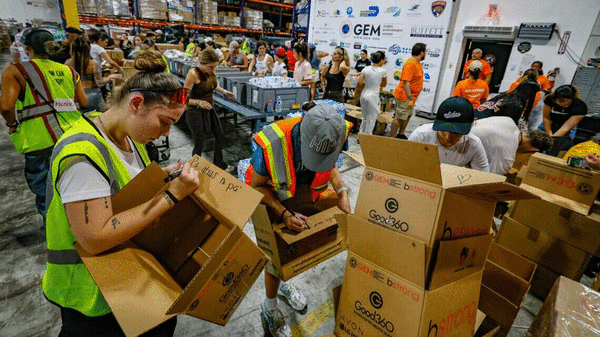
Two weeks after Venezuela was struck by twin earthquakes, families are still searching for loved ones and countries are continuing to deploy rescue teams as the United Nations appeals for continued support for the South American nation.
Tom Fletcher, the U.N.’s humanitarian chief, said Wednesday that Venezuela will need the support of humanitarian partners and the donor community as it prepares to shift from search-and-rescue operations to recovery and reconstruction.
After touring the quake’s epicenter this week, Fletcher appealed on Wednesday for additional international assistance. Humanitarian agencies need another $296 million to respond to the crisis as rescue teams continue searching for survivors trapped beneath the rubble, he said.
The amount is based on assessments that the U.N. has done alongside the government of Venezuela, and looks at the needs of an additional 1.3 million people over the next six months.
“To deliver for that group, we require an additional $296 million... on top of the $632 million that we originally appealed for at the start of the year,” Fletcher said.
The twin magnitude 7.2 and 7.5 earthquakes struck north-central Venezuela on June 24, killing more than 3,500 people and injuring more than 16,700, according to the country’s Ministry of Communication.
The disaster has prompted a massive international response, including from across the Caribbean.
Leaders of the 15-member Caribbean Community, or CARICOM, said Wednesday that 88 containers of relief supplies from a majority of their member states were headed to Venezuela. The regional relief effort is being coordinated by Guyana, Venezuela’s eastern neighbor, with which it has been involved in a decades-old border dispute.
A separate ferry loaded with humanitarian supplies was also preparing to depart from Trinidad and Tobago, Prime Minister Kamla Persad-Bissessar said.
Elsewhere across the region, Haiti has dispatched dozens of medical professionals to assist the relief effort, while Barbados says it is preparing to send its certified field hospital –one of the few such facilities in the region.
“We deployed it to Jamaica for three months after Hurricane,” Barbados Prime Minister Mia Mottley said. “We’re now deploying it to Venezuela because clearly with the levels of injuries and the pressures on the system, this is going to be one of the major areas which the Venezuelan people need.”
CARICOM leaders said they’ve been coordinating their response almost immediately after the disaster.
“We have been in contact with the president of Venezuela,” Mottley added about interim president Delcy Rodriguez. “And we’ll continue to be so because as we said ‘There but for the grace of God.’... We believe that we have a responsibility morally to help the people of Venezuela. It has been a horrific experience for them.”
Speaking from Caracas during an online briefing with nearly 200 representatives of U.N. member states and humanitarian partners, Fletcher described the devastation he witnessed during a visit Tuesday to La Guaira, one of the hardest-hit areas.
“People are in shock and despair,” he said.
He recalled standing with mothers who go to the site each day in the hope of finding any evidence of their children. Amid the noise of the heavy machinery and digging, there are moments “when one of the recovery team members will raise their hand, and everything falls silent,” said Fletcher.
“They hope they have heard, the tiniest noise from beneath the rubble, and everyone stops in the hope that this is a sign of life,” he added. “And to stand with those mothers and fathers at that moment as they hope against all hope that this is maybe, two weeks later, their child in a building 14 stories which is reduced to a few feet in height - you can see the different levels of the buildings, and they are inches apart.”
That was not the case on Tuesday when he visited. After a couple of minutes of silence, the emergency worker raised “two arms to signify that they haven’t heard a sound, and the digging and the searching continues,” said Fletcher. “Those mothers asked me last night: Is help coming?”
The key responders in the crisis have been local communities, Fletcher said, those who went out from the first moment to search for neighbors and loved ones. But also the government has led and coordinated the response
Teams have arrived from around the world, including over 50 urban search-and-rescue teams from over 30 countries. “There were teams mobilized from Syria, from Israel, doing ... vital search-and-rescue work to try to find every survivor possible,” he said. “I pay tribute to all of those over 3,000 rescue workers with 200 search dogs, and the members of our own team, who mobilized.”
U.N. agencies and the private sector have stepped up, he stressed. Businesses have provided direct contributions surpassing $32 million. Supplies ranged from heavy machinery to food, drinking water and satellite imagery.
“It is essential that as we transition from the search-and-rescue effort to the wider humanitarian response, and to the essential reconstruction, early recovery, development response, that we have one clear coordinated plan, and we have that plan,” he said.
Almost 8 million people werealready in need of humanitarian support across Venezuela and the quakes have compounded that.
The Venezuela effort has received $300 million, including $115 million received before the earthquake. But more is needed, he said as he appealed to member states into practical support.
“We need a sustained donor engagement. We will work very closely with our friends across the International Monetary Fund, across the World Bank and the development community, to ensure that this is a single plan with a clear transition,” said Fletcher. “We will, of course, support the efforts to ensure sanctions relief and the release of frozen assets so vital to the response.
“International solidarity must not finish as we move through this search-and-rescue response and into this next phase,” the humanitarian coordinator added. “We have to show that we will answer the question from those mothers: Help is coming, and it will be sustained, and generous, and flexible, and predictable, and alongside these clear needs of the people of Venezuela.”
©2026 Miami Herald. Visit at miamiherald.com. Distributed by Tribune Content Agency, LLC.




Comments